A father shaped by labor, faith, and the sea
Chester Sliwa is one of those names that rarely stands alone for long. Around him, there is always family, movement, and memory. I see him first as a father, then as a merchant seaman, then as a quiet anchor in a large and very public family story. He was born on July 9, 1921, in Cook County, Illinois, and lived a long life that stretched across nearly a century of American change. His life was not built on celebrity. It was built on work, routine, duty, and the steady rhythm of family.
He belonged to a generation that understood survival as a skill. Chester came from Polish roots and was part of a Catholic household shaped by immigrant discipline and working-class values. His public identity is tied closely to service at sea, where he spent decades as a merchant seaman. That kind of work is its own weather system. It asks for patience, endurance, and a willingness to disappear into distance for long stretches. It also leaves behind a family waiting on shore, counting time in letters, holidays, and returns.
Merchant Marine years and a life of labor
Chester Sliwa’s career is most clearly defined by the sea. Public references describe him as a Polish Roman Catholic merchant seaman and a veteran of the U.S. Merchant Marine. The length of his service is reported in more than one way, but the larger truth stays steady. He spent most of his adult life working at sea and later retired in 1986. That means his life was shaped by the machinery of ships, the rough logic of ports, and the disciplined life of maritime labor.
There is something almost cinematic about a man whose work is so large and so humble at the same time. Merchant seamen move through history like freight cars through the night. They carry goods, keep economies alive, and rarely receive applause. Chester seems to have represented that kind of invisible backbone. He was not a man made famous by a public title. He was a man whose title came from the labor itself.
His work also appears to have mattered deeply to his son Curtis, who has spoken of his father as a figure of strength and principle. That matters. In families like this, the father is not just a parent. He is a template. He teaches what endurance looks like without saying much about it. Chester’s long maritime career helped build the atmosphere in which Curtis grew up, one that mixed discipline, religion, labor, and civic toughness.
Marriage to Francesca and a family built around faith
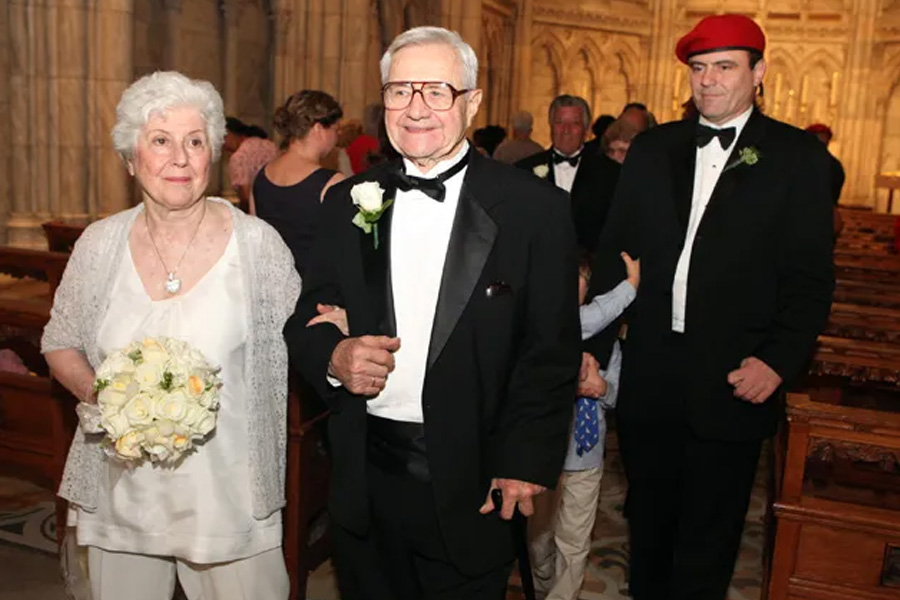
Chester married Francesca Bianchino Sliwa in St. Patrick’s Cathedral in 1944. Their marriage occurred during a wartime period when commitment required sacrifice and uncertainty. For their 65th wedding anniversary in 2009, they were publicly honored. Not a minor feat. A type of architecture. A lengthy marriage can feel like a cathedral erected stone by stone through everyday life.
Francesca and Chester seemed to value family and Catholicism. They raised children, supported public causes, and were visible through their son Curtis’s career. Francesca was visible. She shaped the family story, and Chester’s life cannot be understood without her. The Sliwa family revolved around their marriage.
I think that gives the family story depth. It goes beyond father and son. It involves many duties, loyalties, and expectations. That web revolved on Chester and Francesca. Their house may have been a harbor. Though ships came and departed, the harbor remained.
Children and the public life of the family
Chester and Francesca had at least three children who appear in public references: Curtis, Aleta, and Maria.
Curtis Sliwa is the most widely known of the children. He became the founder of the Guardian Angels and later a political figure in New York City. Curtis’s public image is loud, energetic, and combative, but the roots of that persona point back to Chester’s steady working-class world. Curtis has described his father in ways that highlight labor, faith, and moral seriousness. Chester is part of Curtis’s origin story, not as a dramatic character, but as the deeper current under the surface.
Aleta St. James is another of Chester’s children. Her public visibility increased when she gave birth to twins later in life, a story that drew attention because of her age and because it linked the Sliwa family to a new generation. Her life adds another layer to the family narrative. It shows that the Sliwas are not frozen in one public image. They move across different kinds of attention, from activism to media to personal milestones.
Maria Sliwa appears in public references as a family spokesperson and communication figure. That role matters in a family that often intersects with politics and news coverage. Not every family member becomes a headline figure, but some serve as interpreters of the family itself. Maria seems to occupy that place, helping shape how the family is seen from the outside.
Grandchildren and the continuation of the family line
Chester’s grandchildren include Anthony Chester Sliwa, along with other publicly mentioned grandchildren such as Francesca and Gian, the children of Aleta. Anthony Chester Sliwa is especially visible because he has appeared in recent news coverage connected to Curtis Sliwa’s family. His name carries Chester’s legacy directly in the middle name, which feels fitting for a family where names themselves act like thread stitched through time.
Grandchildren often reveal what a family has become after the older generation passes from view. In Chester’s case, the grandchildren show continuity. The family is still public. It is still active. It still carries the old values of identity, loyalty, and inheritance, even as the setting changes. What once moved through the decks of ships now moves through television, politics, and social media.
Legacy and the shape of memory
The 2012 Queens burial of Chester Sliwa. His existence left little spectacle but something more lasting. He left a family that remembers him, a son who constantly mentions him, and a public record that sets him in the context of New York Catholic family life and immigrant labor.
Chester is intriguing because he is underrepresented. He lacks 1,000 public quotes and a mountain of transactions. He’s more foundational. After seeing him, the structure makes sense. His long Merchant Marine career, marriage to Francesca, fatherhood to Curtis, Aleta, and Maria, and impact on grandchildren like Anthony Chester Sliwa show continuity.
The portrait is simple but interesting. Sea salt, city smoke, and family expectations are in it. It reads like a steady narrative of a working man.
FAQ
Who was Chester Sliwa?
Chester Sliwa was a merchant seaman, a U.S. Merchant Marine veteran, and the father of Curtis Sliwa. He was born in 1921 and died in 2012. His life was shaped by labor, Catholic faith, and family loyalty.
Who was Chester Sliwa married to?
Chester was married to Francesca Bianchino Sliwa. They married in 1944 at St. Patrick’s Cathedral and remained married for more than 60 years.
Who were Chester Sliwa’s children?
The publicly identified children are Curtis Sliwa, Aleta St. James, and Maria Sliwa. Curtis is the most widely known because of his activism and political career.
Did Chester Sliwa have grandchildren?
Yes. Public references identify Anthony Chester Sliwa as one of his grandchildren. Other publicly mentioned grandchildren include Francesca and Gian, the children of Aleta St. James.
What kind of work did Chester Sliwa do?
He worked as a merchant seaman and spent decades in the maritime world. His career was long, disciplined, and tied to the U.S. Merchant Marine.
Why is Chester Sliwa remembered?
He is remembered as the father of Curtis Sliwa and as a strong family figure whose life reflected working-class endurance, Catholic values, and long service at sea.