Decoding Macro Dynamics: Navigating the Modern Real Estate Market
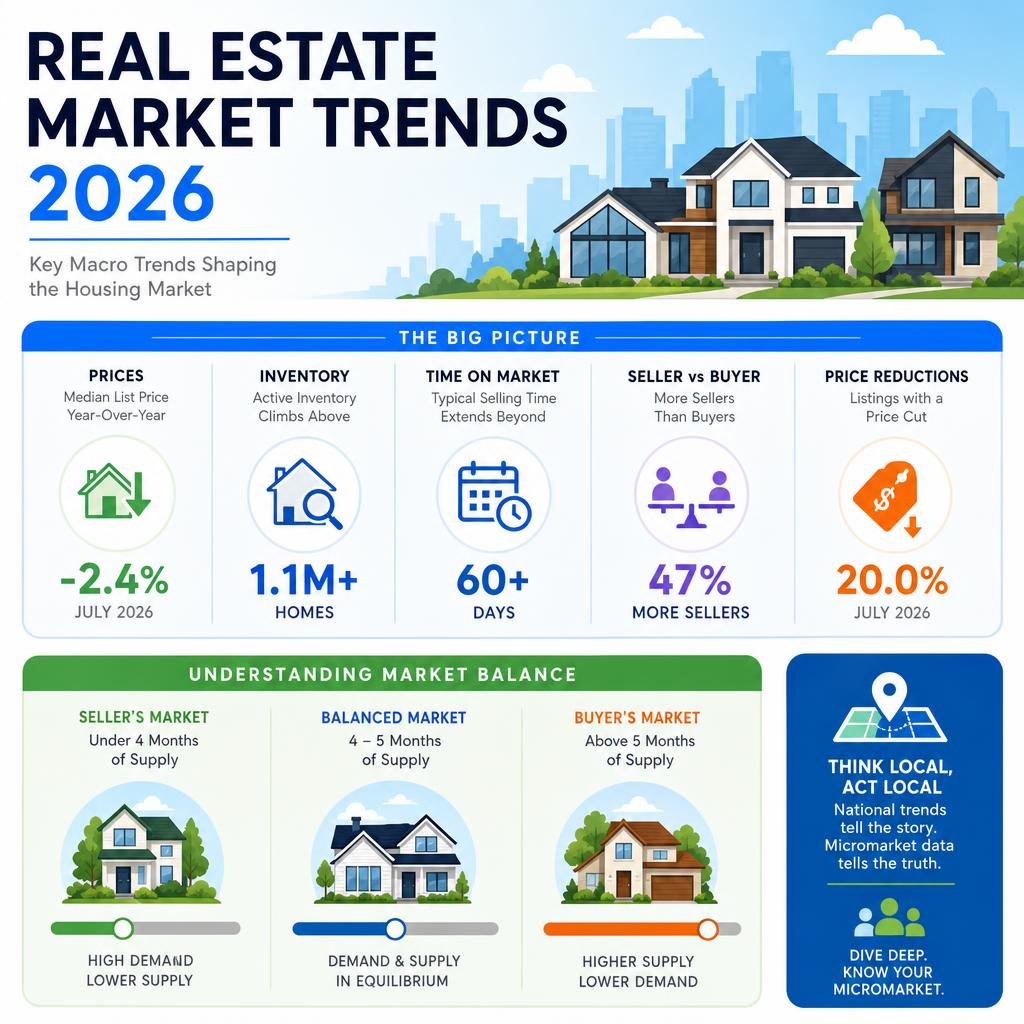
The real estate market in August 2026 is characterized by a complex interplay of interest rates, housing inventory, and shifting economic leverage. Understanding these macro dynamics is crucial for anyone looking to make informed decisions. We’ve seen a period where median list prices have continued a downward trend, dropping 2.4% year-over-year in July 2026, building on June’s 2.5% decrease. This softening in prices, combined with active inventory climbing above 1.1 million homes and typical selling times extending beyond 60 days, suggests a recalibration in market conditions. Nationally, the balance of power has shifted, with roughly 47% more sellers than buyers, leading to a significant increase in price reductions—20.0% of listings saw a price cut in July 2026. However, this national narrative often masks the intricate realities playing out at a more granular level.
Micromarket Data vs. National Buyer’s Market Headlines
While national headlines might proclaim a “buyer’s market,” savvy participants understand that real estate is inherently local. Relying solely on broad national statistics can be misleading and lead to missed opportunities or unrealistic expectations. Instead, we advocate for a deep dive into micromarket data, which provides a far more accurate picture of local conditions.
Consider the “months of supply” metric, a critical indicator of market balance. Under four months of supply typically signifies a seller’s market, where demand outstrips supply. Between four and five months suggests a balanced market, and anything above five months indicates a buyer’s market. Despite national inventory levels suggesting more buyer leverage, many specific neighborhoods, price points, or property types still exhibit tighter supply. For instance, while active inventory has climbed nationally, it remains 11.6% below typical 2017–19 levels, indicating that in many areas, the “inventory squeeze” persists.
Agents and clients should focus on hyper-local metrics such as:
- Months of Supply:Calculate this by dividing active listings by the average number of homes sold per month in a specific area. This offers a precise gauge of local supply and demand.
- Days on Market (DOM):While the national average for homes to sell is now over 60 days, many desirable micromarkets might still see properties moving much faster. A quicker DOM can indicate stronger local demand.
- Price Cuts:Nationally, the share of listings with a price cut hit 20.0% in July 2026. However, in certain hot neighborhoods, price cuts might be negligible or non-existent, reflecting sustained buyer interest. Conversely, a high percentage of price cuts in a specific zip code signals a need for sellers to adjust expectations.
- Price per Square Foot:This metric provides a more accurate comparison of value, especially when home sizes vary. While the national price per square foot fell 2.0% year-over-year in July 2026, and is declining in 34 of the top 50 metros, some local markets may still be experiencing appreciation or holding steady.
By dissecting these specific data points, agents can effectively counter a generalized “buyer’s market” narrative, providing clients with actionable, localized insights. For instance, a buyer might hear about falling national prices, but their desired neighborhood could still be highly competitive. Similarly, a seller might fear a market crash, but their specific property type in a desirable school district could still command strong interest. Utilizing a comprehensive platform that allows for granular data analysis, such as a national real estate platform, can help both buyers and sellers gain a competitive edge by accessing detailed local market information.
Regional Variations Across Metropolitan Markets
The national real estate picture is an aggregate, and recognize that regional and local variations can be stark. What’s happening in one metropolitan area might be the complete opposite of another, even within the same state. This market fragmentation means that a “one-size-fits-all” approach is rarely effective.
For example, while the median list price per square foot is falling in 34 of the top 50 metros, there are significant outliers. Austin, TX, saw a substantial 8.5% drop in median price per square foot, while Providence, RI, experienced an 8.3% gain. Inventory levels also show dramatic divergence: Minneapolis saw its inventory surge by 29.3% year-over-year, whereas Jacksonville’s inventory fell by 20.0%. These figures highlight how localized economic factors, population shifts, employment growth, and even school quality can create distinct microclimates within the broader market.
Understanding these regional nuances is paramount. For buyers, it means researching specific areas thoroughly, as opportunities for negotiation might be abundant in one metro (e.g., where price per square foot is declining significantly) but limited in another. For sellers, it underscores the importance of working with a local agent who possesses an intimate knowledge of their immediate market, rather than relying on national averages that may not apply. The ability to analyze these localized trends helps in setting realistic expectations, whether you’re evaluating a property for sale or looking for your next home.
First-Time Homebuyer Blueprint: Budgeting, Financing, and Strategy
For first-time homebuyers, the current market can feel particularly daunting. Rising interest rates, though showing some recent moderation, still impact affordability, and while inventory has increased, it remains below historical norms in many areas. Successfully navigating this landscape requires a strategic approach to budgeting, securing financing, and crafting competitive offers.

Budgeting and Pre-Approval: Navigating the Modern Real Estate Market
The first and most critical step for any first-time buyer is to establish a realistic budget. This goes beyond simply looking at a property’s list price. It involves a comprehensive assessment of your financial situation, including:
- Income and Expenses:Understand your monthly cash flow to determine how much you can comfortably allocate to housing.
- Down Payment and Savings:Factor in not just the down payment but also closing costs, which can range from 2% to 5% of the loan amount, and an emergency fund for unexpected home repairs or maintenance.
- Additional Ownership Costs:Remember property taxes, homeowner’s insurance, potential HOA fees, and ongoing maintenance. These can significantly impact your monthly outlay.
Once you have a clear financial picture, obtaining mortgage pre-approval is non-negotiable. Pre-approval from a lender provides a concrete understanding of your purchasing power, demonstrating to sellers that you are a serious and qualified buyer. This is particularly valuable in markets where multiple offers are still common. A pre-approval letter strengthens your offer, as it signals to the seller that financing is less likely to be an issue. Compare multiple lenders to secure the most favorable interest rates and terms, as even small differences can save you thousands over the life of the loan.
When considering properties, create a two-column list: “needs” versus “wants.” This helps to avoid emotional overspending and keeps your search focused on properties that truly meet your essential criteria, allowing for flexibility on less critical features.
Crafting Competitive Offers and Avoiding Costly Pitfalls
In a market that is still competitive in many micromarkets, crafting a compelling offer is an art. While nationally, buyers may have slightly more leverage than in previous years, a well-structured offer can still make the difference.
- Competitive, Not Overpriced:Work with your agent to analyze recent comparable sales and understand the true market value. Avoid overbidding, but be prepared to offer a fair price that reflects the property’s worth and local demand.
- Contingency Strategy:While waiving contingencies can make an offer more attractive to sellers, it also carries significant risks. A professional home inspection, for instance, is a crucial safeguard against unexpected electrical wiring defects or other costly issues. Surprises are great at birthdays, not when you’re talking about electrical wiring. Consider carefully which contingencies you are comfortable adjusting, and which are non-negotiable for your financial safety.
- Flexibility and Timelines:Being flexible with closing dates or offering a quick close can be appealing to sellers.
- Personalization:Sometimes, a heartfelt letter to the seller, explaining why you love their home, can create a personal connection that sets your offer apart.
Common mistakes first-time buyers should avoid include:
- Underestimating Total Costs:Beyond the mortgage, property taxes, insurance, and maintenance can quickly add up.
- Emotional Overattachment:Falling in love with a house before due diligence can lead to overlooking red flags or overpaying. Remain objective.
- Skipping Inspections:As mentioned, a professional inspection is vital to uncover hidden problems.
- Not Researching the Neighborhood:Evaluate the area with a 5-to-10-year future outlook regarding lifestyle, family needs, and potential resale value.
- Not Working with an Experienced Agent:A local agent can provide invaluable insights into market trends, negotiation strategies, and access to off-market listings.
For those considering urban living, understanding local market dynamics is also key. For example, if you’re exploring options like luxury apartments in Vancouver, understanding the specific rental and ownership market trends in that area can inform your long-term housing strategy and potential investment.
Strategic Seller Playbook: Pricing, Staging, and Concessions
For sellers in August 2026, the market demands a strategic and adaptable approach. With active inventory up and prices softening nationally, simply listing a home and expecting multiple offers at top dollar is often unrealistic. Success now hinges on smart pricing, compelling presentation, and a willingness to offer incentives that attract today’s more cautious buyers.

Micromarket Pricing and Preventing Listing Fatigue
One of the most common mistakes sellers make in a shifting market is overpricing their home. While the desire to maximize profit is understandable, testing the market with an artificially high listing price generally results in extra stress, prolonged days on market, and ultimately, lower profits. Data shows that roughly one-third of sellers have been reducing their asking price, and these reductions are becoming meaningful. Overpricing can lead to:
- Listing Fatigue:Properties that sit on the market for extended periods become stale. Buyers often assume there’s something wrong with an older listing, even if there isn’t.
- Cumulative Penalty:Initial overpricing often leads to multiple price reductions, which can signal desperation to buyers and result in offers far below market value.
Instead, we recommend a data-driven approach to pricing:
- Competitive Market Analysis (CMA):Work with an experienced real estate agent to conduct a thorough CMA. This involves analyzing recent sales of comparable properties in your specific micromarket, taking into account factors like location, size, condition, and features.
- Price Strategically:In today’s market, pricing a home slightly below market value can be an effective strategy to generate immediate interest, create urgency, and potentially induce competitive multiple-offer situations, leading to a higher final sale price.
- Repositioning Agreements:Establish written price repositioning agreements with your agent prior to listing. This manages expectations and provides a clear plan for price adjustments if the initial strategy doesn’t attract sufficient buyer interest.
Beyond pricing, presentation is paramount. Minor aesthetic upgrades, like adding an outdoor awning, can significantly improve digital listing appeal. Invest in high-quality professional photography and 3D walkthroughs to optimize digital curb appeal. Remove roughly half of household items to declutter spaces, allowing buyers to envision themselves in the home. Staging with neutral colors creates a versatile blank canvas that appeals to a broader range of prospective buyers. Homes for sale are vanishing faster than you can hit ‘refresh’ on your browser, so making that first impression count, both online and in person, is critical.
Strategic Seller Incentives: Navigating the Modern Real Estate Market
In a market where buyers have more negotiating power and interest rates impact affordability, sellers can gain a significant advantage by offering strategic incentives. These concessions can make a property more attractive without necessarily dropping the list price, directly addressing buyer concerns about financing and upfront costs.
- Rate Buydowns:This is a powerful tool to combat higher interest rates. A seller pays an upfront fee to temporarily or permanently lower the buyer’s mortgage interest rate. For example, a 2-1 temporary buydown lowers the rate by 2% in the first year and 1% in the second, providing significant relief to buyers in the initial years of homeownership. This directly addresses buyer affordability issues caused by fluctuating Federal Reserve interest rates.
- Closing Cost Credits:Offering to cover a portion of the buyer’s closing costs can reduce the upfront cash required for the purchase, making the home more accessible, especially for first-time buyers. Seller contribution limits toward closing costs vary according to the buyer’s loan product (e.g., FHA, VA, or Conventional), so consult with loan officers to ensure compliance.
- Home Warranties:Providing a comprehensive home warranty on an older property can mitigate prospective buyer hesitation around major system repairs, offering peace of mind and reducing perceived risk.
- Other Concessions:Depending on the market, sellers might also offer credits for repairs, landscaping, or even contribute to property tax payments for a period.
By leveraging these seller-paid incentives, you can attract more buyers, shorten your days on market, and ultimately secure a stronger sale. Highlighting seller-covered closing costs or a rate buydown in marketing materials can make your listing stand out against competing properties. These financial tools demonstrate a seller’s willingness to be flexible and understand the current challenges faced by buyers.
The Digital Transformation: Proptech, AI, and Virtual Operations
The real estate industry is undergoing a profound digital transformation, with technology reshaping every aspect of how agents and clients navigate the market. From online listings to artificial intelligence, these advancements are creating new efficiencies, enhancing transparency, and offering immersive experiences that were once unimaginable. This evolution is moving from disparate “Proptech” applications into integrated “PropOS” (Property Operating Systems), streamlining operations and improving client interactions.

Digital Curb Appeal and Interactive Property Media
In today’s market, a home’s first showing often happens online. Digital curb appeal is no longer a luxury; it’s a necessity. High-quality visual content is paramount for attracting buyer interest and standing out in a crowded digital landscape.
- Professional Photography:Crisp, well-lit photographs are the foundation of any successful online listing. They create an immediate positive impression and entice buyers to learn more.
- 3D Virtual Tours and Floor Plans:These immersive tools allow potential buyers to “walk through” a property from anywhere in the world, providing a detailed understanding of the layout and flow. This significantly reduces wasted showings for both buyers and sellers by allowing serious buyers to pre-qualify properties.
- Drone Photography and Video:For larger properties or those with unique outdoor features, aerial views can showcase the home’s context and surroundings, adding a cinematic quality to the listing.
- Interactive Floor Plans and Virtual Staging:These technologies allow buyers to visualize how their furniture might fit or to see the potential of an empty space, overcoming common objections related to layout or outdated aesthetics.
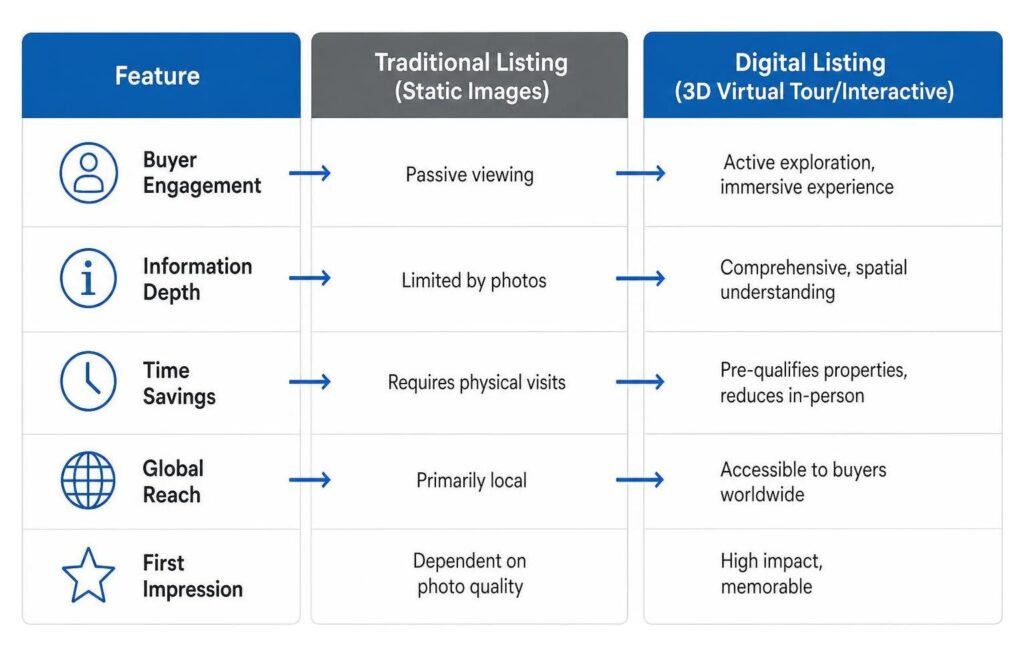
The shift from traditional listings to interactive digital media is clear:
Feature Traditional Listing (Static Images) Digital Listing (3D Virtual Tour/Interactive) Buyer Engagement Passive viewing Active exploration, immersive experience Information Depth Limited by photos Comprehensive, spatial understanding Time Savings Requires physical visits Pre-qualifies properties, reduces in-person Global Reach Primarily local Accessible to buyers worldwide First Impression Dependent on photo quality High impact, memorable
These tools not only enhance the buyer experience but also provide sellers with a powerful marketing advantage, ensuring their property reaches the widest possible audience with the most compelling presentation.
AI Tools and Virtual Operations for Real Estate Professionals
Technology isn’t just changing how properties are viewed; it’s also revolutionizing how real estate professionals operate. Artificial intelligence (AI) and virtual assistants are becoming indispensable, streamlining workflows and freeing up agents to focus on high-value client interactions.
- AI-Powered Lead Generation and Nurturing:AI algorithms can analyze vast amounts of data to identify potential leads, predict buyer behavior, and even personalize communication, ensuring agents connect with the right people at the right time.
- Virtual Assistants (VAs):Real estate agents increasingly leverage specialized virtual assistants to handle administrative tasks such as scheduling appointments, managing databases, social media updates, and lead follow-up. This allows agents to keep up with digital markets and dedicate more time to showing properties and negotiating deals.
- Automated Marketing Campaigns:AI tools can automate email campaigns, social media posts, and targeted advertising, ensuring consistent outreach and brand presence without constant manual effort.
- Property Operating Systems (PropOS):The industry is moving towards integrated PropOS platforms that combine CRM, marketing automation, transaction management, and data analytics into a single, cohesive system. This holistic approach improves efficiency, reduces errors, and provides agents with a 360-degree view of their business.
- Data Analytics and Market Insights:AI-driven analytics can process complex market data much faster than humans, providing agents with deeper insights into pricing trends, inventory levels, and buyer preferences, helping them act as skilled storytellers who translate raw data into clear, relatable narratives for clients.
By embracing these technological advancements, real estate professionals can enhance their productivity, improve client service, and stay competitive in a rapidly evolving market. This shift allows agents to focus on the human element of real estate—building relationships and providing expert guidance—while technology handles the heavy lifting of data and routine tasks.
Frequently Asked Questions About the Real Estate Market
As we navigate the complexities of the modern real estate market in August 2026, several common questions arise for both buyers and sellers. Here, we address some of the most pressing inquiries to provide further clarity.
How do interest rates affect current buyer purchasing power?
Interest rates are a significant factor in determining buyer purchasing power, especially in the current market. When interest rates rise, the cost of borrowing money for a mortgage increases, leading to higher monthly mortgage payments for the same loan amount. This directly reduces a buyer’s affordability, meaning they can either afford a lower-priced home or will have a higher monthly payment for the same property compared to a period of lower rates. For example, if a buyer was pre-approved for a $400,000 home at a 5% interest rate, an increase to 7% could reduce their affordable home price to $350,000, assuming their monthly payment budget remains constant. Conversely, even modest mortgage rate relief, as seen recently, can slightly expand purchasing power and stimulate buyer activity. Monitoring these fluctuations, often tied to broader macroeconomic and geopolitical pressures, is crucial for budgeting.
How is months of supply used to determine market balance?
Months of supply is a key metric used to gauge the balance between supply and demand in a specific real estate market. It’s calculated by dividing the total number of active listings by the average number of homes sold per month in that area.
- Under 4 months of supply:Generally indicates a seller’s market, where there are more buyers than available homes, leading to increased competition and potentially higher prices.
- 4 to 5 months of supply:Suggests a balanced market, where supply and demand are relatively equal, offering a more stable environment for both buyers and sellers.
- Above 5 months of supply:Points towards a buyer’s market, where there are more homes available than active buyers, giving buyers more negotiating leverage and potentially leading to longer selling times and price reductions.
In July 2026, while national inventory climbed above 1.1 million homes and the typical home took over 60 days to sell, this national figure can mask local realities. Some micromarkets might still have tight supply, indicating a seller’s advantage, while others might be experiencing a true buyer’s market with ample inventory. This metric is vital for understanding the true leverage dynamic in any given area.
What is the benefit of a seller-paid rate buydown?
A seller-paid rate buydown is a powerful financial incentive where the seller pays an upfront fee to the lender to temporarily or permanently lower the buyer’s mortgage interest rate. This strategy offers several key benefits in the current market:
- Increased Affordability for Buyers:By reducing the buyer’s monthly mortgage payment, a buydown makes the home more affordable, especially when interest rates are higher. This can help buyers qualify for a loan they might otherwise struggle with or simply make the home more attractive financially.
- Attracting More Buyers:In a market with more sellers than buyers, offering a rate buydown can significantly differentiate a listing, drawing in more potential buyers who are sensitive to monthly payment costs.
- Maintaining Home Value:Instead of reducing the list price, which can set a lower precedent for comparable sales, a seller can use a buydown to incentivize a sale while maintaining the desired sale price. This can be more cost-effective for the seller in the long run than multiple price reductions.
- Faster Sales:By addressing a key buyer concern (affordability), a buydown can shorten the time a home spends on the market, reducing listing fatigue and the potential for further price cuts.
This strategy directly addresses the “real problem may be the payment” for many buyers, making it a highly effective tool for sellers looking to close deals in a shifting market.
Conclusion
Navigating the modern real estate market in August 2026 requires a blend of data-driven insights, strategic planning, and technological savvy. We’ve explored how national headlines can often mislead, emphasizing the crucial role of micromarket data in understanding the true balance of power between buyers and sellers. For first-time homebuyers, a meticulous approach to budgeting, securing pre-approval, and crafting competitive yet cautious offers is paramount. Sellers, in turn, must embrace strategic pricing, professional staging, and innovative incentives like rate buydowns to stand out.
The digital transformation continues to reshape the industry, with professional photography, virtual tours, AI tools, and virtual assistants becoming indispensable for both agents and clients. By leveraging these advancements, participants can enhance their efficiency, reach wider audiences, and make more informed decisions.
Whether you’re looking to buy your first home, sell a cherished property, or grow as a real estate professional, success in today’s dynamic market hinges on adaptability, local expertise, and a willingness to embrace the tools and strategies that define modern real estate. By understanding these key dynamics, you can confidently find your place and achieve your real estate goals.