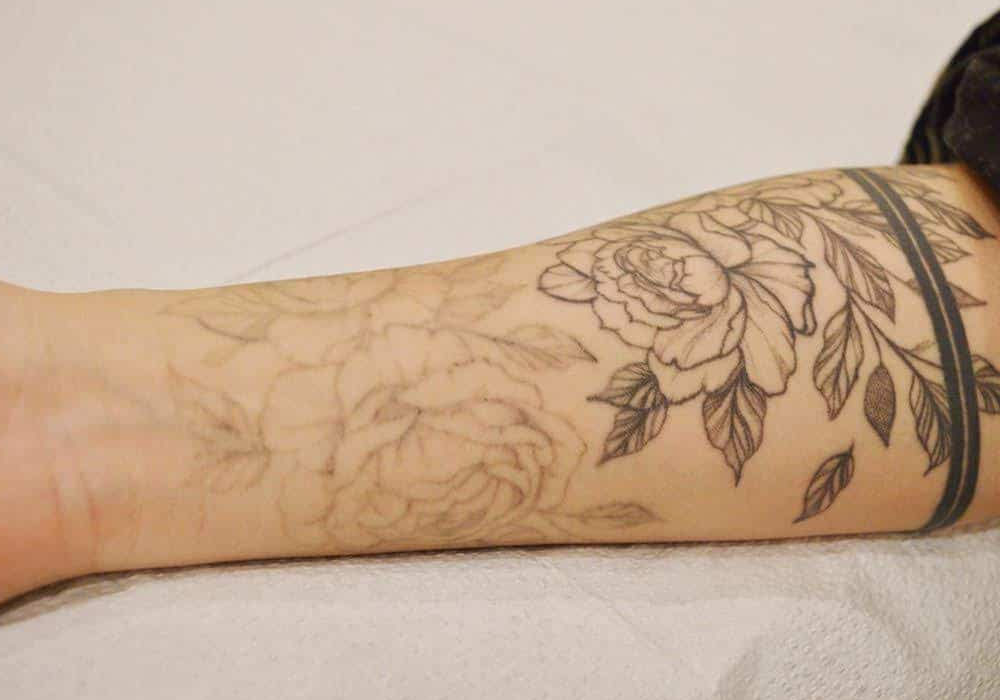
A cover-up only works as well as the canvas underneath it. If the old tattoo is too dark, too saturated, or has heavy black outlines, the new design has to fight through that pigment, which limits color choice and often forces the artist toward a bigger, darker piece than you actually wanted. Fading the original ink first gives the new tattoo room to breathe and opens up options that wouldn’t otherwise exist.
Why Fading Matters More Than Covering
Tattoo ink sits in the dermis, and once it’s there, it doesn’t fully disappear on its own. Artists can layer new pigment over old work, but bright colors like yellow, white, or light pink simply cannot cancel out black or dark blue underneath. That’s why so many cover-ups default to dense, dark, oversized designs that swallow the original rather than genuinely replacing it.
Fading changes that equation. Even a 30-40% reduction in pigment density can make a tremendous difference, letting an artist use lighter colors, finer linework, and a design that doesn’t need to be twice the size of the original just to hide it.
How Laser Fading Actually Works
Laser tattoo removal breaks up ink particles using targeted pulses of light. The body’s immune system then carries those fragmented particles away through the lymphatic system over the following weeks. For a full removal, this process repeats over many sessions until the ink is gone.
For a cover-up, the goal isn’t complete removal. It’s a partial fade, which typically takes fewer sessions than full removal. Most cover-up candidates see enough fading after 3 to 6 sessions, though this depends heavily on the ink’s age, color, and depth.
Older tattoos, especially ones done more than 10 years ago, often fade faster because the ink has already broken down somewhat over time. Fresh tattoos, black ink, and professionally applied work with dense saturation tend to take longer to lighten.
What to Expect During the Fading Process
Sessions are spaced 6 to 8 weeks apart to give the skin time to heal and the body time to clear out loosened pigment. Trying to rush this timeline by scheduling sessions too close together increases the risk of scarring and doesn’t actually speed up the fading.
Immediately after a session, expect redness, swelling, and a sensation similar to mild sunburn. Blistering can occur, particularly after the first couple of treatments, and this is normal rather than a sign something has gone wrong. Over the following days, the treated area may scab lightly, and it’s important not to pick at this, since doing so can pull out ink unevenly or cause scarring.
Between sessions, the tattoo will look progressively lighter and sometimes patchy, which is completely expected. It’s not going to fade in a smooth, even sheet. Some areas lighten faster than others depending on ink density and original technique.
Choosing the Right Provider for Fading
Because cover-up fading requires more precision than standard removal, it matters who performs the treatment. A provider who understands cover-up work will discuss the new design early on, since the fading pattern needed for a bold black-and-grey piece differs from what’s needed for a colorful, detailed design.
Ask specifically about experience with cover-up fading rather than removal in general. Some clinics specialize in aesthetic removal work and coordinate directly with tattoo artists to make sure the fading achieves exactly what the new design requires. Those offering safe and effective tattoo removal Camberwell residents have come to rely on tend to have this kind of collaborative approach, working alongside local tattoo studios so the fading and the future artwork line up properly.
Bringing reference images of the intended cover-up to the removal consultation helps the technician calibrate the treatment plan. A rushed, generic fading job can leave uneven pigment that complicates the artist’s work later.
Timing the Cover-Up After Fading
Patience matters here more than almost any other part of the process. Skin needs to fully heal between laser sessions, and it also needs recovery time after the final fading treatment before new ink goes in. Most artists prefer waiting at least 4 to 6 weeks after the last laser session before tattooing over the area.
Tattooing too soon over skin that hasn’t finished healing from laser treatment increases the risk of poor ink retention, infection, and scarring. It also makes it harder for the artist to judge exactly how the old tattoo will read once healed, which can throw off color matching in the new design.
Communicate with both the removal technician and the tattoo artist throughout the process. A provider who does one but not the other should still be willing to coordinate on timelines so nothing gets rushed.
Setting Realistic Expectations
Fading rarely produces a blank canvas, and that’s fine. The point isn’t to erase the old tattoo entirely but to reduce it enough that an artist has real creative flexibility. Some ghosting or shadowing will likely remain, and a skilled artist can usually design around this rather than being blocked by it.
The most successful cover-ups happen when the client, the removal technician, and the tattoo artist all work from the same plan from the start. Skipping the fading step or rushing through it to save time almost always limits what the final tattoo can look like, so treating the fade as a real phase of the process, not just a preliminary chore, pays off in the finished result.