
Navigating the U.S. Youth Soccer Development Pyramid
We know that navigating U.S. youth soccer can feel overwhelming. With so many different organizations, leagues, and acronyms, understanding where your child fits and how to foster their talent is a significant challenge.
This guide aims to demystify the complex landscape of youth soccer levels explained, from recreational play to elite national platforms. We will explore the structures of governing bodies like US Youth Soccer (USYS) and US Club Soccer, compare top national leagues such as MLS NEXT, ECNL, and Girls Academy, and delve into regional competitions.
We’ll also cover the financial realities, the upcoming 2026/2027 age group changes, and the true picture of college recruiting. Our goal is to provide you with a clear roadmap, empowering you to make the best choices for your player’s growth and success. Whether through traditional leagues or specialized programs offered by a youth soccer development organization, our focus remains on fostering talent and a lifelong love for the game.
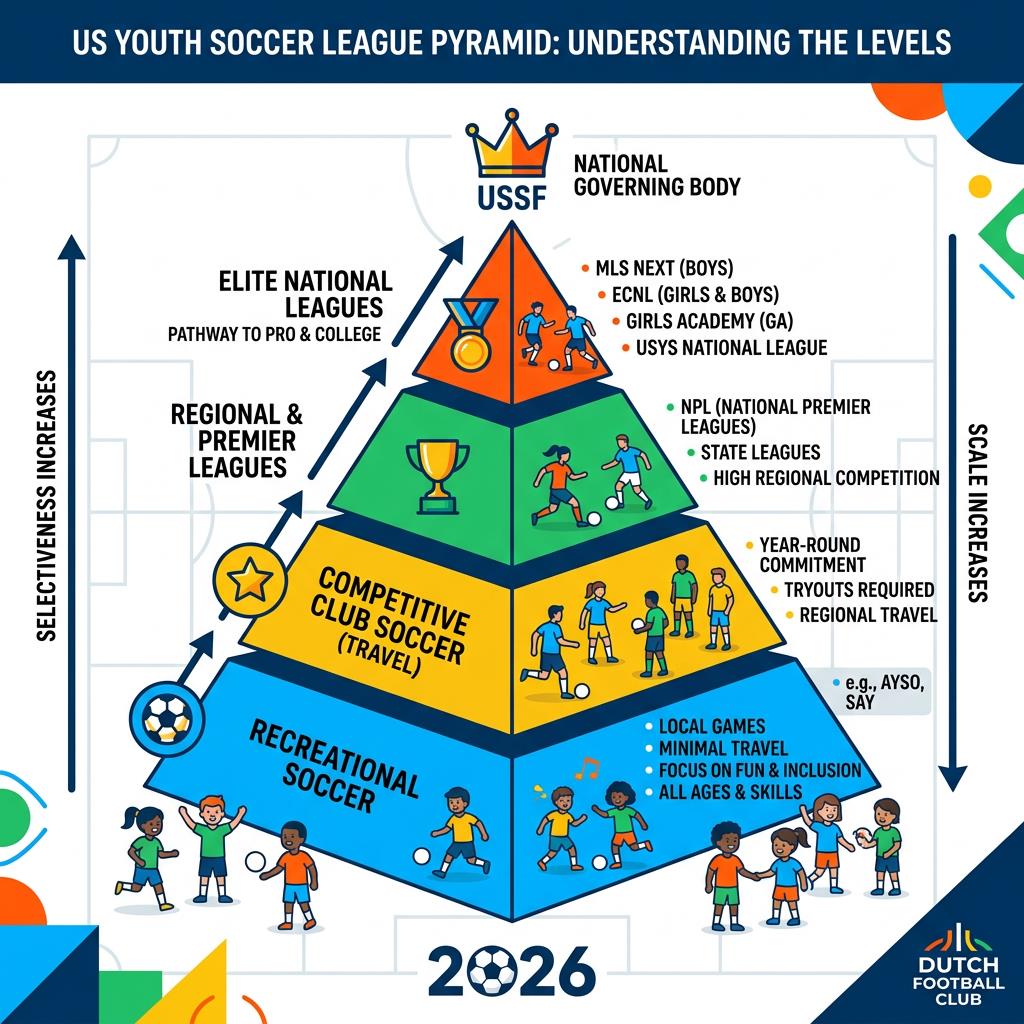
The structure of youth soccer in the United States is often described as a pyramid, with various levels of competition and governance. At the apex is the U.S. Soccer Federation (USSF), the national governing body responsible for overseeing all soccer in the country, from youth to professional. Beneath the USSF, two primary national organizations sanction the majority of youth soccer activities: US Youth Soccer (USYS) and US Club Soccer. These organizations, while both operating under USSF, have distinct league structures and philosophies, leading to a somewhat fragmented but diverse landscape.
USYS, established in 1974, is the largest youth sports organization in the U.S., operating through 55 state associations. It emphasizes a broad-based, inclusive approach, offering pathways from recreational play up to national competitions through its National League and National Championship Series. US Club Soccer, founded in 2001, positions itself as a member-driven organization focused on player development, offering more flexibility and autonomy to clubs. It sanctions leagues like the Elite Clubs National League (ECNL) and National Premier Leagues (NPL), which are often seen as direct competitors to USYS’s top offerings. Understanding the nuances between these two governing bodies is crucial for parents and players, as clubs typically affiliate with one or the other, influencing the competitive pathway available.
The competitive landscape is further defined by a hierarchy of leagues, each catering to different levels of commitment, skill, and ambition. From local recreational leagues to highly selective national platforms, the options can be dizzying. To provide clarity, we’ve compiled a comparison of some of the most prominent national and regional leagues:
Recreational vs. Competitive Club Soccer
For many families, the journey into youth soccer begins with recreational soccer. This level, often associated with organizations like the American Youth Soccer Organization (AYSO) or Soccer Association for Youth (SAY), is designed to be inclusive, fun, and focused on basic skill development and sportsmanship. It typically involves local games, minimal travel, and a strong emphasis on participation, with rules often ensuring equal playing time for all children. Costs are generally low, making it an accessible entry point for young players (U4-U10) to discover a love for the game without significant pressure.
As children grow and their interest or talent develops, parents may consider competitive club soccer. This level involves tryouts, professional coaching, and a higher commitment to training and travel. Clubs affiliated with USYS or US Club Soccer offer various competitive tiers, from local travel teams to regional and state-level premier divisions. The shift to competitive soccer often means more specialized training, higher expectations for performance, and a greater financial investment.
When considering this transition, parents should ask several key questions:
- What is the club’s coaching philosophy?Does it prioritize long-term player development over winning at all costs?
- How are players evaluated and placed on teams?Is there transparency in the tryout process?
- What are the expectations for player commitment and attendance?
- What is the training curriculum like?Does it focus on technical skills, tactical understanding, and physical conditioning?
- How does the club handle playing time across different age groups and skill levels?
- What is the club’s track record for player retention and satisfaction?
The goal is to find an environment that matches your child’s current skill level, commitment, and enjoyment, while also aligning with your family’s values and resources.
The National Platforms: MLS NEXT, ECNL, and Girls Academy
At the pinnacle of U.S. youth soccer, beyond state and regional competitions, lie the elite national platforms. These leagues represent the highest level of competition for aspiring collegiate and professional players, offering extensive travel, professional coaching, and significant exposure to college scouts.
MLS NEXT is the top-tier boys’ league, launched in 2020 by Major League Soccer to replace the U.S. Soccer Development Academy. It features academies affiliated with MLS clubs and other top youth clubs, providing a rigorous training and competition environment. MLS NEXT is designed to identify and develop future professional players, with a strong emphasis on technical and tactical development. For players fortunate enough to join official MLS Academies, the cost is typically $0, as these programs are fully funded and cover club fees and travel, making them incredibly selective.
For girls, the Elite Clubs National League (ECNL) has long been the dominant top tier. Founded in 2009, ECNL offers an unparalleled level of competition and college recruiting exposure through its national showcases. The Girls Academy (GA) emerged in 2020, also providing a national platform for elite female players, particularly after the dissolution of the Development Academy. Both ECNL and GA offer highly competitive environments with extensive travel and significant visibility for college recruiting. Below these top tiers, the Development Player League (DPL) often serves as a pathway or secondary league for ECNL clubs, offering a competitive environment for a broader pool of players.
These national platforms are characterized by:
- Intense Competition:Featuring the most talented players and teams from across the country.
- Extensive Travel:Teams often travel nationally for league games and showcase tournaments, leading to significant time and financial commitments.
- High-Level Coaching:Professional coaches with advanced licenses and experience.
- College Recruiting Exposure:National showcases are heavily attended by college coaches, making these leagues prime recruiting grounds.
Beyond these leagues, USL Academies are also emerging as a pathway for both boys and girls, affiliated with clubs in the United Soccer League (USL) professional structure. While not as established as MLS Academies, they offer another avenue for high-level development and potential professional opportunities.
Regional Leagues and State Premier Divisions
Beneath the national platforms, a robust network of regional and state leagues forms the backbone of competitive youth soccer. These leagues provide excellent competition within a more manageable geographic footprint, serving as crucial stepping stones for player development and college exposure.
Organizations like NorCal Premier in Northern California, the National Premier Leagues (NPL) under US Club Soccer, and the Eastern Development Program (EDP) are prime examples of strong regional leagues. These leagues offer a high level of play, often with regional showcases and opportunities to advance to national competitions. They are typically less expensive and involve less travel than the national platforms but still demand significant commitment.
Within these regional and state structures, competitive tiers are often clearly defined. For instance, in a league like NorCal Premier, the levels of play are typically structured as follows, from most competitive to least:
- State Premier League:The highest tier, generally for U13-U19, featuring the most competitive teams across the state.
- Premier:A highly competitive tier, often regionalized.
- Gold:Strong competitive play, usually within a defined region.
- Silver:Mid-level competitive play, focusing on development and regional competition.
- Bronze:Entry-level competitive play, emphasizing skill development and tactical understanding.
- Copper:The foundational tier of competitive play, often bridging recreational and travel soccer.
Division formation in these leagues is a meticulous process. League staff determine team placement based on several factors, including:
- Competitive history:Past performance in league play and tournaments.
- Team location:To minimize travel for teams in lower divisions.
- Preferred division request:Clubs and coaches indicate their desired level, though final placement rests with the league.
It’s common for regions with fewer teams to combine lower divisions, such as “Region 1 Silver/Bronze,” to ensure viable league sizes. This structured approach helps ensure appropriate competitive matches for player development. Parents and coaches are usually given a feedback window to review preliminary placements, as divisions are typically finalized and unchangeable once posted.
Understanding the 2026/2027 Age Group Shift
A significant change is on the horizon for U.S. youth soccer, impacting how players are grouped by age. Beginning with the 2026/2027 seasonal year, US Youth Soccer (USYS), AYSO, and US Club Soccer will transition back to an August 1 – July 31 registration cycle. This shift is a major policy reversal from the calendar year (January 1 – December 31) mandate that was implemented in 2017. We believe this change has far-reaching implications for player development, team dynamics, and the overall youth soccer experience.
Reverting to the August 1 Cutoff
The decision to revert to the August 1 – July 31 school-year cycle stems from extensive review and feedback from clubs, coaches, and parents. The primary rationale is to better align players with their school classmates, fostering stronger social connections and team chemistry. Prior to 2017, the school-year grouping was the norm, and many in the soccer community felt that the calendar-year system inadvertently separated friends and made team formation more challenging, especially in older age groups.
This upcoming change for the 2026/2027 season means that a player’s age group will be determined by their age on July 31st of the upcoming year. For example, for the 2026/2027 season, a player who turns 13 between August 1, 2026, and July 31, 2027, will be considered U13. This contrasts with the current system where a player’s birth year alone dictates their age group.
It’s important to note one significant exception: the Olympic Development Program (ODP) will continue to use the calendar year (January 1 – December 31) for its groupings. This creates a dual system for elite players involved in both club soccer and ODP, which could present unique challenges for scheduling and player identification. Despite this, the overarching goal of the August 1 cutoff is to create a more cohesive and socially integrated youth soccer environment.
Impact on Team Rosters and Trapped Players
The shift back to the school-year cycle will undoubtedly have a notable impact on team rosters and player placement, particularly for the 2026/2027 season. Many players will find themselves in a different age group than they would have been under the calendar-year system. This change is specifically designed to address the issue of “trapped players”—those who, due to their birth month, were forced to play in an older age bracket than their school grade peers, potentially isolating them socially and developmentally.
For clubs, this means a significant re-evaluation of team formations. Coaches and technical directors will need to carefully manage player transitions, ensuring that teams maintain a competitive balance and positive team chemistry. While the change aims to reduce social friction by aligning players with their classmates, there may be temporary adjustments as existing teams adapt.
Regarding competition rules, USYS has stated that no age variances or “play-downs” will be granted for national competitions (e.g., National Championships, Presidents Cup). This means players must compete in their correct age group or “play up” to an older age group if their skill level warrants it. State associations, however, may have the discretion to grant local variances for state-sanctioned play, offering some flexibility at the grassroots level. Club management systems like PlayMetrics will also need to be updated to reflect the new birth year to age group guidance, streamlining the registration and rostering process for clubs and parents. The ultimate goal is to create a more natural and socially beneficial grouping for youth players across the country.
The Financial Reality of Elite Youth Soccer Development
Participating in youth soccer in the U.S. can range from highly affordable to exceptionally expensive, largely due to the prevailing “pay-to-play” model. While recreational soccer remains a low-cost option, the journey into competitive and elite levels often involves significant financial commitment. Understanding these costs, both upfront and hidden, is crucial for families planning their child’s soccer pathway. We believe transparency about these expenses helps families make informed decisions that align with their budget and goals.

Breaking Down Club Fees and Hidden Travel Costs
The cost of youth soccer varies dramatically by level. Recreational soccer typically costs between $100-$500 per year, covering basic registration and a uniform. However, as players move into competitive club soccer, the expenses escalate.
For state premier or regional leagues (like NPL, EDP, or state-level premier divisions), annual club fees can range from $2,500 to $4,500. This usually includes coaching salaries, league registration, field usage, and some administrative costs. At the elite national platform level (MLS NEXT, ECNL, Girls Academy), club fees typically fall between $4,000 and $8,000 annually.
However, these club fees are often just the tip of the iceberg. Many hidden expenses contribute to the total annual cost, which can easily reach $8,000 to $15,000, and sometimes even exceed $20,000 for top-tier players. These hidden costs include:
- Travel Expenses:For national and even regional leagues, travel is a major component. This includes flights, hotel stays, rental cars, gas, and meals for away games and tournaments.
- Tournament and Showcase Fees:Beyond league play, teams often participate in multiple tournaments and college showcases, each incurring additional registration fees.
- Private Training:Many ambitious players supplement team practices with private coaching sessions, which can cost $50-$150 per hour.
- Equipment and Gear:High-quality cleats, shin guards, training apparel, and specialized equipment are ongoing expenses.
- Uniform Cycles:Clubs often have mandatory uniform kits that must be purchased every 1-2 years, adding hundreds of dollars to the bill.
- Medical and Injury Costs:While not always directly soccer-related, the increased intensity of play can lead to injuries requiring physical therapy or specialized care.
These costs highlight the financial barrier that can exist for many talented players, making it essential for families to plan carefully and understand the full scope of the investment.
Affordable Alternatives for Youth Soccer Development
While the costs associated with elite club soccer can be daunting, we firmly believe that a high-quality soccer education and pathway to development don’t necessarily require spending $8,000-$15,000 per year. There are viable and often more effective alternatives that prioritize fundamental development and passion for the game.
One of the most impactful and cost-effective strategies is home training and skills-first development. Research suggests that a player consistently engaging in 10-30 minutes of daily individual practice at home can accumulate tens of thousands more ball touches per year than through club practices alone. This focus on technical mastery—dribbling, passing, receiving, and shooting—builds a strong foundation that translates to success at any level. Many online resources and training programs offer structured guidance for home-based skill development at a fraction of the cost of private coaching. Organizations like a youth soccer development organization often advocate for this approach, emphasizing that true talent is cultivated through consistent, focused individual effort, not just expensive team affiliations.
Furthermore, many local competitive leagues and state premier divisions offer excellent coaching and competition at a significantly lower cost than national platforms. A player who excels in a strong NPL or state premier team, consistently works on their individual skills, and proactively seeks exposure opportunities can often achieve similar developmental and recruiting outcomes as a player on an elite national team, especially if they are a starter getting significant playing time.
Multi-sport participation in early years (U4-U12) is also an excellent, affordable alternative. It helps prevent burnout, reduces injury risk, and develops a broader range of athletic skills, all while keeping the love for soccer intact without the pressure of early specialization and high costs. The key is to prioritize genuine player development, enjoyment, and a sustainable family approach over simply chasing a prestigious league name.
College Recruiting and the Pathway to the Next Level
For many aspiring youth soccer players, the ultimate goal is to play in college. The NCAA (National Collegiate Athletic Association) offers various divisions: Division I (DI), Division II (DII), and Division III (DIII), each with distinct athletic and academic requirements, as well as scholarship opportunities. While DI and DII schools can offer athletic scholarships (full or partial), DIII schools are prohibited from offering athletic aid, relying instead on academic scholarships and financial aid. Understanding this landscape is crucial for families navigating the recruiting process.
The Myth of the Elite League Golden Ticket
There’s a common misconception that playing in an elite national league like MLS NEXT or ECNL is the sole “golden ticket” to college soccer. While these leagues undoubtedly provide high visibility and exposure to college coaches through their national showcases, it’s a critical oversimplification. The reality of college recruiting is far more nuanced, and simply being on an elite roster does not guarantee a scholarship or even a roster spot.
Statistics reveal the challenging odds: only about 6.1% of high school boys and 7.9% of high school girls go on to play NCAA soccer at any level. For Division I, these numbers drop even further to a mere 1.4% for boys and 2.7% for girls, and most do not receive full scholarships.
We’ve observed that individual effort, consistent playing time, and genuine development are often more critical than the league name on a player’s jersey. A backup midfielder on an ECNL roster, for instance, might receive less playing time and therefore less development than a starting player on a strong NPL or state premier team. College coaches are looking for impact players, not just players who were on a prestigious team. They value a player’s individual skill, tactical understanding, athleticism, and character above all else. While elite leagues offer a platform, they are not a substitute for personal drive and strong fundamentals.
Proactive Steps for High School Recruits
Regardless of the league your child plays in, a proactive and strategic approach is vital for college recruiting. Here are key steps we recommend for high school recruits:
- Academic Excellence:This is paramount. College coaches recruit student-athletes. A strong GPA, good test scores, and academic eligibility are non-negotiable. Many DIII and even some DI/DII scholarships are academic, not athletic.
- Create a Professional Highlight Video:A well-edited highlight reel showcasing a player’s best moments (3-5 minutes) is essential. It should demonstrate technical skills, tactical awareness, and impact plays.
- Direct Communication with Coaches:Players should take ownership of their recruiting process by directly emailing college coaches. Personalize each email, include the highlight video link, academic information, and a brief introduction. Follow up professionally.
- Attend ID Camps and Showcases:While elite leagues have their own showcases, attending specific college ID camps allows players to train directly under college coaches and be evaluated in a controlled environment. Targeted showcases, even for players in regional leagues, can also be effective.
- Seek References:Ask current club coaches for recommendations and help in reaching out to college programs.
- Be Realistic and Open-Minded:Explore all NCAA divisions (DI, DII, DIII) and NAIA/Junior College options. The “best fit” might not always be a DI school, but one that offers the right balance of academics, soccer, and social environment.
College recruiting is a marathon, not a sprint, and it’s a highly individualized process that rewards diligence, talent, and a comprehensive approach.
Frequently Asked Questions about Youth Soccer Levels
Navigating the complexities of youth soccer can lead to many questions for parents. We’ve compiled answers to some of the most common inquiries to help you better understand player placement, league comparisons, and the overall development pathway.
What is the highest level of youth soccer in the US?
For boys, the highest level is generally considered MLS NEXT, followed closely by the top ECNL teams. These leagues are designed for the most elite players with aspirations for collegiate and professional careers. For girls, the ECNL (Elite Clubs National League) is widely recognized as the premier national platform, with the Girls Academy (GA) also offering a top-tier competitive environment. Beyond these leagues, direct entry into professional academies (like MLS Academies or USL Academies) represents the absolute pinnacle for a select few.
How do the 2026/2027 age group changes affect my child?
Starting August 1, 2026, for the 2026/2027 season, youth soccer will revert to an August 1 – July 31 school-year cycle for age group determination. This means your child’s age group will be based on their age on July 31st of the upcoming season, rather than their birth year (January 1 – December 31). This change aims to align players with their school classmates, which can impact team rosters and social dynamics. Parents should check the official age matrix to determine their child’s new age group for the 2026/2027 season and be prepared for potential roster transitions within their club.
Can my child get recruited to college if they don’t play in ECNL or MLS NEXT?
Absolutely. While ECNL and MLS NEXT offer significant exposure, playing in these leagues is not a prerequisite for college recruitment. Many players from strong NPL, EDP, or state premier divisions successfully commit to college programs, including NCAA Division I, II, and III. The key is a proactive recruiting strategy that includes creating high-quality highlight reels, directly contacting college coaches, attending specific ID camps, and maintaining excellent academic standing (GPA). College coaches are ultimately looking for talented players who fit their team’s needs and culture, regardless of the league they played in. Your child’s individual effort, skill, and academic profile often matter more than the league badge on their uniform.
Conclusion
The landscape of U.S. youth soccer, while complex and sometimes costly, offers a diverse range of pathways for player development. From the inclusive environment of recreational leagues to the rigorous demands of national platforms like MLS NEXT and ECNL, the options are designed to cater to varying levels of ambition and commitment. Understanding the roles of governing bodies like USYS and US Club Soccer, the nuances of regional leagues, and the impending 2026/2027 age group changes is crucial for making informed decisions.
We’ve emphasized that while elite leagues provide exposure, they are not the sole determinant of success. A focus on skills-first development, smart financial planning, and a proactive approach to college recruiting can open doors for any dedicated player. Our goal is to foster player development, encourage long-term success, and cultivate a lifelong love for the beautiful game within a healthy and supportive environment. By prioritizing the child’s enjoyment, growth, and overall well-being, we can help them achieve their full potential on and off the field.