Key Takeaways
- Emergency vehicle training should develop judgment, vehicle control, communication, and risk awareness together.
- Scenario-based practice lets officers rehearse hazardous situations without exposing the public, officers, or fleet vehicles to the same level of risk.
- Programs should measure safe, repeatable decisions, not just speed through a course.
- Regular refresher sessions and data-led coaching help agencies identify skill gaps before they contribute to a crash.
- Budget decisions should account for instructor time, facility access, vehicle wear, scheduling, and the cost of preventable collisions.
Emergency driving is a demanding operational task, not simply a test of how quickly an officer can reach a destination. A response may involve changing traffic patterns, pedestrians, poor weather, radio traffic, limited sight lines, and incomplete information. Building safer habits requires a program that repeatedly connects driving technique to sound judgment.
When agencies evaluate training investments, police driving simulator cost should be considered alongside the broader value of practice, assessment, and coaching. Acron Aviation offers PatrolSim through its Driver Training Solutions service area for law enforcement, providing a simulator-based environment for patrol, pursuit, defensive driving, and emergency response practice. Its focus on configurable scenarios, instructor controls, performance assessment, and after-action review makes it a relevant resource for agencies comparing practical ways to extend an EVOC program beyond occasional track time.
Why Emergency Driving Training Needs A Modern Plan
A single annual driving qualification can confirm that an officer completed a course, but it may not reveal whether that officer can consistently manage risk under pressure. Skills such as threshold braking, intersection scanning, backing, and speed selection fade when they are not reinforced. More importantly, real calls rarely unfold like a predictable cone course.
A modern program should test decisions as well as physical control. Officers need opportunities to explain why they slowed, changed lane position, cleared an intersection, discontinued a response, or chose a safer route. This supports wider responder-safety goals, including the coordination principles promoted through the Federal Highway Administration’s Traffic Incident Management training efforts. Safe emergency operations depend on how responders communicate and share the roadway, not solely on vehicle handling.
The Main Risks Officers Face On The Road
Common risks are often ordinary conditions that become dangerous when combined. Excessive speed for the road surface, an obscured intersection, an unexpected driver reaction, or distraction from a mobile data terminal can quickly narrow an officer’s margin for error. Fatigue, stress, and tunnel vision can further weaken scanning and judgment.
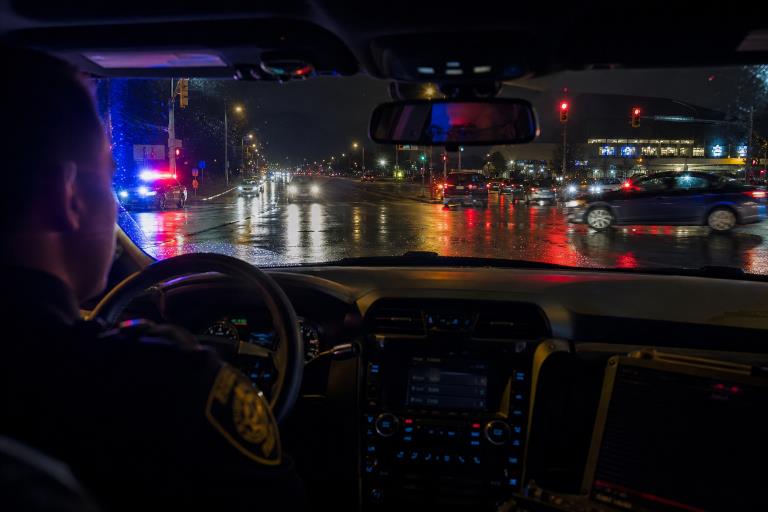
Consider an officer approaching a crowded intersection at night during rain. The safest outcome depends on reducing speed early, checking each traffic lane, anticipating a driver who may not hear the siren, choosing a position that preserves an escape path, and communicating clearly with dispatch or other responding units. Speed alone does not create a successful response.
What A Strong EVOC Program Should Cover
An effective Emergency Vehicle Operator Course should cover six connected areas:
- Vehicle control:Braking, steering, cornering, backing, lane position, skid recovery, and controlled stops.
- Risk judgment:Knowing when to slow down, stop, reroute, downgrade, or cancel a response.
- Traffic awareness:Recognizing conflict points, reading driver behavior, and managing following distance.
- Communication:Using warning equipment, radio traffic, and crew coordination without creating additional distractions.
- Policy knowledge:Applying pursuit rules, response restrictions, and fleet procedures to actual decisions.
- After-action review:Identifying what occurred, why it occurred, and what should change next time.
EVOC Curriculum Review Checklist
- Does training include both controlled exercises and decision-based scenarios?
- Are local crash patterns, road types, weather conditions, and fleet vehicles reflected in the curriculum?
- Do instructors use clear scoring standards that officers understand before training begins?
Where Scenario-Based Practice Fits
Scenario-based practice fills the gap between classroom policy lessons and live driving exercises. It can expose officers to routine patrol decisions, emergency responses through busy intersections, night driving, changing surfaces, sudden hazards, collision avoidance, and pursuit decisions. The strongest scenarios reflect local conditions rather than generic hazards alone.
For example, an agency with rural highways may emphasize wildlife strikes, long braking distances, and limited lighting. An urban department may focus more heavily on pedestrian activity, congested intersections, delivery vehicles, and drivers who stop unpredictably. Each exercise should have a defined learning objective, followed by a review that lets the officer connect actions to outcomes.
How To Build A Practical Training Cycle
A practical cycle does not need to disrupt operations for weeks on end. Agencies can begin by reviewing crash reports, vehicle damage, citizen complaints, and supervisor observations. From there, leaders can set a few measurable objectives and schedule recurring practice.
- Establish a baseline assessment for each officer.
- Deliver classroom instruction on policy, risk recognition, and decision-making.
- Run controlled driving exercises for high-risk skills such as braking, backing, and intersection approach.
- Use scenarios to practice judgment under changing traffic, weather, and visibility conditions.
- Provide coaching, assign targeted refreshers, and review aggregate results every 90 days.
How Instructors Can Measure Progress
Measurement should reward safe performance. Useful criteria include braking consistency, proper speed for conditions, intersection scanning, following distance, lane position, use of warning equipment, and decision quality during urgent responses. Officers should also be able to explain the reasoning behind important choices.
Video replay, instructor notes, event logs, and standardized scorecards can make feedback more specific. Instead of telling an officer to “be more careful,” an instructor can identify the exact point where the officer entered an intersection too quickly, missed a visual scan, or failed to create space from another vehicle. That kind of feedback is actionable and fair.
Budgeting For Long-Term Driver Safety
The purchase price of a training tool is only one budget factor. Agencies should also consider instructor availability, travel, track rental, vehicle downtime, maintenance, scheduling constraints, software support, and the operational consequences of preventable crashes. A lower initial cost may not be the strongest value if it provides limited repeat practice or weak reporting.
Leaders should ask how many officers will be trained annually, whether the system can support recruits and veterans, whether scenarios align with local risks, and how results will be evaluated at 6 and 12 months. A sound investment creates a repeatable process for improving judgment, not a one-time event.
Questions Police Agencies Should Ask
- Does the training reflect the department’s actual fleet and patrol environment?
- Can instructors adjust traffic, terrain, weather, and time of day?
- Does the program evaluate judgment alongside vehicle-control skills?
- Can officers receive immediate, specific feedback?
- Can the agency compare results across officers, shifts, and training dates?
- How will the program support current pursuit and emergency-response policies?
Conclusion
Safer emergency driving comes from steady practice, clear standards, realistic scenarios, and honest review. A strong 2026 training plan helps officers make better choices before a critical moment occurs. It also gives agency leaders a practical way to track progress, target coaching, protect public resources, and strengthen officer and community safety.