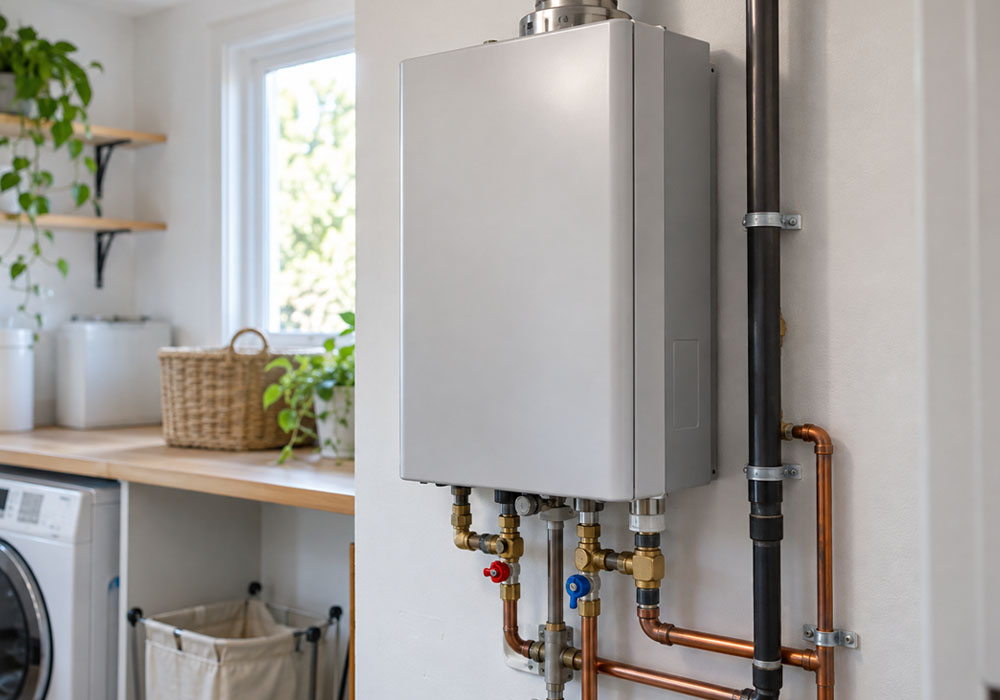
Most people who call a plumber about going tankless have already watched the same three videos and read the same two listicles. Then the estimator walks in, looks at the gas meter, looks at the flue, and starts asking questions nobody prepared them for. That gap is where budgets die.
Here’s the honest version: a tankless swap is usually a smart move, but the heater is rarely the hard part. The hard part is your gas supply, your venting path, and how many hot fixtures run at once. Get those three right and you’ll love the thing for fifteen years. Get them wrong and you’ll hate every shower. This guide covers what actually drives the decision, what drives the price, and how to judge a quote without getting talked into the wrong unit.
What “endless hot water” really means in practice
Tankless units heat water as it flows, so you aren’t draining a stored supply. That’s the whole pitch, and it’s real, up to a point. The catch is flow rate. Every unit has a maximum, measured in gallons per minute, and that ceiling is where your expectations meet your plumbing.
Run the math on your own morning. A shower head might draw a couple gallons a minute. The dishwasher pulls a bit. The bathroom sink adds some. Stack two showers plus a load of laundry and you can push past what a small unit can handle, which means someone gets a lukewarm surprise mid-rinse.
Sizing isn’t guesswork. You add up the fixtures you might realistically run at the same time, then pick a unit that clears that number with room to spare. Also factor in your incoming water temperature, which matters more than people expect. Cold groundwater in the Rockies in February is genuinely cold, and the unit has to work harder to lift it to shower temperature than it would in a milder climate. That’s not a sales pitch, it’s just physics, and it’s why a unit that satisfies someone in a warm state might disappoint you here.
The three things that decide whether your house can take one
Gas capacity
This is where most surprises live. A tankless heater fires hard while it’s running. That draw can exceed what your existing gas line and meter deliver, especially in older homes. The fix might be a larger gas line, a meter upgrade, or both. Your utility gets involved in some cases. None of that is exotic, but it isn’t free, and any quote that skips it is a quote you shouldn’t sign.
Venting
Tank units typically vent into a standard flue. Tankless units often need different venting, either stainless steel or PVC depending on the model. Where your current flue runs, how far the new vent has to travel, and whether it can exit a side wall all change the labor number. Ask specifically which venting material the quote assumes, then ask what happens if the run is longer than expected.
Electrical and condensate
You’ll need a standard outlet nearby for the controls and ignition. Some high efficiency models also produce condensate, which has to drain somewhere. That’s usually a small line to a floor drain or neutralizer. Easy in a basement, annoying when the heater lives in a hallway closet with no drain in sight.
What the swap actually costs, beyond the box
The unit itself is one line item. Labor, venting materials, gas line work, permit fees, and any plumbing changes are the rest. Skipping permits to save money is a bad trade, and the U.S. Department of Energy is clear that proper installation and maintenance are central to how efficiently these systems actually perform over their lifespan.
Ask for a quote broken into categories rather than one lump sum. Unit. Labor. Venting. Gas. Permit. Disposal of the old heater. Extras. A contractor who itemizes is a contractor who’s thought about your specific house. A contractor who hands you a single number is guessing, or hiding.
Also ask about the old unit. Someone has to haul it out, and in some cases a tank that old has sediment to deal with on the way. It’s a small line, but it tells you whether the quote was built or copied.
Hard water, maintenance, and the lifespan question
Tankless heaters last a long time in theory. In practice, mineral scale is what kills them early. If your water is hard, scale builds on the heat exchanger and efficiency drops before anything visibly fails. Annual descaling is the maintenance that keeps the warranty intact and the unit honest. If you’re not going to do it yourself, budget for someone to do it.
Many manufacturers require documented maintenance for warranty claims, which is worth knowing before you skip year three. Water quality varies a lot across the metro, and the Environmental Protection Agency maintains public information on drinking water quality and treatment considerations that’s useful if you want to understand what’s coming out of your tap.
One more thing people learn the hard way: a tankless unit gives you hot water, but it doesn’t give it to you instantly at a fixture across the house. There’s a delay while the water travels. Recirculation setups solve that, and they cost more. If instant hot water at the far bathroom is your real goal, say so up front. It changes the design.
A decision checklist before you sign anything
- Count your simultaneous hot water fixtures and know your target flow rate.
- Confirm your incoming water temperature assumption with the installer.
- Get the gas capacity question answered in writing, not verbally.
- Ask which venting material the quote assumes and where it exits.
- Find out whether condensate needs a drain and where it goes.
- Confirm permit handling is included.
- Ask what annual maintenance costs and whether the warranty requires it.
- Get the itemized breakdown, then compare two or three quotes side by side.
If a contractor can’t walk you through each of those without hedging, that’s your answer. You want someone who has done this in your neighborhood and can tell you what the gas meter situation usually looks like on your block. Local knowledge shows up in the details, and it’s the difference between a two day job and a two week argument.
Budget planning deserves its own attention here. Financing terms, utility rebates, and federal incentives change, so it’s worth checking current guidance on residential energy improvements from the Department of Energy before you assume the sticker price is the final number. Sometimes there’s help available. Sometimes there isn’t. Either way, you’ll know.
When you’re ready to move forward, getting a few local bids on tankless water heater replacement denver co homeowners can compare side by side is the single fastest way to separate a fair price from a padded one. Two quotes tells you market rate. Three tells you who’s padding.
Choosing a unit without drowning in spec sheets
Brand loyalty is mostly noise. What matters is flow rate, the temperature rise the unit can achieve, venting compatibility with your house, warranty terms, and whether local technicians actually service that brand. A slightly cheaper unit that nobody in town stocks parts for is a worse purchase than a pricier one with a service network.
Here’s my stance: size up one notch from your calculated need if your household is growing or you’re adding a bathroom. Running short on hot water is the complaint I hear most, and it’s the one that can’t be fixed with a setting change. Oversizing a little costs money once. Undersizing costs you every morning.
And read the warranty carefully. Heat exchanger coverage, labor coverage, and the conditions attached to both vary wildly between manufacturers. That document tells you more about real world durability than any marketing page. Done right, a tankless swap is one of the few home upgrades you’ll notice every single day. Done on a guess, it’s an expensive lesson in flow rates. Which one you get depends almost entirely on the questions you ask before the first wrench turns.