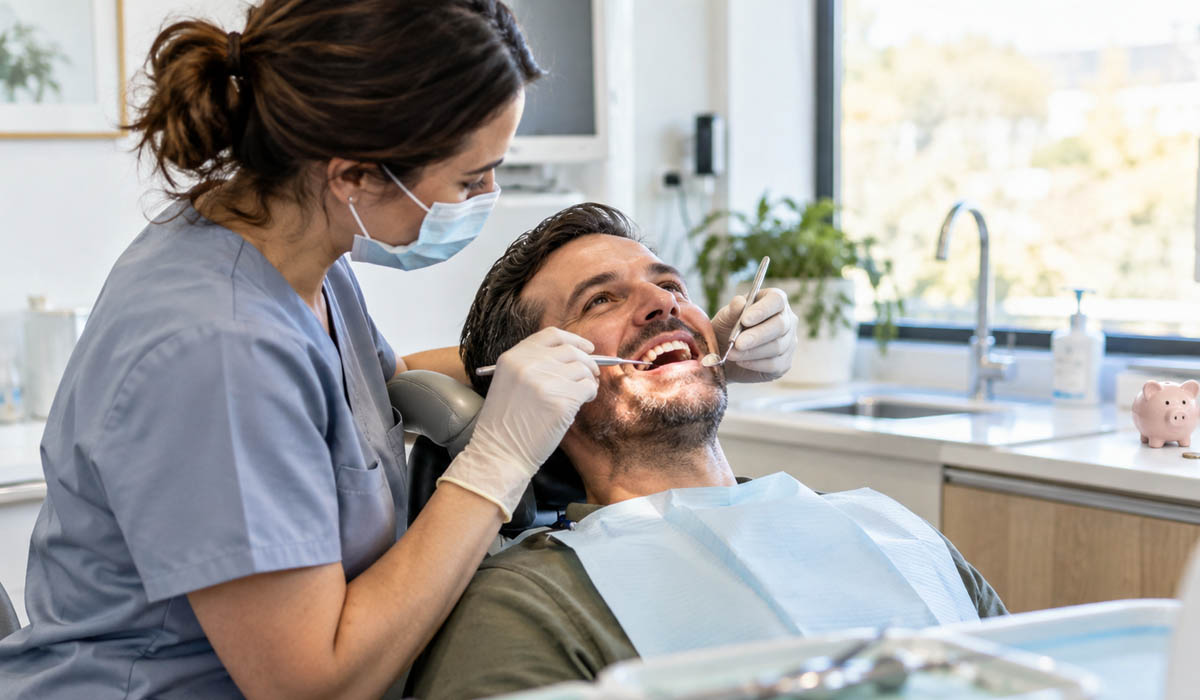
Nearly 3.5 billion people are affected by oral disease worldwide which is the most common noncommunicable disease globally (WHO). Much of this suffering was unnecessary. A large proportion results from a single easily avoidable choice made repeatedly, year after year: not having a check-up that would have detected the problem while it could still be treated cost-effectively.
The math nobody does before they cancel an appointment
Many people skip or postpone routine dental checkups for seemingly logical reasons. They might be short on money or time, or feel that since they’re not experiencing any pain, why go? However, these justifications make sense only if we disregard the consequences.
The cost of a routine checkup and cleaning is minimal compared to getting a filling. The cost of a filling is minimal compared to needing a root canal. The cost of a root canal is minimal compared to an extraction and an implant. When you put things into perspective, a checkup is not an expense; it is the least expensive insurance you will ever have.
Dentists emphasize the importance of recall visits for a reason. They see the same scenario play out with countless patients: small, preventable issues become big, expensive-to-treat problems.
How a single cavity turns into a much bigger bill
Cavities don’t appear overnight. In the beginning, there is plaque that adheres to enamel, this plaque feeds off sugar in your diet, creating acid as a byproduct. This acid will degrade the enamel and eat into the softer dentin underneath, forming a hole. At this point, a Hounslow dentist can often treat it with a simple filling, or with a fluoride coating if it is identified early enough.
Ignore it, and the hole will continue to grow. When it reaches the pulp – the nerve at the middle of the tooth – a simple filling will no longer be enough, and you will need root canal treatment. This treatment is more invasive, longer, and costs more. A root canal also often requires a crown afterward to protect the rest of the tooth structure, which will increase the invoice again.
If the infection is too severe before anyone catches it, extraction may be the only option. Then you’re choosing between living with the missing tooth or paying for a dental implant, which is one of the most expensive procedures in general dentistry. The same lesion, at three different stages, produces three wildly different invoices. Prevention is not about escaping treatment altogether, but about identifying the problem while the treatment is still small.
Gum disease costs more precisely because it doesn’t hurt
At least with a cavity, you’ll probably get a warning. Gum disease is worse in one very important respect: it doesn’t tell you anything’s wrong until it’s too late.
The first stage, known as gingivitis, often just means you’ll see a bit of blood when brushing your teeth. That’s all. No pain, no other symptoms. The good news? This stage can be totally reversed with a clean from your hygienist and better cleaning at home. This is also usually the least expensive stage to treat, so naturally, it’s the one when you feel you can probably leave it another six months!
Without treatment, the condition progresses to periodontitis. This literally sees your gums peel away from your teeth because the tartar on them has spread. You now have deep gum pockets, which in turn provide easy access for the bacteria to the bone that holds your teeth. Now, a cleaning is no longer sufficient. Instead, you will need scaling and root planing which scrapes tartar out from under your gums. In more severe cases, you may also face gum surgery and even teeth extractions. The bone around the teeth will have been destroyed and cannot be repaired. What might have cost £/$50 to £/$80 will now cost you well into the hundreds, probably over several visits.
The financial gap between gingivitis and periodontitis may genuinely be greater than the one between a small cavity and a root canal. It’s just that no one ever makes a movie about a patient who lost all their teeth.
Restorative work is never really a one-time cost
Many people believe that once they have paid for a filling, a crown, or an implant, that the tooth is fixed and will last forever. Unfortunately, this is not the case. Fillings can wear away and occasionally crack or fall out, especially when they are large and biting forces are high. Crowns will eventually need replacing too, usually after about a decade to fifteen years but this can be longer if you are lucky with the material, the manufacturer, or the technician who made them, or shorter if you fail to look after the tooth underneath. Implants need regular monitoring and thorough cleaning to avoid the equivalent of gum disease, called peri-implantitis, undermining the artificial root, and if this is not treated the implant will fail.
In reality, every filling, crown, or implant you put in is the beginning of a long series of repairs and replacements, not a one-off event that ends the problem it is addressing. This is why prevention quickly saves you money. A tooth you keep healthy and strong is a tooth that never requires fixing or replacing. Avoiding a whole set of teeth desperately in need of help a decade later adds up to some serious savings over a lifetime.
Waiting for pain is the most expensive strategy available
If you wait for pain to book a dentist, you’re using the worst indicator dentistry has. Most of the decay can develop inside a tooth before feeling pain. Gum disease can destroy bone structure with little to no pain present. By the time you feel the pain, you’re taking the most expensive route.
Here’s the part that many people get wrong in the argument “preventing expenses”: It is not just about being cheaper than treatment. Pain absence doesn’t mean you don’t need treatment. A dentist is trained to look for what you can’t see or feel, such as minuscule decay between your teeth, bone loss, or signs of a bite issue. Those won’t cause you any pain until they turn into a full treatment.
Why dental benefit plans are built around checkups
If you take a close look at the way most dental insurance and benefit plans work, you’ll find one common aspect: preventive visits, exams, and cleanings are covered 100% or at the highest percentage, preventive services are often subject to little to no deductible or waiting periods, while restorative services such as fillings, crowns, and root canals have much higher out-of-pocket percentages and lower annual maximums.
That’s not coincidence or even the kindness of insurers’ hearts. They have the data – and they know that the cost of a preventive visit is minuscule compared to the cost of an ignored mouth when it finally becomes a costly claim. In other words, by simply covering checkups 100%, they’re saving themselves money in the long run. If the people paying the bills structure their entire model around encouraging prevention, that’s a strong signal about where the actual value sits.
The costs that don’t show up on a dental bill at all
Gum disease is not a local infection. Scientific studies show that chronic inflammation of the gums can contribute to diabetes management issues, and can also elevate the risk of developing cardiovascular issues. The exact causal links are still under research, but the correlations are strong enough to encourage many healthcare providers to routinely inquire about gum health.
This has real financial implications, as both diabetes and cardiovascular disease require continuous management and financial investment. Making these conditions harder to manage only raises costs for the patient. For example, if you face both diabetes and gum disease, you may need to take more medicine for your blood sugar, and may also need more frequent checkups. The costs only multiply. Treating gum disease in the early stages may also help ease the burden on a patient managing another chronic illness.
Turning prevention into a predictable line item
None of this requires perfection. It requires a checkup on a schedule that actually matches your risk level, rather than the vague “every six months” rule most people were taught as children and never questioned again. Some patients with excellent oral hygiene and low decay risk can safely stretch to annual visits. Others with a history of gum disease, dry mouth, or heavy plaque buildup need to be seen more often. There’s no universal number that applies to everyone.
This is exactly the kind of assessment worth getting from someone qualified rather than guessing. Independent practices generally publish clear price lists for exams, cleanings, and common procedures, and many offer membership plans that spread preventive costs across the year instead of hitting you with one large bill. NHS routes exist too, for patients who qualify, at fixed banded charges that are far lower than private restorative fees. The barrier to consistent care is usually smaller than people assume once they actually look at the options.
Dental anxiety plays a role here too. Plenty of people delay checkups not because of cost but because they’re genuinely nervous about the chair. That’s understandable, but it feeds the same financial trap: anxiety causes delay, delay allows small problems to grow, and growth in dental problems always tracks with growth in cost. Practices that deal with anxious patients regularly usually have ways to make the visit easier, and that alone can be worth asking about before writing off checkups entirely.
The choice is smaller than it feels
Deciding not to get a checkup never seems like a financial choice at the time. It seems like nothing at all, and that’s the difficulty. You don’t get a bill for the appointment you didn’t make, you don’t get a receipt for what you chose to skip. The invoice arrives later, in months or sometimes years, except that it’s not stamped “PAST DUE” in red letters; it comes disguised as a root canal, a crown, an extraction – all of which cost far more than the checkup that might have prevented them. A checkup is the smallest and, by far, the least painful thing your dentist will do for you.