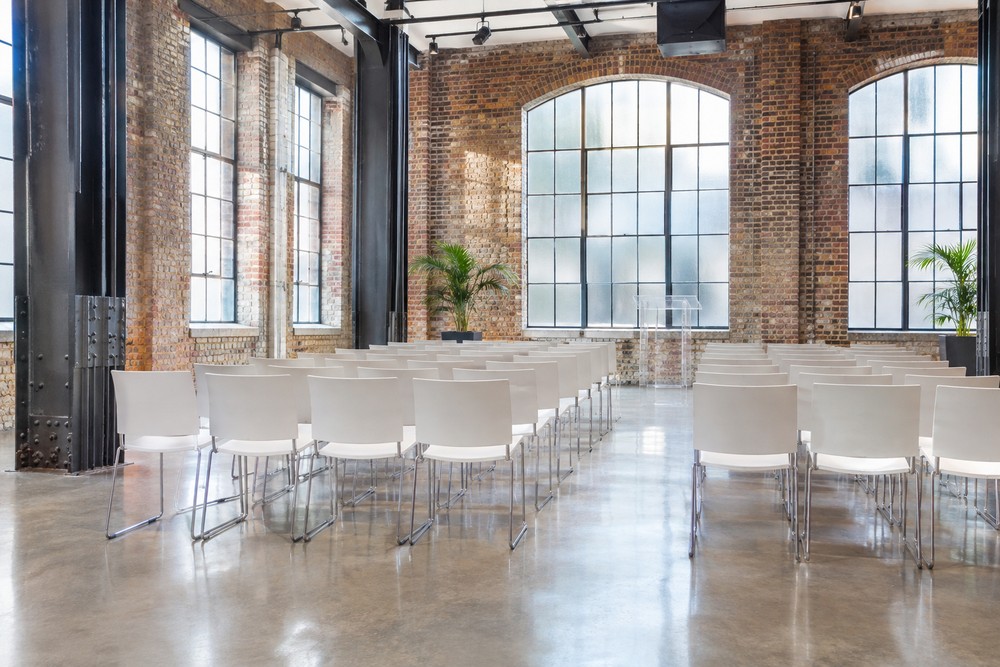
The costliest venue mistakes usually happen before anyone sees the space. They start when organisers rely on capacity charts and treat the hire fee as the whole cost. Once that choice is wrong, catering, production, staffing and the guest experience all become harder to put right. Many common beliefs about hiring a London event venue rest on assumptions that were never accurate or stopped being accurate years ago. The myths below are the ones that cost organisers the most, along with the questions that correct them.
Myth: capacity numbers are universal
A capacity figure means little until it is tied to a format. The same room holds very different crowds as theatre, cabaret, banquet or reception, and the gaps between those layouts are large. Banquet rounds take far more floor per guest than theatre rows, so the layout you need decides what the room can actually hold.
Brochures tend to quote the biggest number the room has ever held. That figure usually assumes a standing reception with no staging, no dance floor, no catering stations and no registration desk. Two rooms with the same headline capacity can work very differently, because ceiling height, pillars, sightlines and floor shape decide how much of the quoted number is usable for your format.
A room that’s too large for a small guest list feels flat, and lighting can’t fill empty floor. The useful capacity is the one that matches the format and the expected attendance, not the biggest you can afford.
Before comparing spaces, request capacity figures for each layout. Find out what each figure assumes: where the stage sits, how much room catering needs, and whether breakout space is included or separate.
Myth: historic means outdated
Age says nothing about infrastructure. Many restored venues pair original brickwork and steel beams with modern power, AV, venue-wide WiFi and climate control. Others don’t. Architecture shows how a space looks. The specification shows how it runs.
Scepticism should work both ways. A brand-new box can have dead acoustics and patchy connectivity, while a two-hundred-year-old shell may hide a thoroughly modern build inside. The questions are technical either way. What power capacity is available, and where? Is the WiFi built for hundreds of devices at once? How is the space heated and cooled when it’s full?
Access deserves the same treatment. Some converted buildings have step-free routes, lifts, ramps and accessible facilities; others don’t, and provision varies more than marketing suggests. Don’t rule a venue out from photos, and don’t rule it in either. Walk the route a guest would take, from arrival to the main space, before deciding.
Request the technical specification before the site visit and check it in person. Together they give a clearer picture.
Myth: a venue is just four walls
The room is the visible part of the product. What you’re actually hiring is the operating team behind it: the people who coordinate AV, catering, security and the build, and who answer for all of it on the day.
Two identical spaces can produce completely different events because of this. A strong in-house events team catches problems in the load-in schedule and the floor plan before you do. A weak one leaves all of that with you, and you find out at the worst possible time.
Service partners matter almost as much as staff. Most venues work regularly with particular caterers and production companies, and those teams know the building’s quirks: the awkward loading bay and the room with the echo. Ask who the venue recommends and why.
Looking up events venue london returns a long list. The useful filter is character and modern infrastructure, backed by an in-house team that runs the day with you.
Find out what’s included and what’s outsourced. Ask who the event-day point of contact is, and whether the venue supports streaming or remote audiences when needed. Those answers show whether the offer is a space or a service.
Myth: you’re locked into the venue’s suppliers
This belief survives because organisers don’t ask the question that settles it: is this dry hire or wet hire?
Dry hire means the space with fewer bundled services, though existing furniture or technical facilities can still come with it. Wet hire bundles more services with the room, but neither label settles who supplies what. Some venues require in-house catering but welcome external production. Others reverse it. There’s no standard split, so get the inclusions in writing.
Catering is usually the line that moves the budget most. Whether food and bar service must come from the house or can come from outside changes both the cost and the quality ceiling. Ask before you fall in love with the room.
The bar deserves its own question. Per-person packages, consumption billing or a mix each suit different events, and the billing model changes the total as much as the price list does.
Each model favours a different buyer. Space-led hire suits organisers with established suppliers and the experience to run them, with every supplier paid separately on top of the venue fee. Bundled services can simplify coordination by putting more of the event under one roof. Comparing labels alone is less useful than comparing what each quote includes and what the total commits you to.
Myth: the headline quote is the final price
The hire fee may cover staffing, security, cleaning or technology, or it may exclude them, so check what the quote actually includes. Ask whether the figures include VAT before you budget around them.
The fee is only the starting point. Ask every venue for an itemised quote that separates each of those lines. Then ask about conditions, because conditions are where low starting prices hide. A minimum catering spend, a required security level, an approved supplier list or a service charge each change what you’re actually committed to. A low fee with a high minimum spend can commit you to more than a higher fee with most of it included, and you can’t see that from the headline.
Staffing is the line organisers underestimate most. Cloakroom attendants, security staff, cleaners and technicians are real costs that scale with guest numbers, and they appear on the final invoice whether or not they appeared in the headline.
Set the figures side by side for each venue: the hire fee, the minimum spend, the hours covered and the overtime rate. Events rarely end on the minute, and the last hour of a party is often billed at a different rate than the first.
Clear quoting often points to clear operations. An itemised quote also gives an early sense of how the rest of the relationship will go.
Myth: only Zone 1 works
The assumption is that a central postcode guarantees attendance. Journey time decides attendance, and a well-connected East London venue near Bank or Canary Wharf can be an easier trip for much of a corporate guest list than a West End address.
Run the check properly. Look at where delegates actually travel from, then time the journey at the hour they’ll travel it. A venue ten minutes from a major station often beats a famous postcode that needs two changes. For guests arriving from outside the city, what matters is the link from the arrival points, not the prestige of the address. Check when transport thins out at night, too. An event that ends after the last easy train home ends early in practice.
Price follows the same logic. Value per square metre varies across the city, and a Zone 1 address guarantees neither quality nor cost. Compare itemised totals and journey times instead. The postcode is the least informative line on the quote.
Myth: you must book a year in advance
Peak dates do go early, and if your event is tied to one specific Thursday in June, lead time matters. But that’s the exception being treated as the rule.
Midweek slots, off-peak months and shorter lead times are realistic at many venues, especially for small meetings and workshops. Flexibility on dates gives you options that rigid timelines don’t, and venues would rather fill a gap than hold out for a booking that may never come.
The myth cuts both ways, though. A large exhibition or a full production genuinely needs months of planning, and no amount of flexibility changes a build schedule. Match the lead time to the complexity of the event, not to a rule of thumb. Ask what’s available at short notice before assuming the answer is nothing.
Ask whether the venue will hold a date while you decide. A first or second option usually costs nothing, and it buys time to confirm speakers and budgets before committing.
Myth: every venue can handle a full production
Production feasibility is where venue choices quietly fail. Load-in and load-out windows, freight lifts, floor loadings and power capacity vary hugely between spaces, and the load-in window is often the real constraint for exhibitions and product launches. A room can be perfect for the event and impossible for the build.
Ask the operational questions early. When can production vehicles arrive, and where do they unload? What are the floor loadings, and what rigging or fixings are permitted for a brand takeover? How much power is available, and how long is the breakdown window? A venue that hesitates on these answers is telling you something. If the event includes streaming or a hybrid audience, confirm upload speeds and ask for a hardline connection; venue WiFi alone may not carry a broadcast.
Share the production schedule with the venue before signing, not after. If the build doesn’t fit the window, the booking doesn’t fit the event. That’s cheaper to learn on paper than on the day.
Before you sign
Every myth on this list survives for the same reason: organisers don’t ask, and venues don’t volunteer. The questions cost nothing, and a site visit answers most of them in an hour. A floor plan rarely shows how a room feels.
Shortlist two or three spaces and walk each one. Ask the same questions at every venue, and compare the itemised answers, not the brochures. The right London event venue is the one whose answers hold up.