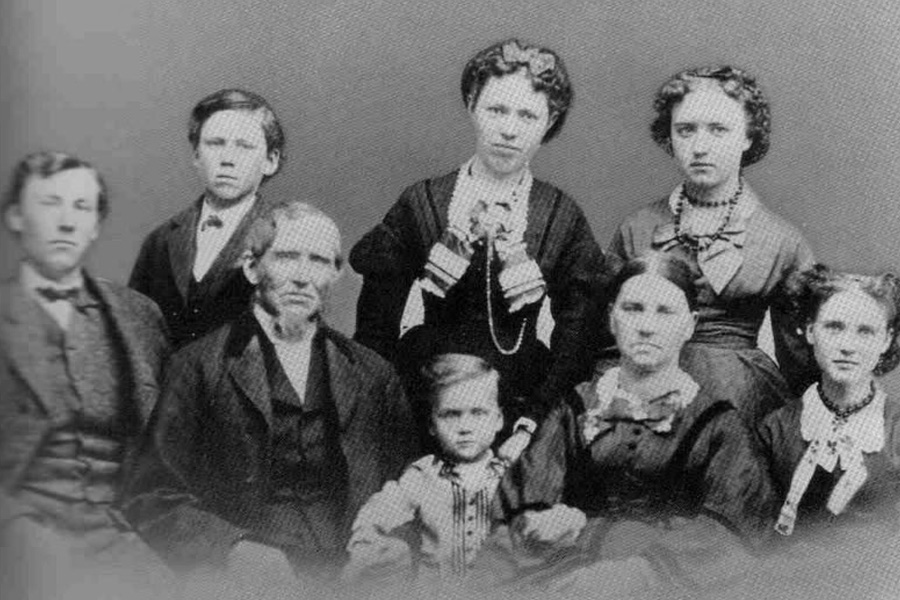
A life rooted in land, labor, and lineage
I think of James Mason Wilder as the kind of man who leaves a mark not through spectacle, but through gravity. He was born on 26 January 1813 in Bridport, Vermont, and his life stretched across a century that transformed America from rural inheritance into restless expansion. He worked the old way, with land under his hands and responsibility on his shoulders. That matters, because his story is not only his own. It is the trunk of a family tree whose branches reached into literature, settlement, migration, and memory.
James Mason Wilder became best known as the father of Almanzo Wilder, and through that link he became part of a larger American story. His family farm, purchased in 1840 in New York, stood as both a livelihood and a landmark. I see it as a kind of anchor dropped into the soil. Around it gathered children, hard work, grief, marriage, movement, and the daily mathematics of survival.
Early years and family roots
James Mason Wilder was the son of Abel Wilder and Hannah Paine Wilder. His ancestry stretched back into older New England lines, where surnames repeated like echoes across generations. The family carried names such as Wilder, Paine, and Day, each one signaling a network of kinship that mattered deeply in 19th century life. In those days, family was not background. It was infrastructure.
Abel Wilder and Hannah Paine Wilder gave James a place in a large and sturdy family system. His grandparents are generally identified as Daniel Wilder and Mary Polly Gould on one side, and Thomas Paine and Sarah Stewart Mason on the other. Some family traditions also extend the Paine line farther, linking it to John Paine and Alice Mayo Paine. Whether traced through town records, family trees, or remembered lineages, the picture is clear enough. James Mason Wilder came from a people who put down roots and stayed close to them.
That background shaped him. He did not emerge from nowhere. He was one bead in a long string, and that string ran through farms, marriages, and children who would carry the name forward.
Marriage, loss, and a growing household
Two marriages for James Mason Wilder. Mary Shonyo was his first wife, married at Malone on 4 November 1840. No children survived their brief marriage. We believe Mary died in 1842. In records, loss is generally recorded with few specifics, but the absence screams loudly. A brief marriage can leave a life hollow.
His second marriage was to Angeline Albina Day Wilder on August 6, 1843. He focused on that union afterward. They had six children, and the Wilder tale revolved around them. I imagine a crowded weather system there. Kids grew, debated, worked, and learnt. The farm did more than house them. It shaped them.
Laura Ann Wilder Howard, Royal Gould Wilder, Eliza Jane Thayer Gordon, Alice Maria Baldwin, Almanzo James Wilder, and Perley Day Wilder were their offspring. Each kid shaped the family’s future, but Almanzo was most remembered for his link to Laura Ingalls Wilder and his literary career. Each youngster demands attention.
The 1844-born Laura Ann Wilder lived till 1899. 1847-born Royal Gould Wilder became a minister and missionary. Born in 1850, Eliza Jane Wilder lived until 1930. Born in 1853, Alice Maria Wilder died in 1892. Almanzo James Wilder, born in the 1850s, married Laura Ingalls Wilder and became the cornerstone of Little House. Born in 1869, Perley Day Wilder was the youngest and survived until 1934.
This family was like a mini-republic. Each child had a function, and the parent in charge kept things moving.
Farm life and work achievements
James Mason Wilder’s main achievement was not a title or office. It was the farm. In 1840 he purchased the property in the Malone or Burke area of New York, and he turned it into a working homestead. He cleared the land, built the structures, and made the place productive. That kind of labor does not always get written into grand histories, but it built the country one fence line at a time.
A farm in that era was a machine made of weather, muscle, patience, and risk. Every season could reward or punish. Every acre had to justify itself. James Mason Wilder lived inside that reality. His work was physical, repetitive, and essential. He belonged to the class of men whose names may not ring through the ages on their own, yet whose efforts made the lives of later generations possible.
The family sold the farm in 1875, which marked the end of an era. That sale did not erase the place. It simply changed its form. The homestead later gained recognition as a literary landmark because of its connection to the Wilder family and the Farmer Boy world. That recognition rests on the fact that James Mason Wilder had built more than a house. He had built a setting that would outlive him in memory.
Later life and final years
James Mason Wilder’s final years were distant from Vermont. He was buried in Crowley Cemetery after dying in Mermentau, Louisiana, on February 1, 1899. Before this, the family had undergone considerable upheavals. The old New York residence was sold. His kids grew up. His name was part of a heritage that extended to new locations and stories.
That lifestyle is quietly monumental. Not glittery. Settles. Like a river that appears silent until it carves the terrain.
James Mason Wilder in family memory
What keeps James Mason Wilder alive in memory is not merely that he was the father of Almanzo Wilder. It is that he represented a type of American fatherhood that was rooted in labor, continuity, and practical provision. He stood at the center of a household that bridged Vermont, New York, and Louisiana. He fathered a son whose life would later be preserved in famous books, but he also fathered daughters and sons whose lives mattered in their own right.
I see him as the hinge between generations. Behind him were older family names, some carried from colonial New England. In front of him were children who would scatter into different directions, carrying the Wilder line into new contexts. The family did not simply inherit his name. It inherited a way of life marked by endurance.
FAQ
Who was James Mason Wilder?
James Mason Wilder was a 19th century American farmer born in Vermont in 1813. He is best known as the father of Almanzo Wilder and the patriarch of the family tied to the Wilder homestead in New York.
Who were his parents?
His parents were Abel Wilder and Hannah Paine Wilder. His family line also connects to older New England names such as Daniel Wilder, Mary Polly Gould, Thomas Paine, and Sarah Stewart Mason.
How many times was he married?
He was married twice. His first wife was Mary Shonyo, and his second wife was Angeline Albina Day Wilder.
How many children did he have?
He had six children with Angeline Albina Day Wilder. Their names were Laura Ann, Royal Gould, Eliza Jane, Alice Maria, Almanzo James, and Perley Day Wilder.
Why is James Mason Wilder important?
He mattered because he built and sustained the family farm, raised a large household, and became the father of Almanzo Wilder. His homestead later became part of a much larger literary and historical memory.
Where did he live later in life?
He spent his later years in Louisiana and died there in 1899. His burial took place in Crowley Cemetery in Crowley, Louisiana.
What is the connection between James Mason Wilder and Rose Wilder Lane?
Rose Wilder Lane was his granddaughter through Almanzo Wilder. She became a writer and carried the family legacy into another generation.
What happened to the family farm?
The family sold the New York farm in 1875. The homestead later became recognized for its historical and literary significance, preserving the landscape connected to the Wilder family.