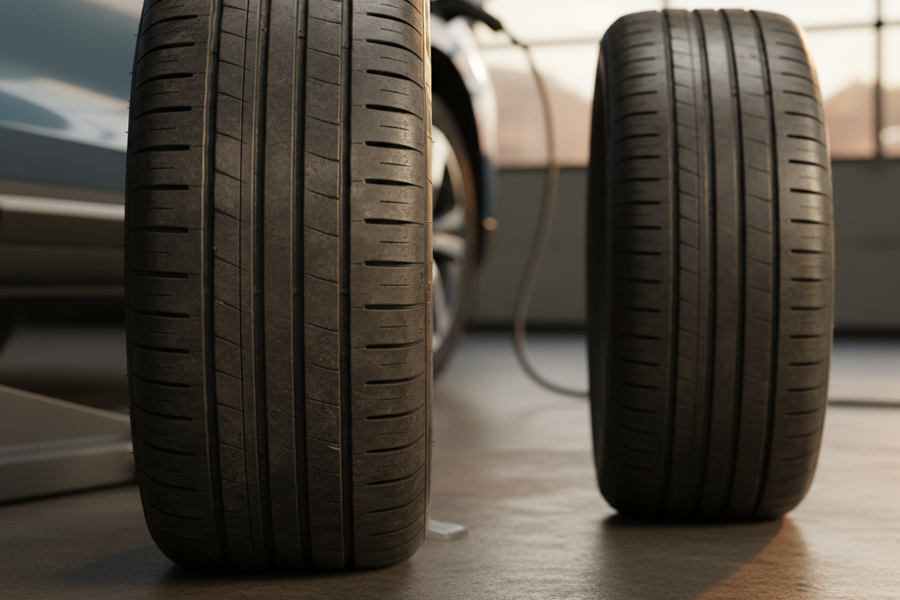
Why small tyre issues become big bills
The road and your car touch hands with tyres. Fuel economy and driving precision suffer when that connection weakens. A subtle vibration or soft pressure can lead to shoulder-chopped tread, burned wheel bearings, or a steering rack that seems ten years old. Sirens don’t bring charges. The tide comes in slowly.
Treat tyres as part of your vehicle’s foundation, not disposable rubber. The pay-off is more grip when it matters, fewer surprise workshop visits, and a vehicle that feels planted rather than vague.
Energy drain: fuel and EV range penalties
Underinflated or misaligned tyres boost rolling resistance. You need more energy to go the same distance. For petrol and diesel vehicles, that is a higher weekly spend. For EVs, that is a shorter range and more charge cycles.
Consider a simple example:
- A commuter doing 15,000 km a year
- Vehicle average consumption 7.5 L per 100 km
- Fuel cost 2.70 NZD per litre
- A mild underinflation issue that adds 3 percent to consumption
Annual fuel spend without the issue is roughly 3,038 NZD. The 3 percent penalty adds about 91 NZD. That is one small error paying for an alignment or a pressure gauge.
For EV owners, the same drag means fewer kilometres per charge, more time at chargers, and more heat in the battery. High torque loads with poor pressures also scrub the tyre shoulders, so range drops and tyre replacement arrives sooner. It becomes a double hit on running costs.
Wear patterns that tell a story
Every wear pattern is a clue:
- Center wear: Pressure too high or repeated high-speed running
- Shoulder wear: Low pressure or consistently heavy cornering
- One-side wear: Camber or toe error, often an alignment issue
- Cupping or scalloping: Worn shocks or unbalanced wheels
- Feathering: Excess toe and aggressive scrub on each rotation
Reading tyres is like reading tree rings. When you catch the pattern early, the fix is small. If you ignore it, the problem migrates into joints, bushes, and bearings.
Alignment and geometry: the silent budget leak
Wheel alignment is not about straight wheels. It is about correct toe, camber, and caster so the tyre rolls in harmony with the suspension. A tiny toe error multiplies with speed and distance. Think of it like walking with your toes slightly turned in. You will arrive sore and slow.
New Zealand roads are rude. Chip seal, potholes, speed humps, and driveway lips can destroy geometry instantly. After exiting, the tires drag instead of rolling. Heat and uneven wear result from drag. Check alignment before a pull with a routine. Most drivers wait until the steering wanders, which is costly.
Balancing: smoothness, safety, and speed
Unbalanced wheels can feel like mallets at 100 km/h while being only grams off. You need the vibration to lower the contact patch on a wet highway or during an evasive swerve. As the shake spreads to bearings and the steering column, confidence and components shake.
Balancing is fast, inexpensive, and protective. Treat it like tyre rotation. If you rotate, balance.
Case studies from NZ roads
- Tradie van: A carpenter’s van with equipment and sheet goods has front pressures for an empty vehicle. Shoulders erode in 12,000 km. The vehicle tracks poorly in crosswinds after early tire replacement. Reset load pressures, align after a deep pothole, and tires last 30,000 km. Safer highway driving and hundreds of dollars saved.
- The Auckland commuter: A daily run over patched tarmac loosens geometry. The driver notices a faint drift but ignores it. By the next Warrant of Fitness, inside edges are down to the cords. Now it is two new fronts, an alignment, and a noisy bearing to catch up on. Cost jumps from a simple alignment to a multi-item invoice.
- High resting torque and low pressures wear the family EV’s edges. The car feels heavy on turn-in and range drops. After installing EV-rated tires with stiffer sidewalls and weight-appropriate pressure, the family gains range and steering stability. Tire life is extended on all four corners by the modification.
EVs, utes, and towing: special demands
- EVs: Heavy batteries and quick torque damage tires. Choose load indices that match the vehicle’s mass and follow the manufacturer’s pressure recommendations for efficiency. Stronger design and compound adjusted for quiet operation and load longevity are common in EV tires.
- Utes and 4x4s: Tools, tow bars, and off-road gear push axle loads high. Underinflation while towing can make the rear tyres run hot and the sidewalls flex more than they should. If you switch between empty and full load, adjust pressures accordingly. Carry a quality gauge in the glovebox.
- Vans and light trucks: Frequent kerb hops and low-speed turns punish shoulders. Rotate often and align more frequently than a typical passenger car. The steering box and tie-rod ends will thank you.
Age, heat, and weather: the slow killers
Tyres not only wear out. They age. UV, coastal salt air, and heat cycles harden rubber. A tyre can appear good yet grip like a hockey puck when wet. Summertime pressures rise with warmth. Winter pressures fall. Ten degrees Celsius changes pressure by 1 psi. That lets you start the season underinflated without touching a valve.
If you drive on polished surfaces in sudden rain, tread depth saves you. Even if regulatory limitations are lower, hydroplaning risk rises quickly below 3 mm tread. Many drivers replace earlier for this reason alone. Visibility and stopping distance go beyond brakes. They’re also about your tires’ microscopic water-exit passages.
Smart maintenance cadence that actually saves money
You can keep this simple and effective:
- Check pressures monthly and before long trips. Adjust for load.
- Rotate 8,000 to 10,000 km to equalize wear patterns front to rear.
- Balance at each rotation or when a vibration appears.
- Align at least annually or after a hard hit, a new set of tyres, or any suspension work.
- Inspect tread with a torch. Look for patterns, not just depth.
- Replace valve stems and check TPMS sensors when fitting new tyres.
A short routine prevents the expensive sort of drama. Tyres are cheaper than suspension parts. They are also cheaper than a long insurance conversation after a wet-road slide.
FAQ
How do I know the right tyre pressure for my vehicle?
Check the gasoline flap or driver’s door jamb for the plaque. This lists regular, full, and sometimes greater speed pressures. The tyre sidewall number represents the maximum cold inflation rating, not recommended. Always set pressures cold and check temperature swings.
Is nitrogen inflation worth it?
For most drivers, regular air is perfectly fine. Nitrogen leaks more slowly and reduces pressure swings with temperature changes, which can be useful for vehicles that see track use or heavy loads. If you are consistent with monthly checks, the difference is small.
What tread depth should I target for replacement?
Many drivers choose to replace at around 3 mm for wet performance, even though legal minimums are lower. Braking distances and hydroplaning resistance deteriorate sharply below that point. If you frequently face heavy rain or standing water, consider earlier replacement.
Can I mix different brands or tread patterns?
Mixing across the same axle can create uneven grip and odd handling, especially in the wet. If you must mix, keep identical tyres on each axle and ensure size, load index, and speed rating match. For AWD vehicles, tread depth differences can stress the drivetrain, so aim to keep all four in sync.
Why do my tyres wear on the inner edges only?
That is commonly excess negative camber or toe-out. It may stem from lowered suspension, worn bushes, or a hard curb strike. An alignment with a full suspension inspection will reveal whether geometry can be reset or if a component needs replacement.
How often should I align after hitting a pothole?
There is no fixed rule, but if you felt a sharp impact, noticed a new vibration, or the steering now sits off-center, book an alignment check promptly. Catching the change early can save a set of tyres from one-sided wear.
Do EVs need special tyres?
They benefit from increased load ratings, lower rolling resistance, and quieter operation tyres. Reinforced sidewalls and improved compositions help EV tires handle bulk and torque without losing range or comfort. Always match tyre load index and speed rating to vehicle specifications.
Why does my steering wheel shake at highway speeds?
That is usually wheel imbalance, but it can also be a bent rim, a separated tyre belt, or worn suspension parts. Start with a balance and visual inspection. If the shake persists, escalate to a full check of rims, tyres, and front-end components.