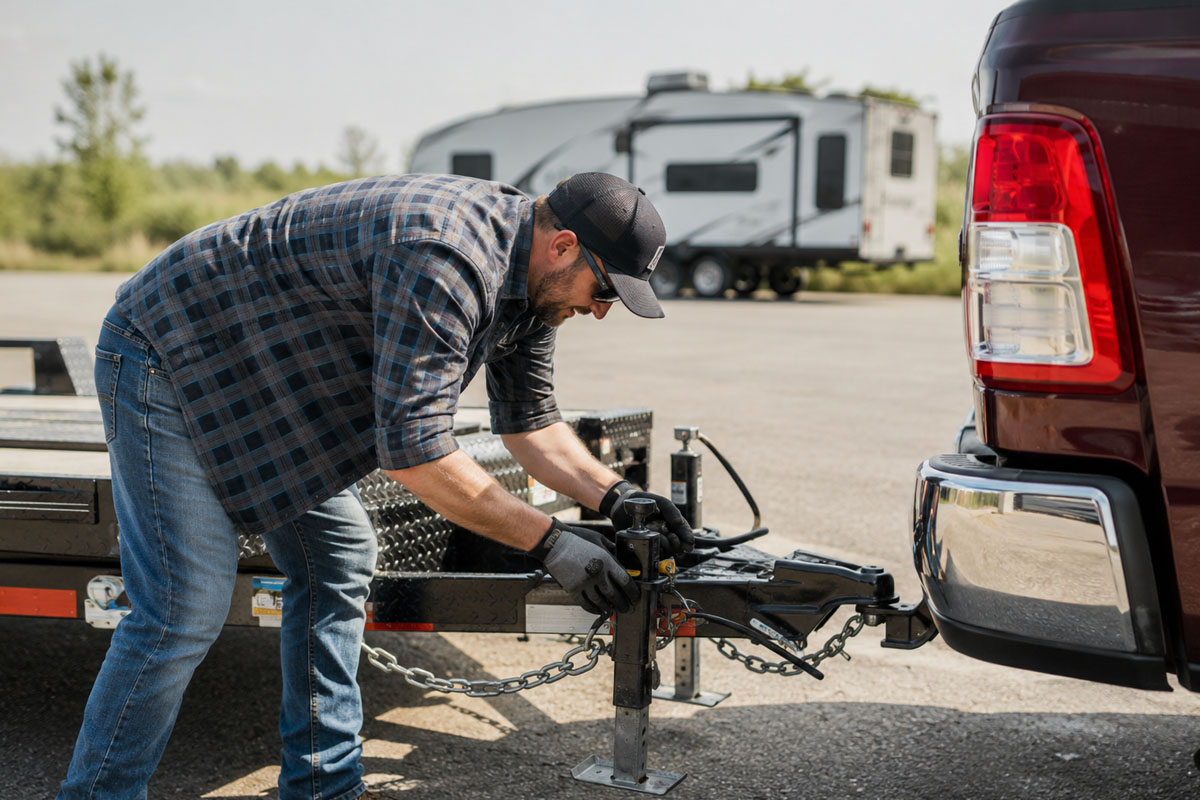
Long-distance towing is a whole different ball game than hauling your trailer a few kilometers to the local campground on the odd weekend. Stress accumulated over days on the highway may become unbearable in hours during those three- or four-hour stretches when a thousand-kilometre tow separates you from your destination, your family and your patience. So a tiny thing that wouldn’t even give its presence away during a couple of dozen uneventful weekend trips can suddenly make the thousand-kilometre nightmare haul from mess genuinely nightmarish.
Why Interstate Towing Breaks Rigs That Local Towing Doesn’t
A trailer that can handle short drives may not necessarily be suitable for an eight-hour highway drive with temperature variations and unsealed roads. High temperatures can affect bearings and brakes differently over long distances than they would over short trips. Corrugated and unsealed roads can also aggravate the normal wear of suspension components, wheel bearings, and tire sidewalls. Without those factors, the wear might only become apparent over a period of years. Sprinkle on longer space between towns and what would be a quick roadside repair at home maybe days of downtime while parts are shipped in and an even larger recovery bill.
Brakes: The Number-One Reason Rigs Get Pulled Off The Road
Electric trailer brakes may not be as effective as we often assume. The magnets used to spread the shoes wear out. The shoes themselves get thinner. The wires, which tend to be low-quality copper, corrode quite easily at the connectors. None of this wear and tear is detectable by a walk-around inspection, but it’s all quite apparent when you are coming down a long grade fully loaded.
This is one of those areas where maintenance tends to slip because it’s behind the scenes. Shoe thickness, magnet wear, and controller output are all things you can check in a driveway. Give the controller a quick test with a voltmeter rather than trusting how the trailer “feels” when you brake. A controller that’s under-delivering voltage will let the tow vehicle’s brakes do all the work, which wears your vehicle’s pads fast and gives you far less stopping power than you think you have.
Data for roadside inspections says pretty consistently from year to year that brake-related defects are the number one reason trucks and buses get put out of service every year (CVSA). That doesn’t apply just to trailers; it pulls for towed loads almost as strongly as for trucks.
Wheel Bearings: The Failure That Destroys More Than Itself
If the bearings haven’t been repacked in the last 12 months or 20,000 km, do it before you go. A seized bearing at highway speed doesn’t just strand you – it can chew through the spindle, hub and wheel in under a minute, turning a $50 part into a $2,000 recovery and axle repair. That’s the maths that makes this the highest-priority item on the whole list.
Carry a spare bearing kit and the grease to go with it. In a lot of regional areas, a bearing failure means waiting for a part to be freighted in, and that wait can run into days if you don’t have a spare on hand. At every fuel stop on the trip itself, check hub temperature with the back of your hand or an infrared thermometer. A hub that’s noticeably hotter than the others is the earliest warning sign you’ll get, and it usually shows up well before any noise or vibration does. Knowing where to source trailer repairs and parts ahead of time is the difference between a same-day fix in a regional town and a two-week wait for a part to be freighted in from somewhere else entirely.
Tyres: Age Beats Tread Depth Every Time
Most people focus on tread. What really kills tyres on long-haul runs is age. UV light rots the sidewalls. A tyre with plenty of tread that’s old enough to vote can literally fall apart between the sidewall and the tread. As a rough rule, replace tyres once they get to six years old. It doesn’t matter if there’s 10mm of tread and they’ve barely done 30,000kays; if they’re that old, they’re dangerous.
Similarly, it doesn’t matter how much rubber is still on the tyres. If you’re towing and the tyres aren’t carrying enough pressure for the load, they’ll overheat and fail. Best way to do that is check their pressures cold before takeoff. Don’t just trust they’ve got the right pressure in them because they had it in them last time. Also, make sure the pressure you’re running matches the load you’re carrying. That can vary dramatically if you’re towing a box trailer or have a camper trailer hooked up behind with a lot of weight on the drawbar.
Coupling, Chains and The Breakaway System
Make sure the coupler is a tight match to the tow ball. Poorly matched ball and coupler diameters are, by far, the biggest cause of coupling failure above any other factor, and easily overlooked if you’ve recently switched tow vehicles or trailers. Checking is simple – do it every trip, not just once after you buy it.
Safety chains have to be rated to the trailer’s gross mass, hooked up properly, and be free of any rust that’s actually eating into the metal instead of just discolouring the surface. If your trailer has a breakaway brake system (it’s mandatory on trailers over 750kg gross trailer mass in a lot of places these days) the battery should be checked for capacity and the lanyard for correct attachment. Corrosion on these terminals builds up slowly and won’t show any symptoms until the trailer actually separates and the breakaway fails to engage the brakes.
Load Distribution and Tongue Weight
A trailer that’s not evenly weighted will be difficult to handle at any speed, but it will be particularly dangerous when you’re going fast. Always do your best to ensure around 10-15% of the trailer’s total weight rests on the tongue. If you’ve been toting around a fair amount of camping gear for a weekend trip and then you load up on furniture, you’ll want to stop and check the tongue weight again since the two loads could handle very differently.
Trailers get ugly when people calculate their safe loads using the GTM figure when they should have used the ATM figure. Each figure is meant to determine the maximum weight your trailer can safely carry, and it’s super easy to double count the trailer’s weight when you’re hitched right up against the limits – not surprisingly, a leading cause of accidents. Braking also causes poorly-secured loads to slide forward or backward, upsetting the balance of the trailer and car, so make sure you’ve got enough properly rated tie-downs and lash the load down correctly.
Lights, Wiring and The “Minor” Faults That End Trips
Issues with vehicle lighting are the primary cause of roadside stops, and they’re typically the result of easily preventable problems: a pin withered away by corrosion, in a flat or round joint, a harness chafing against the chassis, or a blown fuse that went unnoticed. Preempt and repair any indicator, brake, or position lamp and reflector issues before a journey and recheck them each day if embarking on a multiple-day trek.
These faults are cheap and quick to fix at home. They’re a lot less convenient to fix on the shoulder of a highway at dusk with no phone reception.
Suspension and The Corrugation Problem
Leaf springs, shackles, U-bolts, and the weld points at spring hangers are subjected to a lot of strain on unsealed roads. This is not apparent on smooth bitumen roads. Fatigue cracks will often commence directly at the weld joint and with the trailer jacked-up and relieving the load they can still be almost invisible to the naked eye.
Don’t gamble that ‘it should be alright for one more trip’; if the U-bolt or shackle shows corrosion, pitting, or visible distortion replace it. A small crack that proves harmless on the sealed road can easily become suspension failure on the unsealed road.
Building A Breakdown Kit and Knowing Where To Get Parts
After you’ve worked through the checklist above, you’ll likely find something you need to replace rather than simply check – a brake magnet that’s showing wear, a bearing that’s nearing the end of its life, a U-bolt that’s starting to corrode. This is all part of the process, and it’s the reason you want to take care of this stuff before you leave rather than stumbling upon a problem while on the road.
Put together a breakdown kit that includes a roadworthy spare wheel, a jack suitable for the weight of your rig, a spare bearing pack, grease, and basic hand tools. In regions where towns are few and far between, this is the difference between a twenty-minute repair and forking out for the nearest roadside assist – if your recovery insurance even covers your trailer, which many policies don’t, or have a very low ceiling on distance travel.
Also, it makes sense to establish your supply chain beforehand. A lot of outlets outside the big smoke only do irregular orders, and while the part may be on the shelf the week after you ring, there’s a much longer wait if it’s not.
The Trip Goes As Well As The Prep
None of these checks should require more than a couple of hours to complete in total. Doing this before every big trip guarantees that your rig will break down in a controlled environment, near home, during the day, and where tools and parts are readily available. This will be a lot less stressful than breaking down 300 kilometers from the nearest town at night with no cell service and a trailer that you are not sure will make the trip back to civilization.