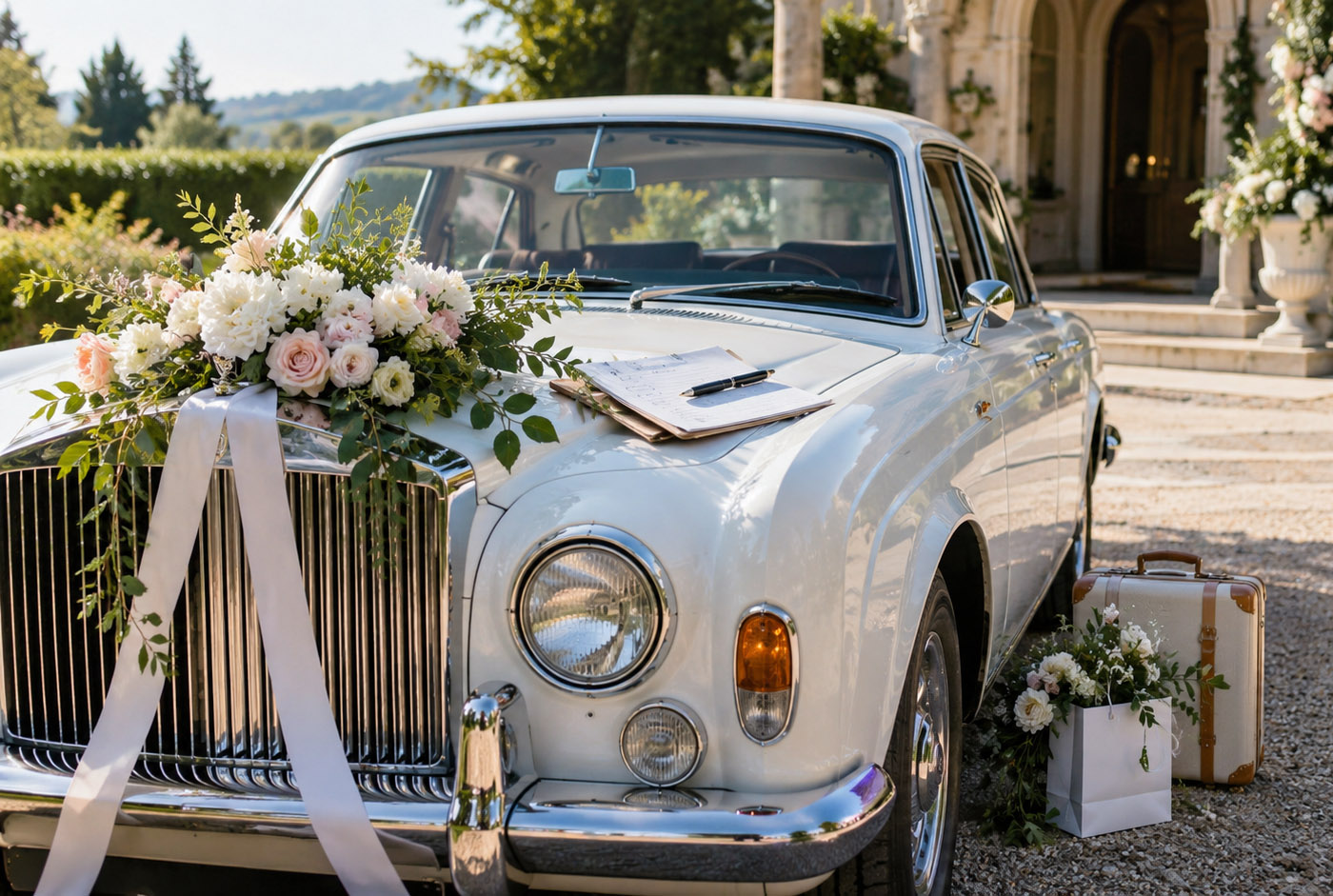
Many couples consider wedding transport unimportant, they think about it after finding the venue, the dress, and the catering. However, it should be the other way around. Transport is the most important logistical aspect of the day. It determines the arrival time of everyone, it determines if the schedule holds up, and it determines how much of the stress you and your suppliers will take on. It should be treated as a business operation with multiple components, and not just a nice vehicle that happens to be in your color palette.
Start With The Timeline, Not The Vehicle
Before you look at a single car, build your run-sheet. Work backwards from the ceremony start time. If the ceremony is at 1pm, your bride needs to be in the car and moving by 12:30 at the latest, which means hair and makeup needs to wrap by 12:00, which means it needs to start early enough to survive an overrun.
This is where most transport plans fall apart. Couples book a car for “1pm pickup” without building in slack. Hair and makeup runs long more often than it runs on time. Photographers ask for five more minutes. Traffic on a Saturday afternoon in summer is never as light as Google Maps predicts. Add a 15-minute buffer at every handoff point in the day – pickup, ceremony, photos, reception arrival – and you’ll absorb the small delays that would otherwise cascade into a genuinely late ceremony.
Your chauffeur should have a copy of this run-sheet, not a verbal summary. A written schedule with addresses, timings, and contact numbers means the driver knows what “on schedule” looks like and can flag problems before they become your problem.
Book Early – Peak Dates Disappear Fast
Reputable local operators are fully booked 6 to 12 months in advance for Saturdays in high summer. If you’re still looking for cars three months from your big day, you’re not choosing from the best, you’re picking from the rest.
This should be a bigger factor with transport than almost any other supplier because local companies operate small fleets. A venue can always hire a marquee to squeeze in extra custom. A florist can bring in agency staff to cope with peak demand. Once a local wedding chauffeur company is driving every car every weekend, there’s nowhere to find a spare vehicle or driver.
Booking early also gives you more power to tweak the contract to suit you and guarantees you a booking before they put their prices up for the annual demand spike. The cost of 90% of your wedding will be the same whether you get married on a Thursday in February or a Saturday in June. For a wedding car, it could be 50% more.
Finally, when you’ve got three suppliers you like in front of you, knowledge of local conditions gives the local guy an advantage over the national chain or internet broker every time. The local company that does a lot of work in your area already knows that there’s a low bridge 17 miles from the church, the best place to pull in for the perfect photo, and that the reception venue with no signs and a half-mile long drive has an easier entrance if you follow the road another mile. Couples in the East of England, for example, are usually better served booking through a specialist that offers Wedding Car Hire Essex, than through a national chain dispatching a driver who’s never seen the venue before.
Assign Vehicles By Group, Not By Guesswork
Many couples think one car, maybe two, can handle everyone. It can’t. Divide your wedding party into groups and assign transport deliberately:
- Bride and father (or whomever is walking her down)
- Groom and groomsmen
- Bridesmaids
- Parents and immediate family
- Wider guests if the ceremony and reception are at separate sites
That’s five entirely separate transport needs, not one. This is how bridesmaids end up begging for rides 20 minutes before the ceremony, or parents are delayed because their journey wasn’t factored in.
If your ceremony and reception sites are more than a stone’s throw apart, guest shuttles are worth the expense. A coach or minibus that shuttles your guests between sites at set times eliminates the headache of 40 cars all trying to park-in on a rural road, and it keeps everyone on the same timetable instead of trickling in an hour late.
Budget It Properly, Not As An Afterthought
Industry experts estimate that couples spend between 2% and 5% of their total wedding costs on transport. Given that the current average cost of a wedding in the UK stands at just over £20,000 (according to the Hitched National Wedding Survey), your wedding vehicle budget is likely to be in the region of £400 and £1,000.
If your quote is significantly lower than the former, you might find yourself with a less-than-ideal vehicle (do you really want to risk that?), a driver working additional hours because of poor route planning, or a vehicle that turns up late because your supplier has cut corners to offer you a good deal. If it’s higher, you could be paying over the odds for a large vintage car fleet you don’t actually need.
Whatever your budget, expect it to be itemised. A single sum quote might seem convenient but it also makes it easy for parts of the bill to be hidden away. Be wary of suppliers that don’t like to reveal the nitty-gritty details until after you’ve signed on the dotted line. It’s your right as a customer to know exactly what you’re paying for before you commit to anything.
Match The Vehicle To The Day, Not Just The Photos
Vintage and classic cars photograph like a dream. They are also far likelier to break down, almost never possess aircon, and pre-1986 won’t have seatbelts for more than two people and often not even for the driver. A 1960s convertible makes for a beautifully stylish tableau in your engagement shoot but on a 30-degree wedding day, a full dressed bride plus layers of skirt, and sheer comfort and safety, a modern executive car with climate control might matter more to you than aesthetics.
None of the above is to argue against vintage cars. None of the above may matter at all to you, and that’s perfectly fair too. It’s just that the equations involved in such decisions tend to work better the more you’re aware there even is a trade-off to be made so you can weigh it up honestly. Some people split the difference between the romantic dream of the old and the mechanized convenience of the new and use a classic for the bridal arrival photos, a modern for the inter-venue move, and perhaps even a getaway car. Ask any supplier what reliability is like, how often it’s gone out on the roads recently, what backup vehicle they’re sending if the classic car won’t start that morning. If they don’t have a clear answer here, that’s not the kind of contractor you want holding your only ride to the ceremony.
Read The Contract Before You Pay The Deposit
This is the boring part nobody wants to read but it’s the clause that causes the most wailing and gnashing of teeth after the event. Look for wait-time fees – what’s the contingency if your guiding hand in marriage overruns by 45 minutes and you’ve booked the car for three hours? Look for mileage caps and viewings, especially if your reception venue is a good hour from the ceremony or you’re having dramatic pre-venue photos halfway up a mountain. Check the cancellation and rescheduling policy, since wedding bookings more than a year in advance have a tendency to be postponed more times than Madonna gigs. And check exactly what’s base and what’s extra – ribbons, champagne, red carpet, extra hours, all of it should be clearly itemized.
If your wedding insurance specifically covers supplier failure, check whether that includes transport. Many policies exclude it, and a car that suffers a breakdown two counties away on the morning of the wedding and doesn’t have to give you your money back is a real risk, not a theoretical one.
Plan The Getaway Car Separately From The Arrival Car
The car used in the morning for photos may not be the one to transport the bridal party to the church service, and so on. Don’t expect the same car and driver to hang around for the endless photo session once everyone has been delivered to the reception. Most cars book by the half-hour with a minimum three-hour charge, others by the hour. Discuss this in advance and communicate the costs to everyone who might be asking for one last scenic spin around the block.
Build A Weather Contingency Before You Need One
Having an open-top and non-air-conditioned classic car is all wonderful and romantic with a beautiful blue sky. They’re just as unbearable in the pouring rain. Would you like to leave this to chance on the morning of your wedding or make a five-minute call with your supplier some weeks before and leave the decision to go with the modern backup car with the driver who’s already been given your alternative route instructions?
Do A Route Recce and Appoint One Point Of Contact
A route recce is simply driving the route you’ve planned in advance and checks things that no map app will flag: roadworks that began last week, a lane so narrow your stretch limo can’t actually turn into it, a car park that’s full by 11am on Saturdays. For rural or semi-rural venues, this is probably worth the hour it’ll take.
Finally, appoint one person – not you, not the couple, not one or other set of parents mid-ceremony – as the single point of contact for the transport side on the day. Give the chauffeurs their number. If a car’s running late, if a group needs to be reshuffled, if the getaway car needs to move up by ten minutes, that’s the person who takes the call and makes the call, so you’re not doing it in your dress with a bouquet in one hand.
Get these right and transport isn’t something you’re worried will go wrong on the day. It’s the one part of the day you won’t even think about – it’ll just work, and people will magically be where they’re meant to be (and, critically, when they’re meant to be there) all day.