Campaign Directors know the frustration of trying to squeeze more out of a flat-rate donation model. Asking supporters for the exact same basic contribution year after year inevitably leads to donor fatigue. You end up hitting a strict revenue ceiling because you aren’t giving people a compelling reason to increase their giving.
The answer to this stagnation is a structured, tiered brick fundraiser. This model transforms a simple request for money into a tangible opportunity for supporters to claim a physical piece of your cause. Donors aren’t just writing a check; they are securing a permanent, visible place in your community space.
Building a highly profitable campaign ultimately comes down to strategy and providing options. Utilizing different sizes of engraved bricks, setting smart pricing benchmarks, and offering replica keepsakes allows you to maximize total revenue. When you align these elements correctly, you build a comprehensive fundraiser that appeals to everyone from local families to major corporate sponsors.
The Foundation: Why Tiered Giving Works in Brick Campaigns
Why should you bother creating multiple donation levels in the first place? When you give people distinct options, you actually reduce their hesitation to donate. Clearly defined tiers help supporters immediately identify where their financial capabilities fit into your overall campaign.
Instead of staring at a blank donation form, supporters see exactly what their money buys. Donation tiers improve the giving process by making decisions easy, spotlighting the impact, and building trust. By presenting a clear menu of giving options, you remove the guesswork and guide them toward a specific commitment.
Tiered giving also strikes a perfect balance between exclusivity and inclusivity. Higher tiers offer prominent recognition that appeals to major donors wanting a substantial legacy. At the same time, lower tiers keep the campaign entirely accessible to the everyday community members who want to participate.
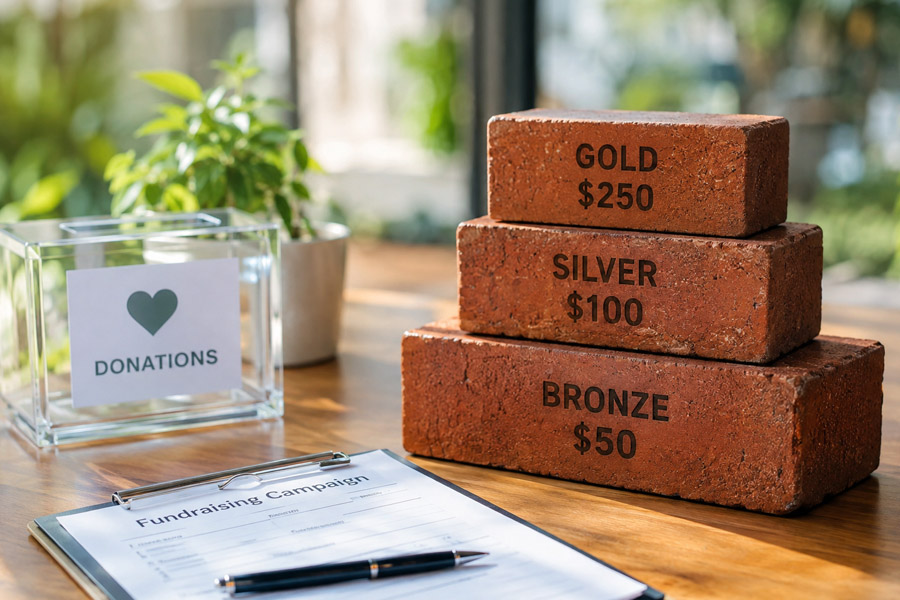
These psychological giving brackets map flawlessly to physical products in a way that digital campaigns simply cannot match. Instead of just naming your giving levels “Gold” or “Silver,” you represent them with actual, tangible objects.
Using Physical Brick Sizes to Differentiate Levels
Physical size is the most visible way to differentiate giving levels in a public space. When a donor walks past your installation, the distinction between a standard brick and a massive, custom paver is immediately obvious. This visual hierarchy naturally encourages supporters to aim for a larger donation if their budget allows.
When structuring your campaign, you can offer standard and large dedication sizes to accommodate your entire donor base. A smaller brick works perfectly for an individual or family honoring a loved one. Meanwhile, a larger paver gives corporate sponsors the premium real estate they expect in return for a significant check.
This modular approach simplifies the design of walkways, patios, or commemorative walls. The varied sizes fit together organically to visually represent the community’s combined support. Planners can easily weave standard bricks around larger anchor pavers to create stunning, cohesive architectural patterns.
Building Your Campaign Tiers: Pricing and Strategy
A successful brick campaign usually splits into two distinct categories. You need a volume-driven community tier and a high-yield sponsorship tier. Separating your strategy into these two buckets ensures you capture every possible dollar available in your network.
Clearly defining these categories makes the giving process incredibly straightforward for your donors. They can look at the options and instantly understand the scale of impact their gift will make on your organization.
Setting up these distinct levels requires understanding the specific motivations behind different types of donors. Let’s break down the exact strategies for structuring your grassroots and premium offerings.
The Grassroots Tier (Standard 4×8 Bricks)
Community campaigns live and die by widespread participation and sheer volume. You need an accessible entry point that invites as many people as possible to join the cause. When an entire neighborhood feels invited to participate, the momentum of your fundraiser grows exponentially.
If your starting price is too high, you risk alienating the vast majority of your potential donor base before they even open their wallets. Standard 4×8 bricks serve as the ideal product for this accessible entry point. They typically allow for up to three lines of text, giving families or individuals just enough space to leave a meaningful message. This standard size keeps your production costs low while providing an emotionally satisfying reward for the donor.
The Premium Tier (8×8 Bricks & Corporate Sponsors)
While volume is wonderful, major gifts are what ultimately push your campaign past its fundraising goals. Yet, many organizations drop the ball when it comes to engaging high-net-worth individuals and local businesses. They ask for corporate money but offer the exact same recognition they give to a twenty-dollar donor.
Research shows that 58% of nonprofit leadership and staff admit their organizations lack a solid strategy for treating major donors uniquely. You have to offer them something distinctly different from the standard community option.
Premium 8×8 dedication bricks solve this exact problem beautifully. They provide prominent, eye-catching space for custom central clipart, family crests, or corporate logos. When a local law firm or dealership sees they can get their actual logo engraved in a high-traffic area, the donation transforms into a smart marketing investment.
Offering this high-visibility tier is vital for major donor retention. It builds stronger corporate relationships by giving businesses a permanent piece of community advertising they can be proud to show off.
Setting Your Benchmark Prices
One of the most common questions Campaign Directors ask is exactly how to price these different brick sizes. You want to maximize profit margins without accidentally pricing your loyal community out of the project. Finding the right balance requires looking at what similar organizations are successfully charging.
You should adjust these baselines according to your specific demographics and overall fundraising goals. A private school in an affluent suburb might easily charge $300 for a standard brick, while a rural community park project might stick closer to the $100 mark.
Expanding Margins: Upselling with Replicas and Mini-Bricks
Once your main tiers are firmly established, you can explore ways to increase the average donation amount without taking up any extra physical installation space. Site space is often limited, so generating revenue from non-installed items is a massive advantage.
Replica keepsakes and mini-bricks act as the perfect auxiliary revenue stream. You can offer full-size identical replicas or smaller felt-backed versions of the installed brick. Donors love having a physical reminder of their contribution sitting on their desk or mantle at home.
The best strategy is to present these scaled replica packages during the checkout process as an immediate upsell. Since the donor is already highly engaged in customizing their message, adding a personal keepsake feels like a natural next step. You simply ask, “Would you like a matching replica to keep at home?” right before they enter their payment details.
These drop-shipped items are especially effective for engaging out-of-town donors. Even if an alumni or former resident never visits the physical site, they can keep a paperweight or desk accessory that connects them to the cause. It guarantees they get to enjoy their brick regardless of where they live.
Protecting Your Legacy: The Importance of Durability and Engraving Methods
A successful campaign doesn’t end when the final brick is laid into the ground. You have to consider future maintenance costs and how the installation will reflect on your organization’s reputation a decade from now. If your beautiful walkway turns into a crumbling mess, your donors will lose trust in your organization.
Donors naturally worry about harsh weathering, fading paint, or illegible lettering. If a family pays for a memorial brick to honor a passed loved one, they expect that legacy to remain pristine. Ensuring the materials and engraving methods hold up is a promise you make to your supporters.
Traditional sandblasting and surface painting methods simply do not hold up over time. Paint inevitably chips, peels, and requires expensive re-application as the seasons change and foot traffic wears down the surface. You do not want to be stuck paying for touch-ups out of your operational budget five years down the line.
Patented laser engraving technology offers a permanent, worry-free alternative. Laser engraving physically alters the brick material to create dark, high-contrast marks that will never wash away or degrade. These bricks require only mild cleaning, guaranteeing a lasting legacy that honors your donors’ investments forever.
Conclusion
A carefully tiered brick campaign does more than just raise immediate funds. It maximizes both grassroots community engagement and major sponsor revenue by giving everyone a designated place in the project. You stop relying on the same flat-rate donations and start offering a dynamic, rewarding experience.
When you combine smart pricing benchmarks, tangible add-ons, and laser-engraved durability, you create a fundraiser that donors are truly proud to be part of. The clear options remove hesitation, while the physical product provides an unmatched sense of ownership.
Long after the fundraising goal is met, your brick installation will remain. It leaves a lasting physical legacy that visibly celebrates the community that built your organization.