Pneumatic systems are widely used in manufacturing environments to operate cylinders, actuators, valves, and automated equipment. Although these systems may appear straightforward, the condition and accessibility of their connections can influence maintenance efficiency and equipment reliability.
For industrial maintenance teams, replacing damaged tubing or modifying an air circuit should be a controlled, repeatable process. Connections that are difficult to access or require extensive disassembly can complicate otherwise routine servicing.
Push-to-connect pneumatic fittings offer a practical connection method for many compressed air applications. Their design allows technicians to install and remove compatible tubing without using conventional compression nuts or separate tubing clamps.
Understanding how these fittings operate, where they are appropriate, and what installation conditions require attention helps maintenance personnel make informed component decisions.
How Push-to-Connect Connections Work
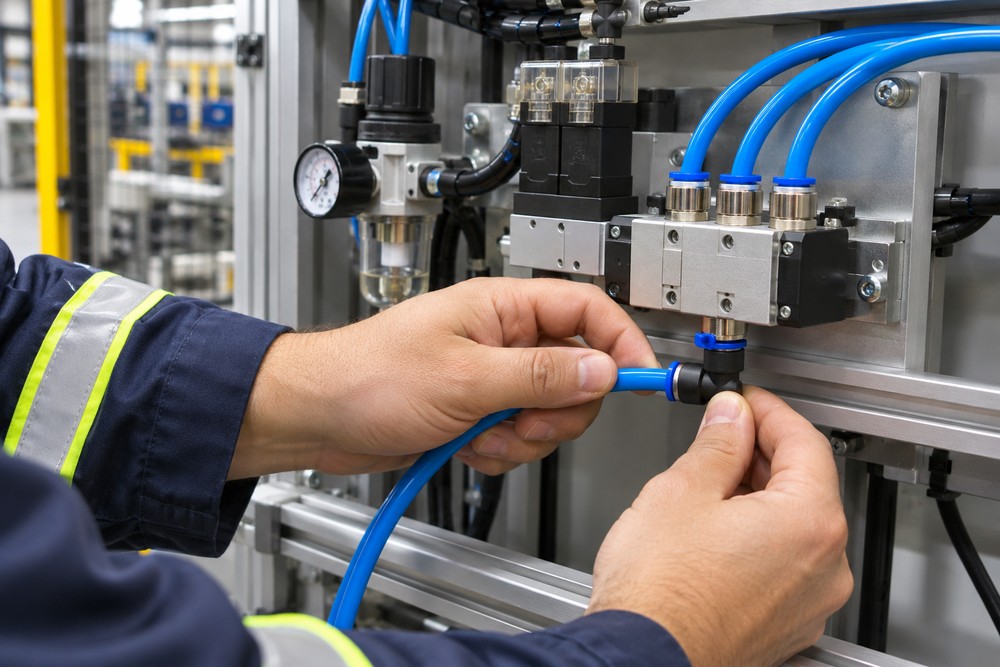
Push-to-connect fittings use an internal gripping mechanism and sealing element to secure pneumatic tubing.
During installation, a technician inserts a properly prepared tube into the fitting until it reaches the required insertion depth. An internal gripping ring holds the tubing in position, while a seal helps prevent compressed air from escaping.
To remove the tubing, the system must first be safely isolated and depressurized. The technician then presses the fitting’s release collar, sometimes called a collet, while withdrawing the tube.
This connection method reduces the number of assembly steps required at the tubing interface compared with some conventional fitting designs.
However, the fitting may still have a threaded connection where it attaches to a valve, cylinder, manifold, or other component. Proper installation of that threaded connection remains necessary.
Pneumatic fittings of this type are commonly used in:
- Automated production machinery and assembly equipment
- Pneumatic control panels and valve manifolds
- Packaging and material-handling systems
- Machine-building projects requiring multiple air connections
- Equipment with replaceable pneumatic tubing sections
Their suitability depends on the pressure, temperature, tubing, and mechanical conditions involved.
Making Tubing Replacement and Machine Servicing More Practical
Routine industrial maintenance often involves identifying air leaks, replacing worn tubing, and restoring connections after equipment repairs.
In these situations, connection accessibility matters.
A technician working inside a compact machine enclosure may have limited space for tools. Push-to-connect fittings can simplify certain servicing tasks because tubing can be released and reinstalled without loosening a compression nut at each tubing connection.
This can be particularly useful when replacing a damaged section of pneumatic tubing or disconnecting a component for inspection.
For example, a maintenance technician replacing a pneumatic actuator may need to disconnect two air lines, remove the actuator, install its replacement, and reconnect the tubing. Where compatible push-to-connect connections are used, this process involves fewer tubing-connection assembly steps.
The same principle applies when machine builders modify pneumatic circuits during equipment upgrades.
However, easier disconnection does not eliminate the need for inspection.
Technicians should examine tubing ends for scratches, deformation, contamination, or previous gripping damage before reconnecting them. A damaged tube section may need to be cut back or replaced to achieve an effective seal.
Maintenance procedures must also require appropriate isolation, depressurization, and verification of stored energy before any pneumatic connection is opened.
Pneumatic Fitting Selection and Tubing Compatibility
Choosing a fitting involves more than matching its general appearance to an existing component.
Effective pneumatic fitting selection begins with confirming tubing dimensions and the operating requirements of the equipment.
The outside diameter of the tubing must match the fitting’s specified connection size. Metric and imperial dimensions should not be treated as interchangeable simply because they appear similar.
Tubing material also matters. Polyurethane, nylon, and other pneumatic tubing materials have different flexibility, hardness, temperature characteristics, and pressure limitations. Not every fitting is approved for every tubing material.
Operating pressure and temperature should be checked against the manufacturer’s specifications, including any reductions in allowable pressure at elevated temperatures.
Other selection considerations include fitting body material, thread type, sealing method, exposure to lubricants or chemicals, and the available installation space.
For Canadian maintenance teams and machine builders reviewing component options, Canada Pneumatics Inc. provides push-to-connect fittings for industrial applications as part of its pneumatic connection component offering.
Regardless of the supplier, maintenance personnel should verify the specific fitting’s technical information before installation.
Connection configuration also deserves attention. Straight connectors, elbows, tees, and threaded adapters serve different routing requirements. The correct configuration should allow tubing to run without excessive bending, twisting, or contact with moving machinery.
For equipment operating in Ontario manufacturing environments, conditions such as temperature variation, machine vibration, and exposure to industrial fluids may influence component selection.
A fitting that works reliably in a protected control cabinet may not be appropriate for an exposed or mechanically demanding installation.
Avoiding Installation Problems and Inspecting Compressed Air Connections
Even correctly selected fittings can develop problems when installation practices are inconsistent.
One common issue is poorly prepared tubing.
Tubing should be cut squarely using an appropriate cutting tool. Angled or damaged ends may prevent proper seating against the internal seal.
Another problem is incomplete insertion. If the tubing does not reach the required depth, the connection may leak or have inadequate retention.
Technicians should follow the manufacturer’s installation instructions and perform an appropriate retention check after assembly.
Mechanical stress is another consideration.
Unsupported tubing, tight bend radii, and repeated movement can place unnecessary loads on fittings. On vibrating equipment, suitable routing and support help limit stress at connection points.
Maintenance inspections should consider several practical questions:
- Are the tubing ends fully inserted and properly retained?
- Are there visible cracks, abrasions, or signs of tubing deformation?
- Is the tubing exposed to repeated pulling, bending, or vibration?
- Are fittings and tubing suitable for the system’s operating conditions?
- Are there audible leaks or other indications of air loss?
Leak detection should follow approved plant procedures and may involve suitable leak-detection equipment or solutions.
A leaking connection should not automatically be repaired by repeatedly reinserting the same damaged tubing. The tubing, fitting, and surrounding installation conditions should be evaluated to identify the cause.
It is also important to recognize that push-to-connect designs are not suitable for every application. Compression fittings, barbed connections, and other connection methods may be preferable where specific mechanical, environmental, or equipment requirements apply.
For maintenance planners and machine builders, connection reliability begins during component selection and continues through installation, inspection, and replacement.
When fittings are matched to compatible tubing and used within their specified operating limits, push-to-connect connections can make routine pneumatic servicing more manageable.
The practical objective is not simply faster assembly. It is to create compressed air connections that are accessible, correctly installed, and appropriate for the equipment throughout its working life.