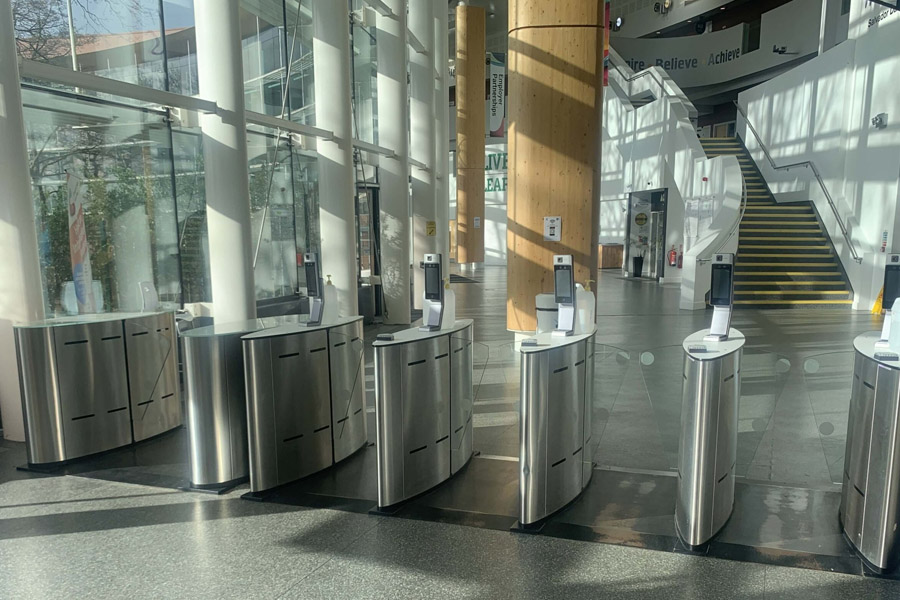
Why the Front Door Dictates Comfort More Than the Boiler Room
Busy facilities lose comfort. This is most evident at apertures where people and commodities cross inside-out. Well-tuned chillers cannot outmuscle a poorly handled entrance that gasps every minute. Consider each door a guardian. If slow, misaligned, or insufficiently insulated, it pulls conditioned air out and unconditioned air in like a siphon. Good gatekeeping makes the rest of the system stable rather than heroic.
Stack Effect and Building Pressure: The Invisible Hand
Air moves for unknown reasons. Warm air rises, creating stack effect pressure. Wind builds air on windward walls and pulls it from leeward ones. Exhaust fans, kitchen hoods, and relief vents change building pressure. Inside that invisible tug of conflict are entrances.
A modest positive building pressure at the inhabited level, 0.02 to 0.05 inches of water column, prevents cold or hot outside air from entering when doors swing. Too much positive pressure blows conditioned air out every door that opens. Insufficient protection allows infiltration through cracks and thresholds. Tuning supply, return, and exhaust around entrances controls door resistance.
Vestibules, Airlocks, and Revolving Doors: Designing a Buffer Zone
A single leaf that opens direct to the outdoors asks the HVAC to sprint all day. A buffer changes the game.
- Vestibules: Two sets of doors with a neutral zone between them break the exchange into smaller gulps. Size that space so both doors are not open at once during peak flows. Eight to twelve feet of depth is a useful starting point for retail and office lobbies. Seal the vestibule to the exterior, seal it to the interior, then control it as its own pressure zone.
- Airlocks with interlocks: In warehouses and labs, interlock the two doors so only one can be open at a time. Add visual cues and fast operators so users are not tempted to prop a door.
- Revolving doors: For high pedestrian volume, a properly sized revolving door behaves like a mechanical airlock. Add a code compliant swing door nearby for accessibility and large items, then coach staff not to default to the swing leaf for routine passage.
- Cold storage ante rooms: For freezers and coolers, use two rapid doors separated by a short conditioned space, with heated thresholds and anti-sweat frames to control frost and condensation.
Smarter Door Hardware and Speed: Cut the Open Time, Cut the Loss
Energy rides out on seconds. Shave them.
- High speed operators: Fast cycling roll ups or sectional doors cut exposure. A change from a 7 second cycle to a 3 second cycle across 1,000 openings in a shift trims more than an hour of open time each week at a single door.
- Adaptive closers: Closers that modulate speed based on wind load and user behavior keep safety and speed in balance. Add hold open logic only when traffic is continuous. Otherwise default to closed.
- Tight seals: Door sweeps, perimeter gaskets, and level thresholds do quiet work. Inspect them like you would belts and filters. Replace when compressed or torn.
- Vision panels and proximity sensors: Give users sightlines so they do not hesitate at the threshold. The fewer pauses, the shorter the dwell.
Loading Docks: Taming the Biggest Thermal Leaks
Docks are the front doors for pallets, and they are often the largest thermal wound.
- Seals and shelters: Match the dock seal or shelter type to trailer variety. Good compression seals reduce the daylight you see around a trailer, and daylight is a proxy for infiltration.
- Vertical storing levelers: Store the leveler upright so you can close the dock door tight to the pit face. Insulate the pit walls and cover gaps around the lip and curb angles.
- Trailer restraints and signals: Keep the door closed until the trailer is locked. Use lights to communicate status so staff do not open early.
- Zoned air distribution: Do not dump warm air right at the door on a cold day. Supply air a few bays back, then use low speed fans to pull that air gently toward the work zone. You temper the dock without wasting heat out the opening.
- Cold chain practices: For refrigerated docks, add strip curtains or automated bi fold vinyl barriers inside the primary door. Heat trace thresholds and install low temperature rated operators to avoid slow cycles.
Air Curtains That Actually Work: Selection and Setup
Air curtains can be force fields or noise makers. The difference lies in sizing and alignment.
- Mount height and width: Choose units that can continuously pour across the opening. For pedestrian doors, 400–600 feet per minute at the floor line is usual. Performance data should indicate floor level velocity and temperature rise for taller industrial doors.
- Nozzle aim: Aim the discharge slightly outward on windward doors to resist infiltration. Keep the stream uniform, with no gaps at the jambs.
- Controls: Interlock to the door so the curtain runs only when the door opens, or runs low when closed and high when open. Add a heat option where comfort is critical, but treat it as a shield, not as primary heating.
- Commissioning: Use smoke pencils to visualize the stream. If the plume breaks or drifts, adjust louvers and pressure.
Wind, Site Planning, and Microclimates Around the Door
Outside air behaves like water in a stream. Boulders, banks, and eddies change its speed and direction. You can create quiet water at entries.
- Canopies, alcoves, and screens: Recess doors or add canopies to disrupt direct wind pressure. Low landscape walls and plantings can redirect gusts away from the threshold.
- Orientation: Where options exist, avoid placing main entries squarely into prevailing winds. Side entries, or entries tucked behind building wings, reduce pressure spikes.
- Snow melt and drainage: Water at the threshold drives heat loss by evaporation and can freeze doors. Keep mats dry, drains clear, and radiant mats on in winter.
Zoning, Sensors, and Controls: Teach the HVAC to Anticipate Traffic
A responsive system wastes less while feeling better.
- Door contacts and analytics: Count openings and aggregate open time by hour. Use that signal to tighten vestibule temperature bands, pause economizers during peak in and out traffic, or bias nearby VAV boxes slightly warmer in winter and cooler in summer.
- Humidity and latent load: In humid climates, doors let in moisture that the system must wring out. Add dehumidification capacity near high use entrances, and coordinate with air curtain heat to avoid creating condensation at the sill.
- Demand driven ventilation: Separate ventilation air for the entry zone from the deep interior. When traffic spikes, ventilate the lobby without over ventilating the whole floor.
Maintenance Habits That Protect the Envelope
Thermal control is not a set and forget feature.
- Quarterly checks of seals, sweeps, hinges, and tracks
- Rebalance pressure when seasons change and wind patterns shift
- Clean air curtain intakes and verify electrical interlocks
- Inspect dock pits for gaps and deteriorated foam
- Calibrate door closers to target closing times and latching force
Small fixes here routinely save more energy than big setpoint tweaks.
Metrics That Matter: How to Know You Are Winning
You cannot manage what you do not measure. Useful markers include:
- Average door open time by entrance and by hour
- Total open minutes per day per door
- Temperature and humidity drift within 15 feet of entrances
- Pressure differential between interior and exterior at entry height
- Heating and cooling energy intensity at similar outdoor conditions before and after changes
Even a two second reduction in average open time at a busy door can cut thousands of cubic feet of unwanted air exchange per day. You feel it as steadier comfort. You see it as flatter load curves.
Mini Scenario: Turning a Drafty Lobby Into a Neutral Zone
A nine story office with a street level lobby struggled every winter. Guests felt a chill at the reception desk, and the first floor thermostat never seemed satisfied. The fix did not require a new boiler.
The team extended the vestibule to 10 feet, added interlocks so both doors were rarely open at once, and replaced sweeping decorative mats with low resistance grates and a heated threshold to dry the sill. A right sized air curtain, aimed slightly outward, now runs only when the outer leaf opens. Supply air that once blasted at the glass was moved deeper into the lobby, with a small dedicated dehumidifier to temper shoulder seasons. Building pressure was reset to 0.03 inches of water column at the lobby. Finally, the controls contractor tied door contact data to the lobby VAV boxes and economizer logic.
Result: lobby temperatures vary less than 2 degrees through a winter day, foot traffic flows without hesitation, and heating energy on design days dropped noticeably at the meter. The gatekeeper got its tools back.
FAQ
How big should a vestibule be for a busy entrance?
Aim for enough depth that two people groups can pass without both sets of doors standing open at once. For offices and retail, 8 to 12 feet is a practical range. Wider doors or higher traffic may call for more width rather than more depth. Treat the vestibule as its own pressure zone with tight seals on both sides.
Are air curtains better heated or unheated?
Depending on use situation. If properly scaled and targeted, unheated curtains can block many uses. In cool, damp weather, heated units minimize moisture and increase door comfort by cutting the apparent draft. Air curtains should not be primary heaters. It protects interior loads.
What pressure should I target at the main entrance?
A slight positive pressure is usually best so outside air does not slip in whenever a leaf moves. A common target is 0.02 to 0.05 inches of water column at the occupied level. Verify with a manometer at the doorway. Adjust supply, return, and exhaust to maintain it under typical wind conditions.
How do I know if my air curtain is set up correctly?
Take a smoke pencil or theatrical fog and watch the stream. With no side gaps, it should reach the floor uniformly and not be carried indoors by wind or stack effect. For pedestrian doors, measure 400–600 feet per minute floor level velocity. If flow stops, modify nozzle angle, discharge pressure, or unit size.
What is the best strategy for loading dock heat loss?
Seal first. Use dock seals or shelters to block trailer light. Vertical storing levelers ensure a tight bay door seal when idle. Keep doors closed until restraints activate. Use low-speed blowers to gradually flow air toward the work area and temper the dock from inside. Insulate cold storage with vinyl barriers and heated thresholds.
Can controls really react fast enough to door openings?
If you send the appropriate signals. Every cycle, door contacts might notify the building automation system. This data can be used to bias the nearest HVAC zone, suspend economizer operation during traffic, or change air curtain timing. Total open time statistics will influence setpoint and scheduling modifications for days and weeks.
Do revolving doors always outperform sliding doors for energy?
A well-sized and maintained revolving door minimizes air exchange better than a sliding or swinging door in high-traffic areas. You still need an accessible swing door nearby. Fast-acting swing doors with a vestibule may be better for sites with many carts. Consider flow, accessibility, and climate, then determine the design that keeps doors closed most of the time without blocking movement.