Electrical Panel Capacity, Load Calculations, and Safety Hazards
Our homes rely more and more on electricity. From new appliances to charging electric vehicles, our power needs are growing fast. Many older electrical systems in our communities simply can’t handle these new demands. This often leads to tripped breakers, flickering lights, or worries about safety. Understanding when and why you need home electrical upgrades is key. It helps keep your home safe, efficient, and ready for tomorrow’s technology.
To learn more about preparing your home for the future, explore our guide. When you’re ready to take the next step, schedule your consultation for home electrical upgrades.
This guide will show you everything about making your home’s electrical system better. We will cover how to spot old or unsafe panels and wiring. We will explain how much power your home needs, from 100 amps to 400 amps. You’ll learn about adding things like EV chargers and heat pumps. We will also look at smart panels and ways to manage your power. Navigating these changes requires careful planning and often the expertise of professionals who understand comprehensive electrical services. We’ll also discuss important safety updates, permits, and how to pay for these upgrades.
Ensure your home is safe and ready for the future by scheduling your consultation today.
The electrical panel, often called the breaker box, is the heart of your home’s electrical system. It distributes power from the utility connection to every circuit in your house. When this panel is old, undersized, or faulty, it can lead to serious issues, including overloaded circuits, frequent breaker trips, and even electrical fires. Understanding your main breaker ratings and the overall capacity is crucial for ensuring safety and preventing issues down the line.
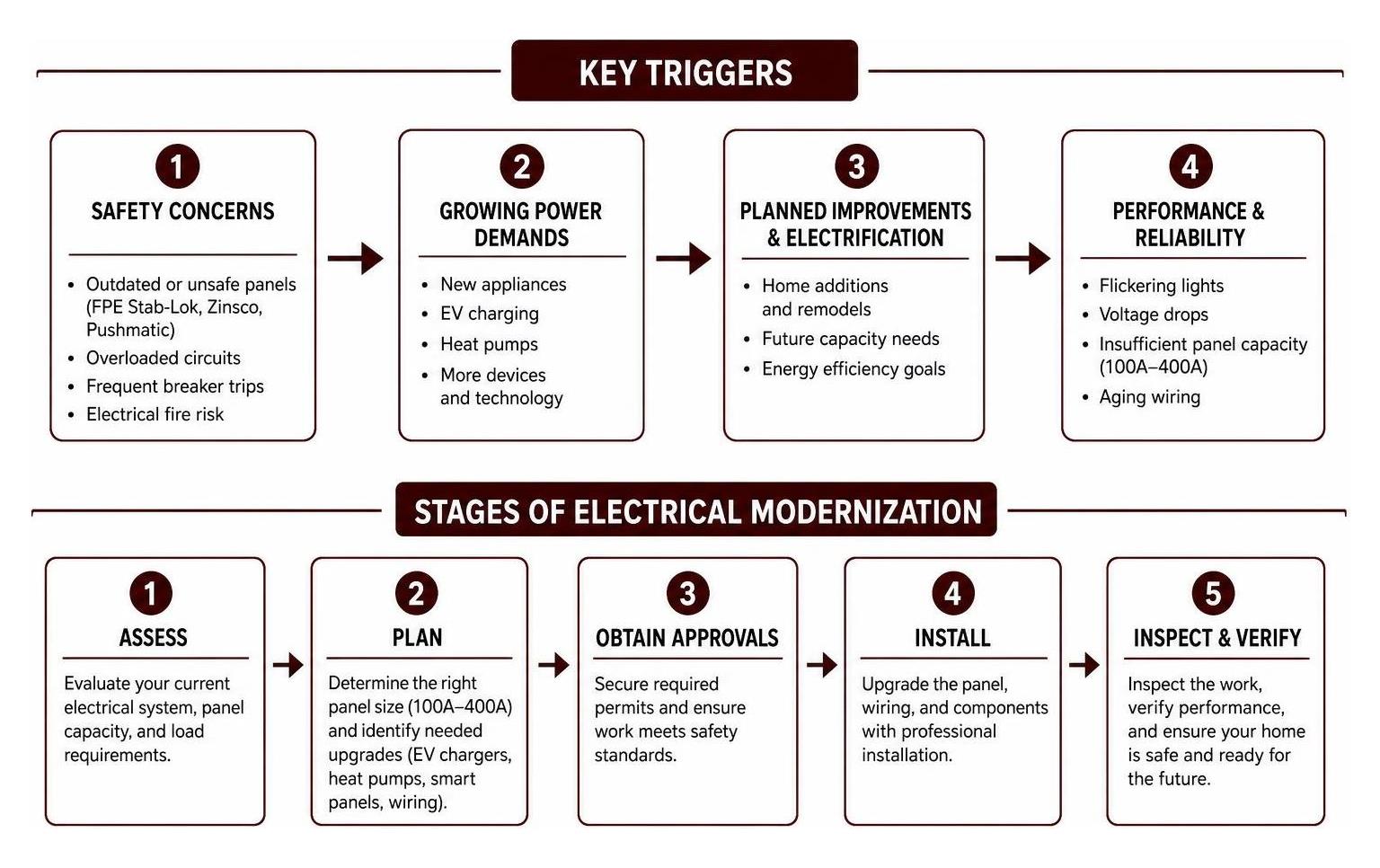
We often find that homeowners only consider an electrical panel upgrade when they encounter persistent problems or plan a major addition. However, there are clear indicators and proactive reasons to consider this essential home improvement. The decision to upgrade is multifaceted, balancing current needs with future electrification goals.
Identifying Outdated Panels and Hazardous Wiring
One of the most critical reasons for an electrical panel upgrade is the presence of outdated or inherently unsafe equipment. Certain brands and types of panels have a documented history of safety failures. For instance, Federal Pacific Electric (FPE) Stab-Lok panels are notorious for breakers that fail to trip when overloaded, posing a significant fire hazard. Similarly, Zinsco and Pushmatic panels are largely obsolete, with Zinsco breakers known to weld shut and melt bus bars, and Pushmatic lacking readily available replacement parts. If your home has one of these, we strongly recommend a professional inspection and likely replacement.
Beyond the panel itself, older wiring can present serious safety concerns. Homes built before the 1950s might still have knob-and-tube wiring, which lacks a ground wire and can become brittle. Cloth-insulated wiring from the mid-20th century can also degrade, exposing live wires. Ungrounded circuits are common in older homes, meaning outlets only have two slots instead of three, preventing modern appliances from being properly grounded. Furthermore, some homes built between the 1960s and 1970s used aluminum conductors for branch circuits, which can expand and contract differently than copper, leading to loose connections, arcing, and fire risks. Fuse boxes, while not inherently unsafe if properly maintained, are often indicative of an older system that may struggle with modern electrical loads and warrant an upgrade. If you notice signs like flickering lights, warm outlets, or the smell of burning plastic, these could be signs that your home’s wiring or electrical system needs an upgrade beyond just the panel.
NEC Load Calculations and Panel Sizing: 100A vs 200A vs 400A
Determining the right size for your electrical panel is not a guessing game; it’s based on precise calculations outlined in the National Electrical Code (NEC). Specifically, NEC 220.82 (for existing dwellings) and NEC 220.83 (for new construction or major additions) provide methodologies for calculating your home’s total electrical load. These “load calculations” consider all your existing and planned electrical demands, helping us determine if an upgrade is necessary and what capacity is required.
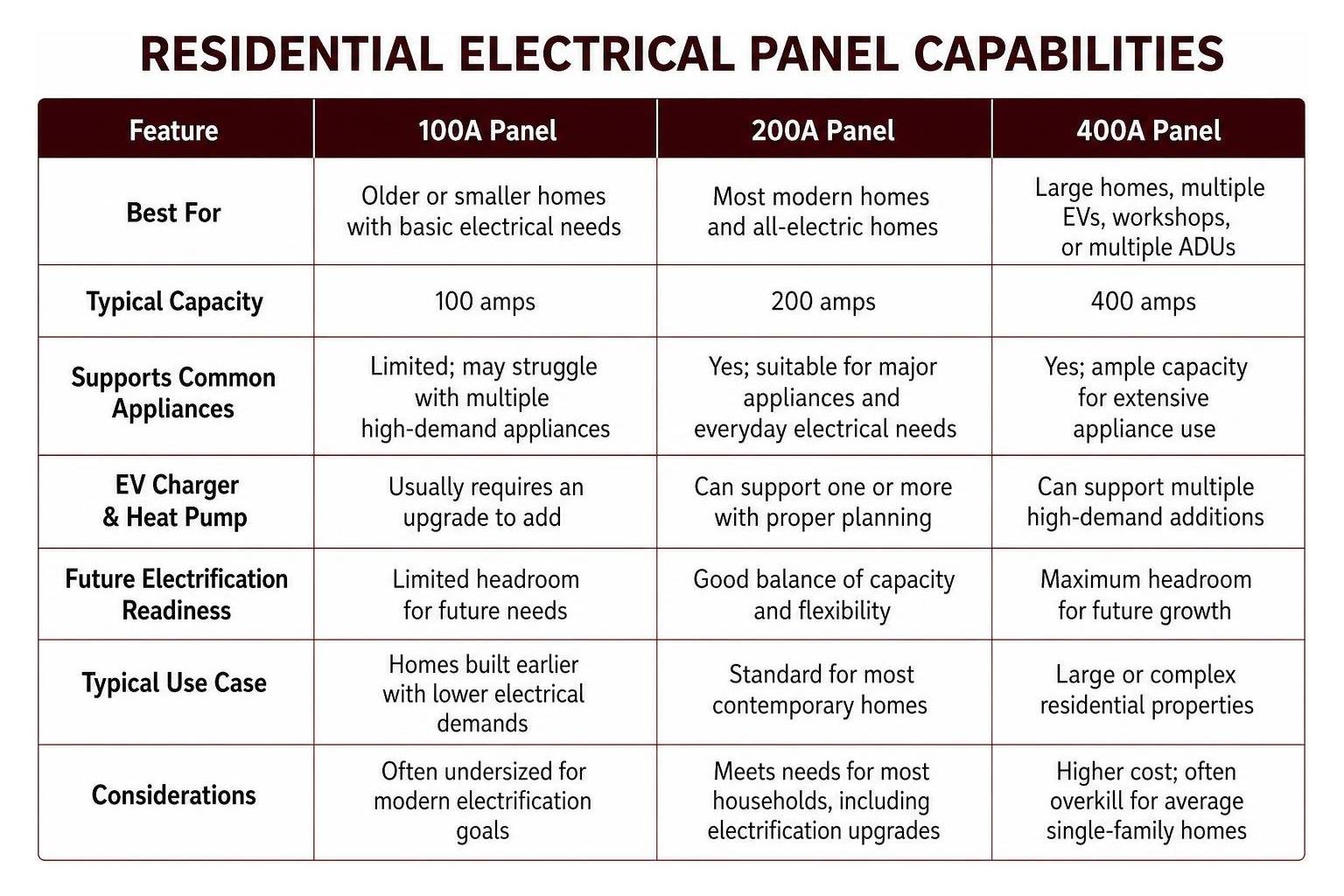
A 100-amp (100A) panel was once standard, but today, it often struggles to meet the demands of modern households, especially if you’re considering electrification. Homes with 100A service or less usually require an upgrade if they plan to add major new appliances. A 200-amp (200A) panel has become the standard for most contemporary homes. It typically provides sufficient capacity for a family to run common appliances, central air conditioning, and even some electrification additions like an EV charger or a heat pump. Most all-electric homes, for instance, find a 200A panel to be sufficient.
A 400-amp (400A) service is less common for single-family homes and is usually reserved for very large residences, homes with multiple high-demand electric vehicles, extensive workshops, or properties with multiple accessory dwelling units (ADUs). While it offers significant headroom, it’s often an overkill for the average household and comes with a considerably higher investment. When planning, we also consider continuous loads, which are loads expected to run for three hours or more, and the 80 percent demand limit, meaning circuits should ideally not be loaded beyond 80% of their rated capacity for continuous operation. This ensures safety and longevity of the system.
Here’s a general comparison of typical residential panel capabilities:
| Panel Size | Typical Use | Considerations |
|---|---|---|
| 100A | Older homes and households with relatively modest electrical demand | May struggle with major new electric appliances or multiple electrification upgrades. |
| 200A | Most contemporary homes and many all-electric homes | Typically supports common appliances, central air conditioning, and additions such as an EV charger or heat pump. |
| 400A | Very large homes, multiple high-demand EVs, extensive workshops, or properties with multiple ADUs | Provides significant capacity but is often more than the average household needs and requires a higher investment. |
Essential Home Electrical Upgrades for Modern Electrification
As we move towards a cleaner energy future, many homeowners are embracing the clean energy transition by electrifying their homes. This means replacing fossil fuel-powered appliances with electric alternatives. These appliance electrification efforts, while beneficial for the environment and often long-term energy savings, place new demands on your electrical system, frequently requiring circuit dedication for specific high-draw items.
Integrating EV Chargers, Heat Pumps, and Clean Energy
Integrating new, high-demand electric appliances is a primary driver for electrical upgrades in September 2026. Level 2 EV chargers, for instance, typically require a dedicated 240V circuit, often pulling 40-50 amps. Installing a NEMA 14-50 outlet for an EV charger is a common upgrade that ensures safe and efficient charging. Similarly, cold-climate heat pumps, which are gaining popularity for their energy efficiency in both heating and cooling, require substantial dedicated circuits.
Other electrification efforts include replacing gas ranges with induction cooktops and traditional water heaters with electric water heaters, both of which also demand significant power. For homes with solar PV interconnection or plans for battery storage, the electrical panel becomes even more critical, as it needs to safely manage power flow in multiple directions. Many homeowners wonder if they can electrify their home without a panel upgrade. The answer is often yes, with careful planning and appliance selection. For example, some lower-kilowatt EV chargers can operate within existing capacity, or smart load management devices can be employed. However, for a truly future-proof and robust system, especially with multiple electrification projects, an upgrade is frequently the most reliable path.
Smart Panels and Alternative Load Management Solutions
For those looking to electrify without immediately committing to a full panel upgrade, or simply to optimize their existing system, smart panels and alternative load management solutions offer innovative options. Smart panels, sometimes referred to as smart circuit breakers, can intelligently monitor and manage electrical loads in real-time. They can prioritize power to critical appliances and even perform automatic load shedding during peak demand, ensuring you stay within your panel’s capacity.
Energy management systems and circuit sharing devices are also excellent tools. For example, a device might allow your EV charger and electric dryer to share a single circuit, ensuring only one operates at full power at a time. This can significantly reduce the peak load on your panel, potentially helping you avoid a costly service line upgrade or deferring a full panel replacement. These technologies are particularly valuable for mitigating grid strain by distributing demand more evenly. While a smart panel itself can represent an investment, it can often be a more cost-effective solution than a full service upgrade, particularly when the main service from the utility company would involve significant infrastructure changes.
Planning, Permitting, and Executing Electrical System Projects
Undertaking an electrical upgrade is a significant project that requires careful planning, adherence to local regulations, and professional execution. It’s not a DIY task due to the inherent dangers and complexities involved. The process typically involves coordination with the local Authority Having Jurisdiction (AHJ) for permits and inspections, as well as coordination with your utility company for service disconnects and reconnects.
Evaluating Home Electrical Upgrades for Renovations and Remodels
If you’re planning a home renovation or remodel, it’s the ideal time to assess and upgrade your electrical system. Major projects like kitchen expansions, bathroom remodels, or adding accessory dwelling units (ADUs) often introduce new high-demand appliances and circuits. It’s far more efficient and cost-effective to address electrical upgrades when walls are already open for other work, saving on labor costs and minimizing disruption. For instance, installing new wiring or a subpanel during an open-wall wiring phase of a kitchen remodel is significantly easier than retrofitting later.
Many jurisdictions, especially in places like California with Title 24 standards, have specific electrical requirements for new construction and major renovations, including mandates for EV-ready circuits. Planning your panel upgrade as part of a renovation ensures compliance and future-proofs your home. For those building luxury personalized residences, meticulous electrical planning is paramount to support advanced smart home systems, high-end appliances, and future technologies without compromise.
Critical Safety Enhancements: Surge Protection, AFCI, and GFCI
A panel upgrade is also an opportune moment to integrate crucial safety enhancements that protect your home and family. Whole-home surge protection (often a Type 2 SPD) is highly recommended. It intercepts voltage spikes from lightning strikes or utility grid fluctuations before they can damage sensitive electronics throughout your house.
Modern electrical codes mandate the installation of AFCI (Arc Fault Circuit Interrupter) breakers in most living areas (per NEC 210.12) to detect dangerous electrical arcs that can cause fires. Similarly, GFCI (Ground Fault Circuit Interrupter) receptacles or breakers are required in areas near water sources like kitchens, bathrooms, garages, and outdoors (NEC 210.8) to protect against severe electric shock. During a panel upgrade, we often recommend replacing older breakers with AFCI/GFCI types to bring your home up to current safety standards. Additionally, ensuring you have interconnected, hardwired smoke alarms and carbon monoxide detectors is another vital safety upgrade.
Budgeting and Incentives for Home Electrical Upgrades
The cost of a panel upgrade can vary significantly, influenced by factors such as your current service, the desired amperage, regional labor rates, and the complexity of the installation. A straightforward panel swap from 100A to 200A, for example, typically represents a substantial investment. More complex projects might involve meter base relocation, service mast replacement, or even upgrades to the utility’s service drop, which can add to the overall expense.
However, we are in an unprecedented era of financial incentives for home electrification. The Inflation Reduction Act (IRA), specifically Section 25C, offers federal tax credits for certain energy-efficient home improvements, including electrical panel upgrades when installed in conjunction with other qualifying efficiency measures like heat pumps. The HOMES rebate program (High-Efficiency Electric Home Rebate Program) also provides significant rebates for low- and moderate-income households undertaking whole-home electrification. Beyond federal programs, many states and local utility companies offer their own utility incentives, rebates, or financing options for panel upgrades, EV charger installations, and heat pump installations. We always advise homeowners to research and apply for these incentives to help offset the investment.
Frequently Asked Questions About Residential Electrical Systems
Navigating home electrical upgrades can be complex, and we often encounter similar questions from homeowners. Here, we address some of the most common inquiries to help you make informed decisions. When considering any electrical work, selecting a qualified, licensed contractor is paramount. Always ask about their licensing, insurance, experience with similar projects, and whether they handle all necessary permits and inspections.
Can I electrify my home without upgrading a 100-amp panel?
Yes, in many cases, you can electrify your home without a full panel upgrade, especially if you have a 100-amp panel that is otherwise in good condition and not maxed out. The key lies in strategic planning and employing smart technologies. We often advise selecting energy-efficient appliances, opting for low-wattage heat pumps, and using smart load switches or power pause devices. These devices can intelligently manage demand, for example, by temporarily pausing EV charging when a major appliance like an electric dryer is running. Careful energy-efficient appliance sizing and understanding your actual load requirements can often prevent the need for an immediate panel upgrade, particularly if your current 100A panel has available capacity.
How long does an electrical panel upgrade take from start to finish?
The physical installation of a panel upgrade, such as a like-for-like 200A swap, typically involves 4 to 8 hours of power-off time for your home. This is the period when the electrician disconnects the old panel and installs the new one. However, the entire project timeline, from initial consultation to final inspection, usually spans 1 to 3 weeks. This includes time for obtaining permits from the local AHJ, coordinating the utility disconnect and service reconnection timeline with your power company, the physical hardware swap, and the final municipal inspection to ensure everything meets code.
What is the difference between a service upgrade, panel replacement, and subpanel addition?
These terms are often used interchangeably, but they refer to distinct electrical projects:
- Panel Replacement: This involves replacing an existing electrical panel with a new one of the same amperage. This is typically done if the old panel is outdated, unsafe (e.g., Federal Pacific), or simply needs modernization for safety features like AFCI/GFCI breakers. It doesn’t increase the total power coming into your home.
- Service Upgrade: This is a more comprehensive project that involves increasing the total electrical capacity (amperage) supplied to your home. For example, upgrading from 100A to 200A. This typically requires replacing the entire service entrance, including the meter socket, service mast, and the conductors coming from the utility. It might also involve the utility company upgrading their transformer capacity or service drop to your home. This is the most extensive and often most costly of the three.
- Subpanel Addition: A subpanel is a smaller electrical panel that branches off the main service panel. It does not increase the overall amperage of your home’s electrical service. Instead, it provides additional circuit breaker slots in a specific area (like a garage, workshop, or ADU) when the main panel is full or when it’s more practical to run a single large feeder cable to a remote location rather than many individual circuits.
Understanding these distinctions is crucial for planning the right project for your home’s needs and future electrification goals.