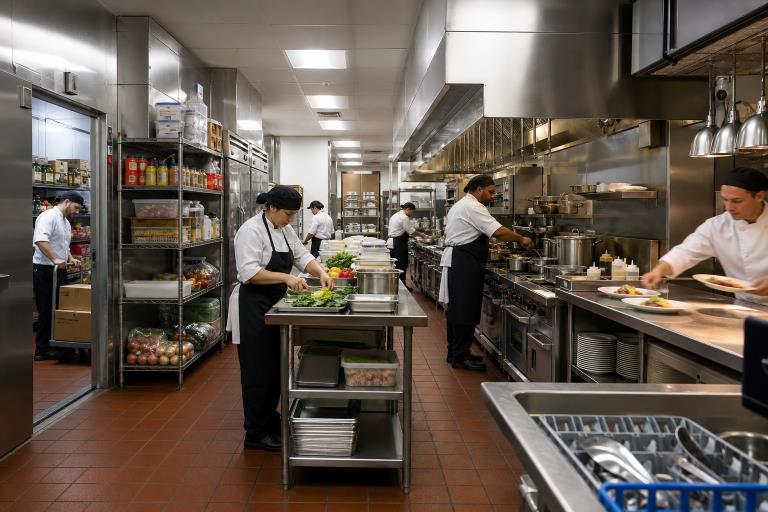
Key Takeaways
- Clear workflows help teams reduce confusion during prep, service, and closing.
- Well-defined kitchen zones can limit unnecessary movement and help prevent cross-contact.
- Labels, timers, checklists, and task ownership make important steps easier to complete and verify.
- Training is most effective when employees practice the procedures they use on their actual shifts.
- Small tests and simple measurements should come before major layout changes or technology purchases.
Kitchen workflow affects nearly every part of foodservice, from receiving ingredients and preparing recipes to serving guests and cleaning equipment. For restaurant, bakery, cafeteria, catering, healthcare, and school foodservice teams, the right routines can support quality, speed, and safety without adding unnecessary complexity. Product planning can also be part of that effort, especially when operators work with partners such as PLZ Corp to source foodservice cooking and baking spray solutions designed for professional kitchen needs.
The best workflow is not necessarily the one with the most forms, signs, or software. It is the one employees can follow reliably when the kitchen is busy. A clear process gives each person a defined task, puts essential tools within reach, and makes it easier for managers to identify breakdowns before they become recurring problems.
Why Kitchen Workflow Matters
Every kitchen has a product path: receiving, storage, preparation, cooking, holding, service, cooling, and cleanup. Delays or uncertainty at any handoff can lead to duplicated work, missed labels, wasted ingredients, delayed orders, or food being stored in the wrong place. These issues can become more noticeable when takeout, delivery, catering orders, menu modifications, and changing staffing levels increase the number of tasks happening at once.
Consistent routines are often more practical than complicated systems. When employees know where to check deliveries, which station owns a prep task, where clean tools belong, and how to document a required check, they can spend less time asking questions or retracing steps.
Start With a Realistic Workflow Review
Rather than redesigning the entire kitchen at once, choose one common, high-volume process. Opening prep, cooling a cooked batch, restocking a service line, or closing sanitation are useful starting points because they involve repeated actions and multiple handoffs.
- Choose one task that affects service, safety, waste, or labor time.
- Write down each step in the order employees actually perform it.
- Mark points where staff wait, backtrack, search for supplies, or repeat work.
- Identify steps that rely on memory rather than explicit instructions.
- Ask the employees doing the work what slows the process down.
- Set one measurable goal, such as fewer missing labels or a shorter restocking time.
Build Clear Kitchen Zones
Receiving and Storage
Keep delivery checks near the receiving area so products can be inspected before entering storage. Provide a designated spot for invoices, thermometers, rejected items, and items awaiting put-away. Storage areas should use a consistent labeling and stock-rotation approach so employees can find products quickly and identify which items should be used first.
Preparation and Cooking
When space allows, separate raw-food work from ready-to-eat food preparation. Keep frequently used tools, gloves, labels, sanitizing supplies, and thermometers near the stations that need them. This reduces unnecessary trips across the kitchen and makes it easier to complete important tasks at the right time.
Service and Warewashing
Review traffic patterns during the busiest service period. Finished food should not share a routine path with waste, dirty dishes, or soiled equipment. If employees must repeatedly cross the kitchen to get containers, utensils, or clean pans, moving those supplies may solve a problem without requiring a major renovation.
Make Food Safety Steps Easy to Follow
Food safety procedures work best when they are visible, brief, and tied to a specific action. “Check cold holding temperature and record the result” gives an employee a clear instruction. “Inspect refrigeration” leaves too much open to interpretation. The FDA’s retail food protection materials provide foodservice operators with model Food Code information, training resources, and science-based safety guidance. State, local, and tribal agencies generally oversee retail food establishments, so each operation should also follow the requirements that apply in its jurisdiction.
Use Labels and Timers to Reduce Guesswork
Labels and timers turn important details into visible prompts instead of relying on memory. Use a consistent label location on containers and keep label supplies close to prep stations. Depending on local requirements and the product, labels may include the product name, preparation date, discard date, and employee initials. Name timers by task, such as “rice cooling,” “soup hold,” or “chicken cook,” so employees know why an alert is sounding. Review labels during shift changes and closing checks.
Create a Practical Prep and Production Plan
A production plan helps teams prepare enough food for expected demand while reducing unnecessary overproduction. Batch sizes should reflect forecasted sales, storage capacity, available staff, menu mix, and service timing. The plan should be simple enough to update when an event, delivery order, staffing change, or unexpected rush affects demand.
What to Include on a Production Sheet
- Product or recipe name and recipe version
- Target quantity, yield, or portion count
- Prep deadline and assigned employee
- Storage location and special handling notes
- A space to record shortages, leftovers, or adjustments for the next shift
Train Staff Around the Actual Shift
Organize training around opening, prep, service, cleaning, and closing responsibilities. Demonstrate the task, let the employee perform it, then provide a short reference guide at the station. Refresh training after changes to the menu, equipment, layout, or process. When a mistake repeats, review the system first: unclear instructions, missing supplies, and poor station setup can all contribute to inconsistent results.
Choose Technology for a Specific Problem
Digital temperature logs, label printers, inventory alerts, portioning tools, kitchen display systems, and automated reminders can be useful when they address a clearly defined issue. Before investing, identify the problem, measure how often it occurs, test the simplest workable option, train the team, and determine whether the tool saves time or merely creates another task to manage.
Track the Results
- Speed: How long does the process take from start to finish?
- Accuracy: How often are labels, portions, or task steps missed?
- Waste: What food, packaging, or labor is being lost through rework or overproduction?
- Safety: Are required checks completed and recorded when needed?
- Training: Can newer employees perform the task with less assistance?
A Simple 30-Day Improvement Plan
- Days 1 to 5: Observe and document one workflow.
- Days 6 to 10: Remove unnecessary steps and assign ownership.
- Days 11 to 15: Test the revised process during slow and busy periods.
- Days 16 to 20: Train the team and gather feedback.
- Days 21 to 25: Compare speed, errors, waste, and completion rates.
- Days 26 to 30: Adjust the process before expanding it elsewhere.
Common Workflow Mistakes to Avoid
- Creating checklists that are too long to use during service.
- Relying on verbal directions that change from shift to shift.
- Keeping critical tools and supplies far from the work area.
- Buying software before identifying the operational problem.
- Training once without reviewing changed conditions or repeated mistakes.
- Copying another location’s process without testing the local kitchen layout.
Helpful Resources for Foodservice Teams
Teams looking for practical operator materials can review the Virginia Department of Health’s foodservice operator resources, which cover topics including active managerial control, allergen awareness, employee education, digital food safety management, and emergency planning. Local health departments remain the appropriate source for site-specific compliance questions.
Conclusion
Safer, more efficient kitchen operations usually begin with small, visible improvements. Clear zones, accessible supplies, useful labels, focused training, and regular reviews can make daily work more consistent. Start with one real workflow, test the change, measure the outcome, and build from what works.