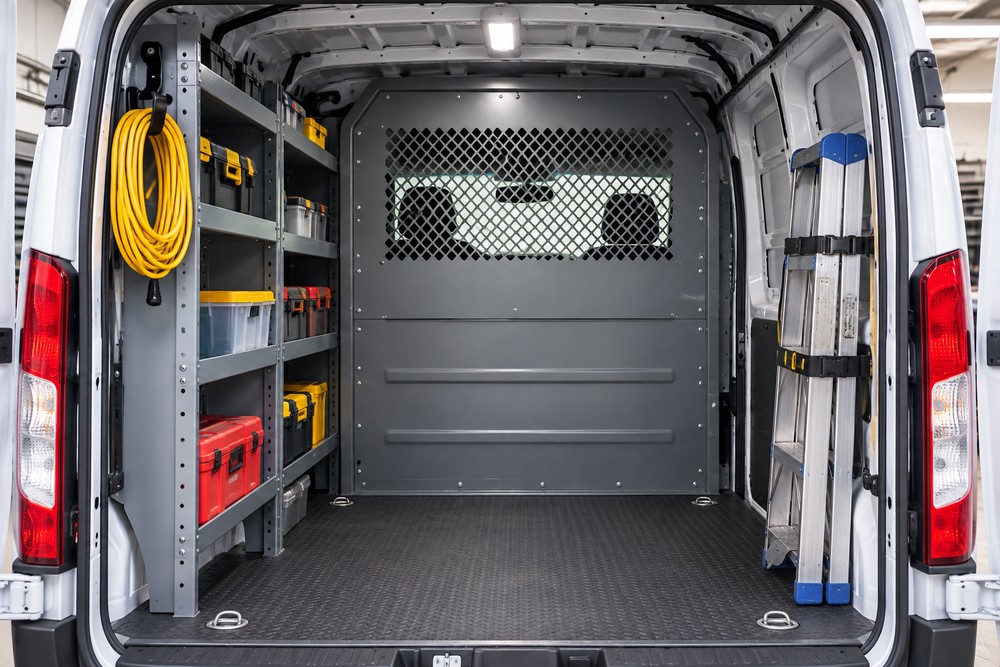
Commercial vans are designed to transport equipment, tools, and materials between job sites. Unlike passenger vehicles, their cargo areas often contain objects of different sizes, weights, and shapes, creating specific considerations for vehicle layout and occupant protection.
A service van may carry everything from small hand tools to heavy equipment cases, ladders, and replacement components. While these items are necessary for daily operations, their movement during driving can create risks when cargo is not properly secured.
Van partitions help address one aspect of this challenge by creating a physical separation between the driver compartment and the cargo area. Understanding how these barriers function, where they fit within a vehicle, and how they interact with other equipment is important when configuring a commercial van.
How Cargo Movement Affects Work Van Safety
Cargo inside a moving vehicle is subject to changes in speed and direction. During braking, cornering, or sudden manoeuvres, unsecured objects can shift because of inertia.
The forces involved depend on factors such as vehicle speed, the weight of the cargo, and how abruptly the vehicle changes direction.
Even relatively small tools can become hazardous when they move unexpectedly. Heavier equipment, including compressors, toolboxes, and material containers, may create additional risks if improperly restrained.
In a commercial van with an open passage between the cargo area and front seats, equipment can potentially move toward the occupants during sudden braking or a collision.
This is why work van safety involves more than organizing equipment for convenient access. The interior configuration should also account for how cargo behaves while the vehicle is moving.
Appropriate cargo restraint systems play a central role in limiting movement. Tie-down points, secured storage compartments, and properly mounted shelving help keep equipment in designated locations.
However, these systems serve a different purpose from a physical partition.
Cargo restraints are intended to prevent individual items from moving, while a partition establishes a barrier between the cargo area and passenger compartment. Both contribute to a more considered vehicle configuration.
The Role of Cargo Barriers in Commercial Van Interiors
The layout of a commercial van influences how closely occupants are positioned to transported equipment.
Many cargo vans have a large interior space extending from the rear doors toward the front seats. Without a barrier, there may be little physical separation between the driver and the cargo area.
Cargo barriers create a defined boundary between these spaces.
Van partitions are generally installed behind the front seating area, separating the passenger compartment from the equipment carried farther back in the vehicle.
Their construction and protective capabilities vary by design, material, mounting method, and manufacturer specifications.
Common partition configurations include solid, mesh, and windowed designs.
Solid partitions provide a continuous barrier between compartments. They can limit direct access from the cab to the cargo area and reduce the transfer of some noise and airflow, depending on their construction and sealing.
Mesh partitions use an open metal structure. They allow visibility and airflow between compartments while establishing a physical boundary. However, their openings may not contain smaller loose objects.
Windowed partitions combine a solid panel with a transparent section. This arrangement can provide visibility into the cargo area while maintaining a more enclosed separation.
Choosing between these designs involves practical considerations.
Drivers who need to monitor equipment from the front seats may value visibility, while operations involving smaller tools or loose materials may require a barrier with fewer openings.
Cab comfort, available interior space, and access requirements can also influence the decision.
Importantly, a partition should not be treated as a substitute for securing cargo. Its ability to resist shifting equipment depends on its design, installation, condition, and applicable ratings.
How Partitions Work Alongside Shelving and Cargo Restraints
Commercial van upfitting often involves combining several interior components into one functional arrangement.
Shelving, drawers, tool cabinets, and floor-mounted storage systems organize equipment, while restraints help limit movement during travel.
A partition must fit alongside these components without interfering with their intended operation.
For example, shelving installed close to the front of the cargo area may affect partition placement. Storage cabinets with opening doors or drawers also require sufficient clearance.
Cargo restraint points should remain accessible after the partition is installed.
The arrangement should account for the size and weight of transported materials, as well as how equipment will be loaded and secured.
Electrical contractors may carry tool cases, cable reels, and smaller components. Plumbing vehicles often accommodate pipes, fittings, and larger tools. HVAC service vans may contain diagnostic equipment, replacement parts, and bulky materials.
These differences can affect the preferred partition design and the amount of usable space required behind it.
The objective is not simply to install as many storage components as possible. It is to create a coordinated interior where equipment can be accessed and secured without compromising the function of other installed systems.
A well-planned layout also considers access through the rear and side doors, allowing workers to handle equipment without unnecessarily disturbing secured cargo.
Why Vehicle-Specific Partition Installation Matters
Commercial vans differ in their body structure, interior dimensions, roof height, and factory mounting provisions.
A partition suitable for one van model may not fit another, even when the vehicles appear similar in size.
Vehicle-specific fitment is therefore important when selecting and installing a partition.
Mounting locations must be appropriate for the vehicle structure, and installation should follow the relevant manufacturer instructions. Incorrect positioning or unsuitable hardware can affect the partition’s stability and interfere with other vehicle components.
Installers must also consider seat adjustment, occupant space, wiring, interior trim, and any equipment already fitted to the van.
Professional selection and installation can help identify these compatibility requirements before modifications are made.
For businesses operating in Kitchener, Waterloo, Cambridge, and surrounding Ontario communities, Tri-City Custom Upfitters is a regional provider offering commercial van partitions as part of vehicle-specific upfitting solutions.
The broader installation process should also involve checking that the partition does not obstruct required safety equipment or interfere with the operation of seats, seat belts, or vehicle systems.
After installation, mounting points and hardware should be inspected according to the product manufacturer’s recommendations, particularly when the vehicle experiences frequent loading and unloading.
Matching Cargo Separation to Everyday Vehicle Use
Different trades and service operations place different demands on their vehicles. A partition configuration that suits a mobile electrician may not be equally practical for a plumbing contractor or a fleet carrying larger equipment.
Fleet operators may also need consistent interior configurations across multiple vehicles while accounting for differences in model specifications.
The most appropriate cargo separation arrangement depends on the equipment transported, the vehicle’s interior layout, and the way occupants interact with the cargo area.
Vehicle owners should evaluate partition construction, visibility, mounting compatibility, and integration with existing storage before installation.
Cargo separation is one part of a broader approach to commercial vehicle safety. Proper load restraint, secure tool storage, suitable equipment placement, and regular inspection remain essential regardless of the partition design.