Key Takeaways
- Automation can improve repeatability, reduce manual handling, and support more consistent production.
- Machine vision, sensors, and controlled equipment can help identify defects earlier in the process.
- Validation, documented change control, cybersecurity, and training are essential parts of any automation project.
- Semi-automated work cells can be a better fit than fully automated lines when volumes or product designs change often.
- Automation changes the nature of work, increasing the need for skilled operators, technicians, engineers, and quality reviewers.
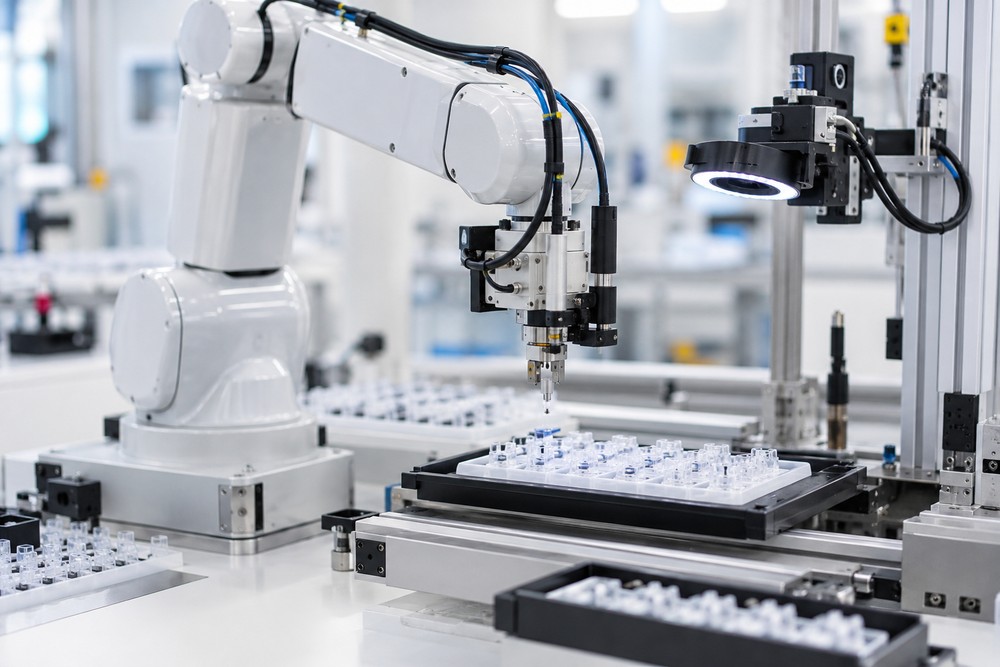
Medical device manufacturing automation is not simply about replacing people with robots. It is about building controlled production processes that can repeat critical tasks, capture useful information, and give teams a clearer view of quality performance. Manufacturers exploring robotic assembly, automated inspection, programmable controls, and connected work cells can see representative approaches at viantmedical.com.
For medical devices, consistency matters at every stage, from component handling and assembly through packaging, labeling, and final inspection. Automation can help reduce variation in repetitive work, but it must be selected for a specific process need and integrated into the manufacturer’s quality system. A successful project keeps human judgment in the loop for review, troubleshooting, and risk-based decisions.
1. Why Automation Matters In Medical Device Manufacturing
Device production often involves tight tolerances, detailed work instructions, controlled materials, and documented acceptance criteria. Manual processes can perform well, particularly for lower-volume or highly variable products, but repetitive tasks may be vulnerable to fatigue, inconsistent timing, or avoidable handling errors. Automation can provide a repeatable sequence for these tasks while recording whether key process conditions were met.
Automation can take many forms. Manual production relies primarily on people to perform and record each step. Semi-automated production combines operator actions with fixtures, sensors, guided stations, or powered equipment. Highly automated production uses coordinated machines to perform most repetitive tasks, with people responsible for oversight, material replenishment, maintenance, exception handling, and quality review.
2. Where Automation Fits Best
The best candidate is not necessarily the fastest operation. A task may deserve attention because it creates defects, causes rework, slows the line, requires difficult inspection, or places an unnecessary physical burden on workers.
- Part feeding, handling, and positioning
- Component assembly and joining
- Controlled dispensing, curing, or fastening
- Packaging, labeling, and barcode verification
- Dimensional measurement and vision inspection
- Material movement between process steps
- Process monitoring, alarms, and electronic record capture
Before automating, teams should confirm that the product design, materials, tolerances, and expected production volumes are stable enough to justify the investment. A flexible fixture or semi-automated station may deliver greater practical value than a rigid, high-speed line when product configurations change frequently.
3. How Automation Supports Quality And Inspection
Automated inspection applies programmed criteria consistently across units. Cameras, sensors, gauges, and software can check for missing components, visible damage, incorrect orientation, label errors, or dimensional variation. For example, a vision system might verify that a molded component has the correct shape and position before proceeding to the next assembly step.
These tools do not eliminate the role of quality professionals. They provide more consistent inspection data and can route uncertain results for human review. The FDA’s smart design and manufacturing pilot has examined how digitally connected design, automated production, sensors, and closed-loop quality concepts may support regulated manufacturing.
4. Worker Safety And Ergonomic Benefits
Automation may reduce repetitive lifting, awkward reaching, handling of sharp parts, and direct interaction with moving or hazardous process equipment. However, a machine only improves safety when its design accounts for normal operation, setup, cleaning, maintenance, and foreseeable misuse.
Safety Practices To Build Into The System
- Use appropriate guards, interlocks, and emergency-stop functions.
- Create clear access points for cleaning, inspection, and service.
- Establish lockout procedures before maintenance work begins.
- Train operators and technicians on normal operation and abnormal conditions.
- Review hazards introduced by automated motion, pneumatic systems, electrical controls, and software failures.
5. Data, Traceability, And Process Control
Connected equipment can record cycle times, inspection outcomes, machine status, alarms, material information, and operator actions. When the records are accurate and easy to retrieve, teams can investigate deviations, recognize recurring patterns, support root cause analysis, and plan maintenance based on actual equipment performance.
More data is not automatically better. Each data point should have a purpose, such as confirming a critical process setting, documenting an acceptance decision, or identifying a developing equipment problem. Data governance should address accuracy, user access, retention, backup, and protection from unauthorized changes.
6. Validation And Compliance Considerations
An automated process must be shown to perform as intended for its defined use. In the United States, the FDA’s Quality Management System Regulation became effective on February 2, 2026. That makes disciplined documentation, risk management, supplier oversight, and control of process changes central considerations for manufacturers subject to the regulation.
Validation planning should begin before equipment design is complete. Define user requirements, identify critical settings and acceptance criteria, assess risks, and test normal and failure conditions. Teams should also document software versions, equipment configuration, calibration, preventive maintenance, training, and any changes to recipes, sensors, inspection rules, or control logic.
7. Common Challenges And Trade-Offs
Automation introduces real constraints. Upfront spending can include engineering, fixtures, integration, installation, qualification, software support, spare parts, and training. Legacy equipment may not readily share data, and limited internal technical expertise can make commissioning or troubleshooting more difficult.
There is also a flexibility trade-off. A fully automated line can be appropriate for a stable, high-volume process, but it may be harder to modify for a new component or product version. Semi-automated cells often cost less, preserve operator flexibility, and provide a lower-risk way to automate the most demanding steps first.
8. A Step-By-Step Implementation Plan
- Map the current process. Document handoffs, delays, defects, safety concerns, and rework.
- Set measurable goals. Define the desired improvement in quality, throughput, ergonomics, or record accuracy.
- Prioritize opportunities. Choose a task with meaningful value and manageable technical risk.
- Test the concept. Use a proof of concept to evaluate the critical process before committing to a full system.
- Plan validation early. Involve quality, engineering, operations, and maintenance teams from the beginning.
- Prepare the workforce. Train users, define escalation paths, and provide practical maintenance support.
- Measure and improve. Compare results with the original goals and use production data to refine the process.
9. Questions To Ask Before Investing
- Which production problem should be solved first?
- Is the product and process stable enough for automation?
- What flexibility will future product changes require?
- What data must be captured, reviewed, and retained?
- How will the system be validated and maintained?
- What happens if an automated step fails or produces an unclear result?
- Who will operate, service, and troubleshoot the equipment?
- What is the full cost of ownership over the equipment’s expected life?
Medical device manufacturing automation works best when it addresses a defined problem rather than pursuing automation for its own sake. A phased approach can strengthen consistency, improve safety, and build better traceability while preserving the flexibility and human expertise that regulated production still requires.