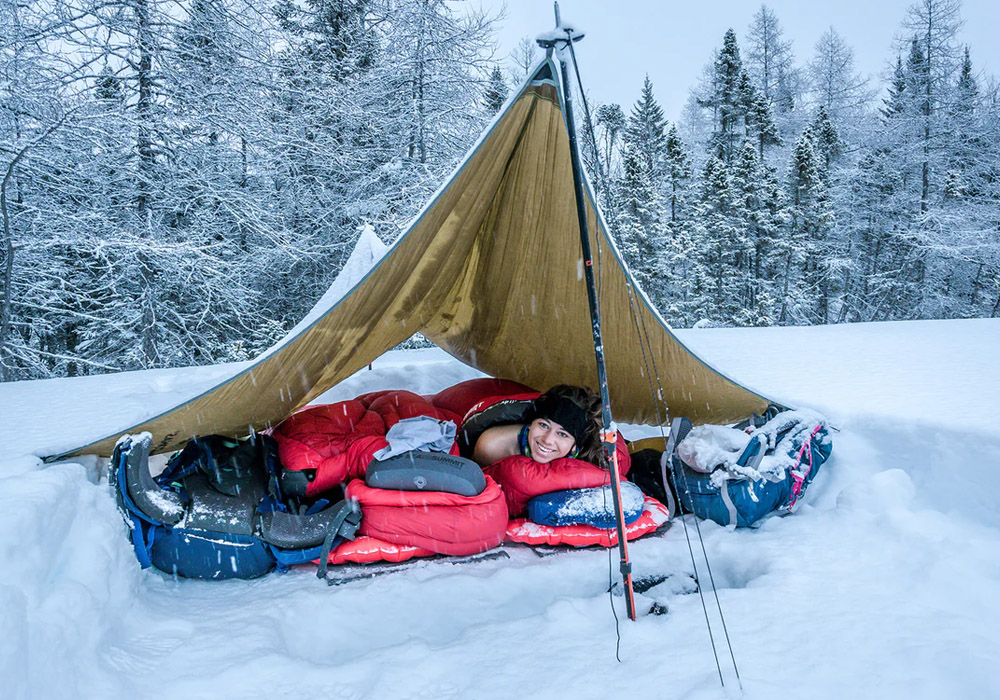
Many individuals approach cold-weather camping as if it’s the same as camping in the summer, but you just need a warmer coat. That sort of thinking is what gets folks into trouble. Subzero temperatures don’t just make you colder; they also cause your gear to function differently, alter the way your body metabolizes food and water, and minimize your room for error while you’re on the trail.
Cold Doesn’t Scale Summer Gear, It Breaks It
A tent that kept the rain out and stayed firmly anchored in October’s mellow winds can turn into a form of frigid, howling torture chamber in January when plastic buckles give way and the rainfly flaps into your face and the interior walls all night long. None of this is rocket science, but the difference between a nice weekend in the Adirondacks and a medical emergency in the Brooks Range is entirely a matter of degree. Or several degrees.
So, just as a runner has to learn to drink from a water bottle without breaking stride, a climber has to learn how to handle gear while bundled up like the Michelin Man. Everything takes more time. Simple tasks, practiced until they were automatic at sea level under calm conditions, need to be relearned in full winter gear at altitude with frozen, clumsy fingers and brain. It can’t be done without practice.
Layering Is About Moisture, Not Warmth
When it’s cold outside, our natural tendency is to put on as many layers as possible. But in reality, that’s not the right thing to do. The three-level clothing system (base, mid, and outer shell) is actually designed to help you better manage moisture, rather than simply keeping in the heat. The base layer works by removing sweat from your skin. The mid layer (fleece, down, synthetic insulation) helps keep the warm air close to your body. Finally, the outer shell protects you from the wind and rain while allowing vapor to escape.
Moisture is your biggest enemy in the cold. If you put on too much clothing and start sweating during your climb, that moisture will not only make you feel uncomfortable, but it will also get your insulation wet. Wet insulation loses most of its ability to keep you warm. And once you stop moving and the sweat cools against your skin, you will get even colder, probably colder than you would have been if you didn’t add that extra layer. The solution is not to put on even more clothes, but to learn to actively adjust your layers. For example, you can open your jacket to let some heat escape, take off a layer before you start your climb, or replace your damp base layer with a dry one at camp.
You should avoid cotton as much as possible. It retains moisture and takes a long time to dry, the exact opposite of what you need when your body is trying to heat itself in sub-zero temperatures.
Sleep Systems Need A Harder Look At The Numbers
Temperature ratings on sleeping bags are often misunderstood. If a bag is advertised as suitable for 20°F, it typically means you can survive at that temperature while inside but may not be entirely comfortable. Manufacturers provide a “comfort” rating and a “lower limit” or survival rating. The difference between the two can be 15 to 20 degrees. If you expect the low to be 20°F, you want a bag rated for much colder temperatures.
The surface you’re sleeping on is just as important as the bag. A well-insulated sleeping pad with a sufficient R-value prevents your body heat from seeping directly into the icy or snow-packed ground. A summer pad with an R-value of 2 will not be sufficient, regardless of how warm your bag is. If you’re not using winter-specific equipment, you can add a liner to your sleeping bag and use a medium-range pad, or double up on pads.
Your tent also matters. A four-season tent with a more robust pole design sheds accumulated snow and stands up to wind better than a three-season tent. If a four-season tent isn’t an option, make some modifications at least. Exchange your regular stakes for snow stakes or deadman anchors, as ordinary stakes easily pull out of snow and cold, loose dirt.
Light Fails Exactly When You Need It Most
Winter days are shorter, so a trek that begins at 9 a.m. in June with 10 hours of daylight left may only have 5 or 6 hours of light available in December. What’s more, many summertime hikes begin as a leisurely race against the sunset and end roughly at the same time in darkness. Navigating a snow-covered trail without good light is even more dangerous than you’d think; missed turns, slips on icy patches you didn’t spot, and disorientation when familiar trail markers are buried are all common problems and the reasons most winter hikers get hurt.
This is when lighting isn’t about reading in the tent; it’s the difference between getting home for dinner and explaining to your friends that you nearly froze your fingers off stumbling around in the dark because Scott was too cheap to pack a backup headlamp. Which is to say, lighting goes from bring-along item to safety equipment.
The most forgotten part is that cold temperatures will kill batteries in a fraction of their normal life. We’ve all seen this in our phones, cameras, and such, and it’s no different with headlamps. Lithium-ion cells drop performance and capacity like a rock once the temperature goes down, not to mention alkaline cells also lose capacity when it gets cold. A headlamp that can pull 8 hours on a charge at 70°F may only yield four hours at 10°F. That’s why a dependable set of headlamps with cold-rated batteries and a solid runtime buffer belongs in every winter pack, along with spare batteries stored somewhere warm rather than in an outside pocket where they’ll drain before you even need them.
Food, Water, and The Thirst Response That Lies To You
Your body burns a lot more calories when it’s cold just to maintain your core temperature. Shivering alone is metabolically expensive. So the granola bar and sandwich lunch that was plenty to keep you going on a summer day hike won’t make the grade in January – you’re going to need denser, higher-calorie food, and more of it, especially if you’re also lugging around more gear weight.
Hydration is the insidious one. Cold tends to suppress your sense of thirst, so you can be shedding water all day long and not really feel the need to drink. This is exacerbated by the simple fact that a lot of winter hydration goes into just keeping your water liquid – bottles freeze, and every hydration-bladder tube used has frozen solid within an hour of moving in serious cold. Add the insulative properties of cold air to the tube problem, and it’s easy to get to the end of your hiking day having drunk almost nothing. Insulated bottles, or bottles carried upside down (ice forms on the surface first, so with an inverted bottle the ice in the opening will thaw before the ice in the bottom), are simple solutions to an avoidable problem.
Recognize Hypothermia and Frostbite Before They Escalate
Hypothermia is not just something for extreme cold. It can develop in wet, windy, 40°F weather more readily than many people suppose, as wind and moisture suck heat from the body much faster than dry, still air at the same temperature. Early warnings include shivering, fumbling hands, slurred speech, and general clumsiness. Since hypothermia clouds judgment, those affected often don’t realize what’s going on. That’s why cold-weather partners should monitor each other, not just themselves.
Frostbite is different but related: it’s localized tissue damage (fingers, toes, ears, maybe even nose) from long exposure to freezing conditions. Wind chill hugely accelerates the process. At an actual 30°F temperature with a 30 mph wind, the wind chill is just 11°F, and you get frostbite on exposed skin in less than 30 minutes (National Weather Service). This difference between thermometer reading and felt reality is enormous, so wind is a big factor in both your long-term choices of what to wear, and your short-term decisions on time exposure.
Plan For The Trip Going Wrong, Not Just The Trip Going Right
Remote trails, early darkness, and snowstorms that build faster than forecast all raise the stakes of winter travel compared to a typical summer hike. A detailed trip plan – route, timing, expected return – shared with someone who isn’t on the trip is basic insurance. Cell coverage is unreliable in a lot of backcountry terrain, so a satellite communicator or personal locator beacon fills the gap when a phone call isn’t an option.
Emergency shelter deserves a place in the pack even on day trips. A reflective bivy weighs almost nothing and takes up little space, but it can be the difference between a bad night and a fatal one if weather turns or someone gets injured miles from the car. Pair it with a reliable fire starter – and know that matches and lighters both perform worse in cold, damp, and windy conditions, so a ferro rod as backup, along with dry tinder carried in a sealed bag, removes a point of failure that’s easy to overlook until it matters.
Choosing and Setting Up A Winter Campsite
Choosing a campsite during winter is a whole different ball game. The wind is your number one enemy and you must take that into consideration when selecting a spot. Tree lines or natural barriers play a more important role than you’d think. A spot with a view isn’t always the best choice.
Look up too. Snow-loaded branches can be dangerous. The branch that drops a foot of accumulated snow on your tent in the middle of the night is not a potential hazard, it’s an actual one.
Snow anchors, deadman anchors, or even better, horizontally buried stakes, all outperform normal stakes in loose and/or frozen ground. An often-overlooked tip for winter camping: stomp down your tent footprint before pitching. It prevents the floor from melting unevenly under body heat overnight, which otherwise leaves you sleeping in a lumpy, refrozen mess by morning.
A Pre-Trip Checklist Worth Actually Using
Before you leave the trailhead, the usual good advice: leave word with somebody off the trail as to where you’re going, check the realistic low temperature for your sleeping bag against the low forecast, and test every battery-powered device you plan to bring along in the cold before you need it. And pack its spare batteries close to your body, not in the outer pocket of your pack. Take more food and water than you think you need; the desire for both diminishes in the cold and appetite is a lying weasel anyway. Bring backup fire starter and at least a most-minimal emergency shelter on even the shortest trips. None of this is difficult. It’s just different rules, not colder variations of the usual ones.
Cold-weather camping rewards people who plan for what breaks, not just what they hope goes right. The gear, the food, the light, the shelter – all of it needs a second look through a winter lens before you ever leave the trailhead.