Planning and Execution in Custom Pool Construction
The journey to an energy-efficient pool begins long before the first shovel breaks ground. Strategic planning and thoughtful execution during the construction phase are paramount, setting the foundation for decades of reduced energy consumption. Factors such as site orientation, pool dimensions, surface area, and the intricate details of hydraulic dynamics and plumbing architecture all play a critical role. By considering these elements upfront, we can design a pool that minimizes energy waste from day one.
For instance, orienting the pool to maximize solar exposure can significantly reduce heating demands, while careful consideration of prevailing wind patterns allows for the strategic placement of windbreaks, mitigating evaporative heat loss. The initial choices made in your pool design and build directly influence the pool’s operational efficiency and long-term costs. It’s a holistic approach that views the pool as an integrated system, where each component contributes to or detracts from overall energy performance.
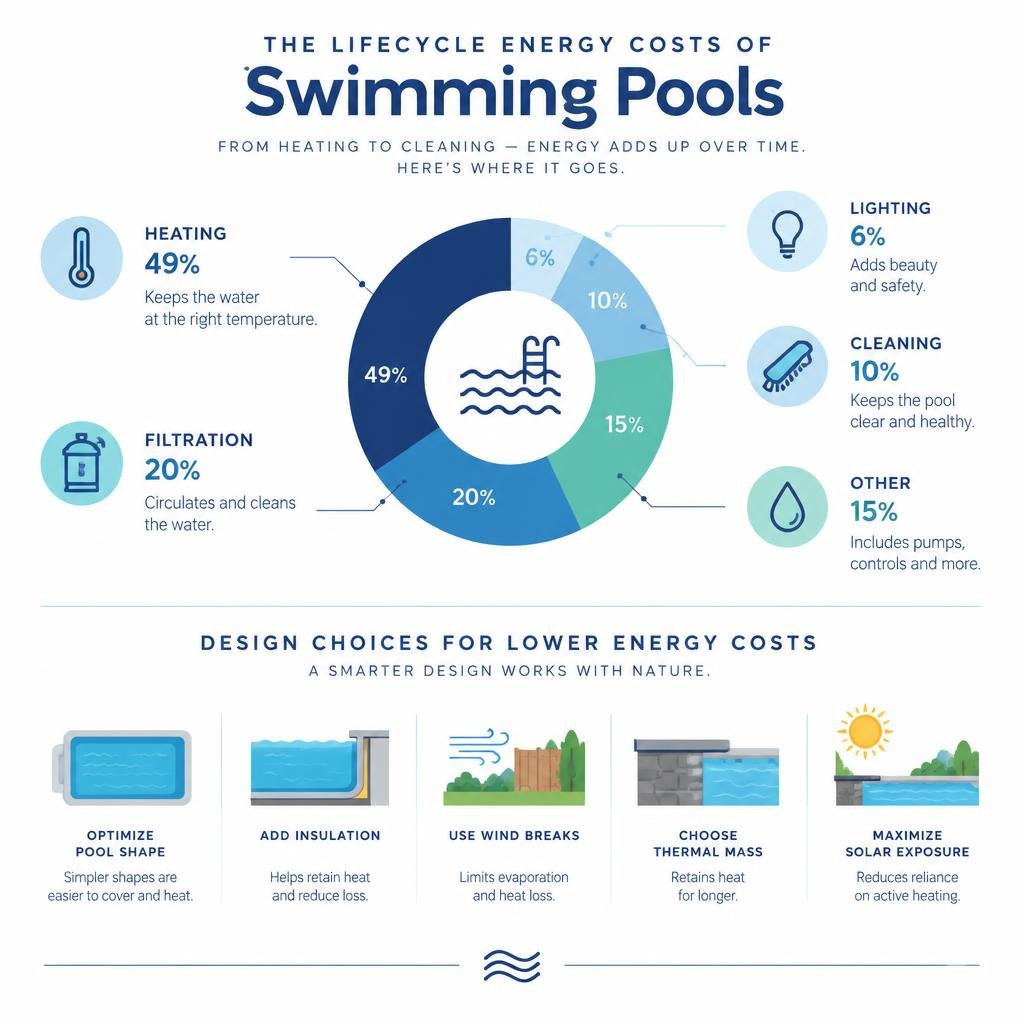
The lifecycle energy costs of a swimming pool are substantial, often underestimated at the outset. These costs encompass everything from heating and filtration to lighting and cleaning. An infographic detailing these costs can highlight where the biggest savings opportunities lie.
Key Principles of Energy-Smart Custom Pool Construction
When embarking on a custom pool project, several design principles can dramatically enhance energy efficiency. The pool’s geometry, for example, impacts how easily it can be covered and heated. Simpler shapes and more uniform depths are generally easier to cover, reducing heat loss and evaporation. A uniform depth also allows for more consistent heating of the water volume.
Structural excavation should consider integrating insulation into the pool shell, particularly in cooler climates, to improve thermal retention. Strategic placement of windbreaks, such as fences, landscaping, or architectural features, can significantly reduce surface evaporation, which is the primary source of heat loss in pools. Materials with higher thermal mass can help retain heat, while maximizing solar exposure through careful siting allows for passive solar heating, reducing the reliance on active heating systems. These design choices ensure that the pool works with its environment, rather than against it, to maintain desired temperatures and water quality with less energy input.
Hydraulic Design and Equipment Pad Layout
The efficiency of your pool’s circulation system is largely dictated by its hydraulic design. This involves meticulous planning of pipe sizing, minimizing head loss, and optimizing the equipment pad layout. Larger diameter pipes reduce friction and allow water to flow more freely, requiring less effort from the pump. Similarly, using sweep elbows instead of sharp 90-degree turns minimizes flow resistance, ensuring the pump doesn’t have to work as hard to move water through the system.
Careful attention to intake grates, ensuring they are clear and appropriately sized, prevents blockages that can force the pump to labor excessively. An efficient manifold layout on the equipment pad ensures that water pathways are direct and unobstructed, further reducing overall flow resistance. By minimizing these hydraulic inefficiencies, we can ensure that the pool pump operates at lower speeds and for shorter durations, translating directly into significant energy savings. This proactive approach during the design phase avoids costly retrofits and ensures optimal performance throughout the pool’s lifespan.
Selecting High-Efficiency Pool Equipment and Systems
Once the foundational design is in place, the next critical step is selecting the right equipment. The market now offers a wide array of energy-efficient pool technologies that can drastically cut operational costs and environmental impact.
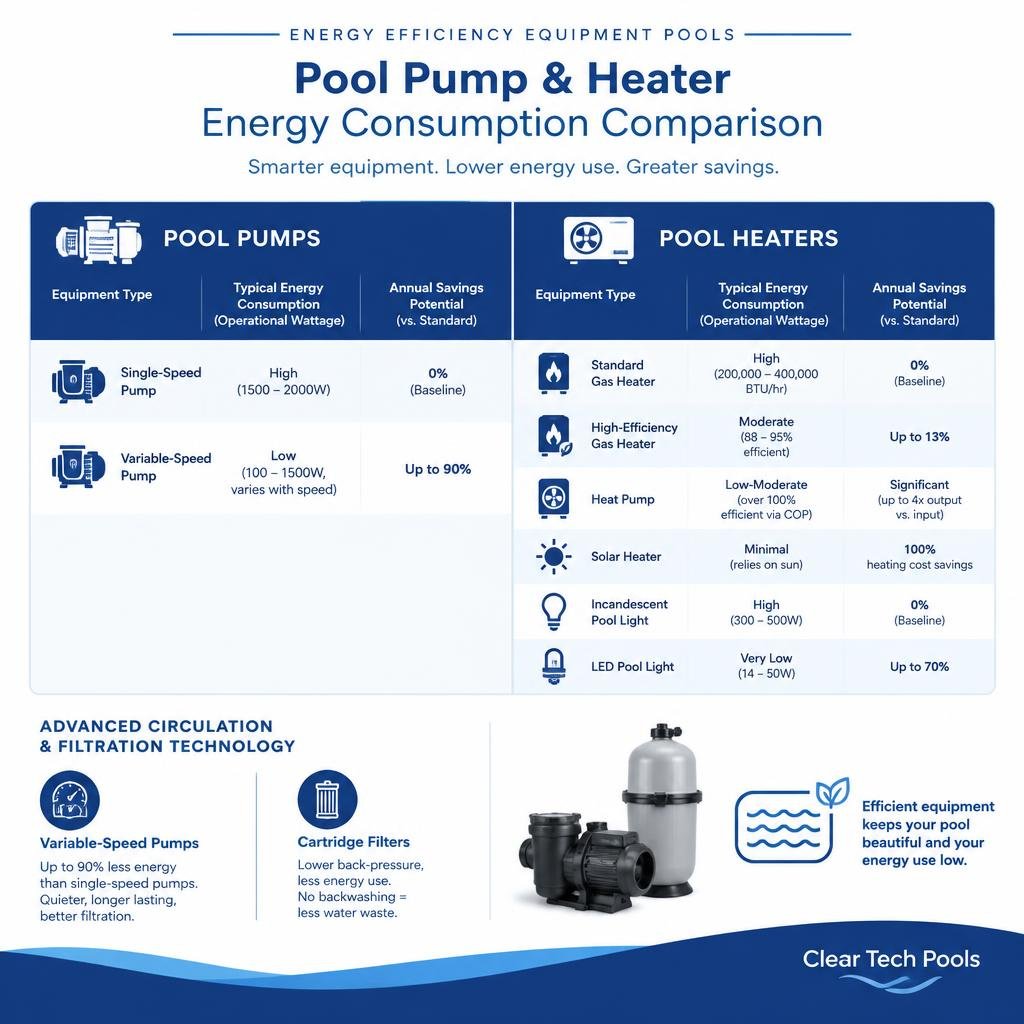
When choosing equipment, consider factors like equipment sizing relative to your pool’s volume, understanding total dynamic head for pump selection, and prioritizing ENERGY STAR certified products. ENERGY STAR certification indicates that a product meets strict energy efficiency guidelines set by the U.S. Environmental Protection Agency. A comparison of operational wattage and energy consumption across different pump and heater types can illuminate the potential savings.
Equipment Type Typical Energy Consumption (Operational Wattage) Annual Savings Potential (vs. Standard) Single-Speed Pump High (e.g., 1500-2000W) 0% (Baseline) Variable-Speed Pump Low (e.g., 100-1500W, varies with speed) Up to 90% Standard Gas Heater High (e.g., 200,000-400,000 BTU/hr) 0% (Baseline) High-Efficiency Gas Heater Moderate (88-95% efficient) Up to 13% Heat Pump Low-Moderate (over 100% efficient via COP) Significant (up to 4x output vs. input) Solar Heater Minimal (relies on sun) 100% heating cost savings Incandescent Pool Light High (e.g., 300-500W) 0% (Baseline) LED Pool Light Very Low (e.g., 14-50W) Up to 70%
Advanced Circulation and Filtration Technology
The pool pump is often the single largest energy consumer in a pool system. Upgrading to a variable-speed pump (VSP) is arguably the most impactful energy-saving measure a pool owner can take. Variable-speed pumps can save up to 90% off current energy consumption compared to traditional single-speed pumps. Unlike single-speed pumps that run at full power constantly, VSPs can adjust their speed based on the pool’s needs, running at lower, more energy-efficient speeds for routine filtration and only ramping up for tasks like cleaning or backwashing. This not only drastically reduces energy costs but also leads to quieter operation, less wear and tear on equipment, and often superior filtration due to slower, longer circulation cycles.
For filtration, cartridge filters stand out as the most energy-efficient option compared to sand or diatomaceous earth (DE) filters. They operate with lower back-pressure, meaning the pump requires less energy to push water through them. Furthermore, cartridge filters do not require backwashing, which saves thousands of gallons of water annually and eliminates the need to dispose of chemical-laden wastewater.
When it comes to keeping your pool clean, the choice of cleaner also matters significantly for energy consumption. Robotic pool cleaners are the champions of energy efficiency in this category. A robotic pool cleaner uses only about 197 kWh per year. In contrast, filter pump cleaners consume around 1,675 kWh per year, and booster-pump cleaners can soar to 2,989 kWh per year. Robotic cleaners operate independently of the main pool pump, often using very little power, making them an excellent investment for long-term savings. While suction cleaners are also quite energy-efficient as they rely on the main pump’s suction, they may not always be as effective at thorough cleaning as their robotic counterparts.
Sustainable Heating Solutions and Smart Automation
Heating a pool can be a major energy drain, but modern solutions offer impressive efficiency. Heat pumps are exceptionally energy-efficient, often achieving over 100% efficiency (measured by their Coefficient of Performance, or COP) by extracting heat from the ambient air and transferring it to the pool water. They work best in moderate climates where outdoor temperatures consistently stay above 50°F. For even greater sustainability and minimal operating costs, solar pool heating systems utilize solar collectors to harness the sun’s free energy. While the initial investment for solar can be higher (typically $2,000-$4,000), the payback period is relatively short, often 2-7 years, especially in sunny climates. These systems extend the usability of your pool season with virtually no ongoing energy costs. Gas heaters, while less efficient (typically 82-88%), offer rapid, on-demand heating and are a good option for cooler regions or for occasional heating needs.
Smart pool automation systems revolutionize energy management. These systems can optimize the run times of pumps, schedule heating cycles, control lighting, and manage other equipment based on real-time conditions and user preferences. By integrating variable-speed pumps, smart automation can ensure the pump operates at the lowest effective speed, and only when necessary.
For pool lighting, switching from traditional incandescent or halogen lights to LED pool lights can yield significant savings. LED pool lights save up to 70% in energy compared to older, less efficient options. Moreover, LED lights boast a much longer lifespan, often lasting up to 25 times longer than incandescent bulbs, reducing maintenance and replacement costs. Solar-powered features, such as solar heating panels or even solar-powered automated pool covers, contribute to long-term savings by leveraging renewable energy sources to offset operational costs.
Long-Term Maintenance and Optimization Strategies
Achieving and maintaining an energy-efficient pool is an ongoing process that extends beyond initial design and equipment selection. Strategic maintenance practices and operational adjustments are crucial for maximizing savings and ensuring the longevity of your investment.
Effective runtime management, meticulous water chemistry, and diligent preventive servicing are all vital components. Additionally, staying informed about utility rebates and certifications, such as ENERGY STAR, can provide financial incentives for continuous upgrades. These practices not only reduce energy consumption but also contribute to water conservation and a healthier swimming environment.
Operational Scheduling and Custom Pool Construction Upgrades
One of the simplest yet most effective ways to reduce pool pump energy usage is through optimized operational scheduling. Many pool owners run their pumps for far longer than necessary. In reality, running a pool filter for only 6 hours a day versus 24 hours can reduce energy use by 75%. Studies have shown that reducing pumping to less than 3 hours per day can save pool owners 60% of their electricity bill for pumping, without compromising water quality.
Timers and smart controllers are indispensable for this. Instead of one long, continuous run, consider multiple short cycles throughout the day. This approach can be more effective at keeping debris suspended and filtered out. It’s also important to understand that longer pump circulation does not prevent algae growth; proper water chemistry and regular scrubbing of pool surfaces are far more effective.
For enhanced water quality and further efficiency, consider chemical-free filtration options like UV disinfection or ozone systems. These technologies can reduce the need for harsh chemicals, improving water quality and potentially extending the life of other pool equipment by reducing corrosive elements. If your utility provider offers variable rates, scheduling pump operation during off-peak hours can also lead to additional cost savings.
Preventive Care and Thermal Protection
Pool covers are indispensable tools for energy efficiency and water conservation. Pool covers can reduce heating costs by a remarkable 50%–70%. Beyond heat retention, they minimize chemical use by 35%–60% by preventing evaporation and degradation from UV rays, and they can cut water loss by 30%–50%. Automated covers offer convenience and ensure consistent use, maximizing these benefits. Since pools lose most of their heat through evaporation, mitigating this process is paramount for thermal protection.
Regular preventive care is also crucial. This includes routine tasks like cleaning skimmer and pump baskets to ensure unimpeded water flow, which prevents the pump from working harder than necessary. Proper filter maintenance, whether cleaning cartridges or backwashing sand/DE filters appropriately (avoiding excessive frequency), ensures optimal filtration without undue strain on the pump. Maintaining balanced water chemistry is not just for swimmer comfort; it prevents scaling and corrosion that can damage equipment and reduce its efficiency over time.
Many local utilities and government programs offer incentives, rebates, or certifications (like ENERGY STAR for pumps and heaters) for upgrading to energy-efficient pool equipment. These programs can significantly offset the initial investment, making energy-efficient upgrades even more appealing. By combining smart equipment choices with diligent maintenance and operational strategies, pool owners can enjoy their backyard oasis with a clear conscience and a lighter utility bill.