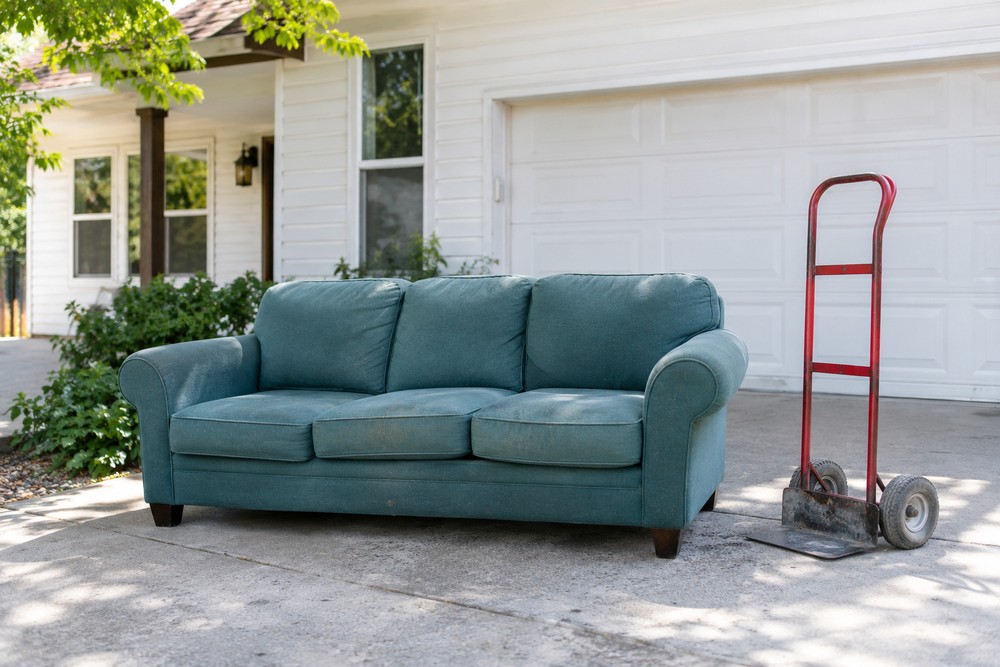
Choosing a junk removal service starts with two questions: how much are you getting rid of, and how many spaces does it sit in? Junk removal and cleanout services are sold in tiers, and matching your job to the right tier before you call a hauler is the simplest way to avoid overpaying.
The three tiers of removal work
Most haulers sell their work in three tiers. A single-item pickup covers one heavy or awkward object, like a sofa or a dead refrigerator. A partial load covers a defined space, such as a garage or a couple of rooms. A full-property cleanout covers an entire home, usually with a crew working across every room.
The pricing model changes with each tier. Small jobs are quoted at a minimum load fee, a flat base charge that covers the trip and a small amount of labor. Larger jobs are quoted by volume, typically as a quarter, half, or full truckload, with disposal fees and labor added on top.
When a single-item pickup is enough
A single-item pickup fits when the entire problem is one object. Mattresses and broken appliances are the classic calls, because they’re heavy and rarely accepted by regular curbside trash collection.
Booking a pickup for one item often beats the DIY route on cost. Renting a truck and paying disposal fees at the dump adds up quickly, and the hauler’s minimum fee usually undercuts that total once you count your own labor.
You also choose the service level. Curbside pickup means you drag the item outside and the crew loads it. In-home service means the crew carries it out of the room for you.
If the item is still usable, ask where it ends up. Haulers who work with donation centers and recyclers keep decent pieces in circulation.
The middle path most people skip
Plenty of jobs sit between the two extremes. A garage half-filled with old tools or two rooms of outdated furniture won’t fill a truck, but they’re well past a single item.
These jobs are quoted as partial loads, usually a quarter or half truckload. Post-renovation debris belongs here too, including drywall scraps, old cabinets, flooring, and broken tile left behind after a remodel.
Tell the hauler which spaces are involved and roughly how much sits in each one. Photos help, and most companies will give a quote from them. Sheds and detached garages are common middle-path jobs, since they tend to collect years of accumulated items.
When the whole property has to go
Some jobs touch every room on the property. Estate settlements after a death or a downsizing move are the most common trigger, and foreclosure turnovers and hoarding cleanups follow the same pattern.
These larger projects are measured in crew-hours as well as volume. The crew works through stairs and narrow hallways, and the quote combines truckload volume with the labor and disposal fees that come with it.
Hoarding situations need extra care. Crews handling them work with sensitivity, and some jobs call for hazmat awareness when conditions have deteriorated.
For work at this scale, booking full-property junk removal covers every room in one job. Defining the whole-property scope in advance helps the crew coordinate rooms and scheduling, especially when a family settling an estate can’t manage multiple visits.
Storm and flood damage can push a household into this tier without warning. After hurricanes in areas like Tampa Bay, waterlogged furniture and ruined drywall can fill a home faster than a family can bag it, and disposal rules for storm debris add more work.
Let the pricing model confirm your tier
The pricing model can confirm the tier. A flat minimum fee points to single-item work, and truckload fractions point to cleanout work.
Ask which pricing model applies before you book. The answer shows how the company sees the job and can expose a mismatch early.
Disposal fees help explain a common price surprise. Haulers pay landfill and transfer station charges on everything they dump, and those costs pass into your quote. That’s why a cheap couch can cost more to haul than you expect.
A wrong scope can raise the price either way. Book a full cleanout for two items and you overpay for truck space you never use. Book a single pickup when you need a whole house cleared and you’ll trigger a second dispatch fee when the crew has to return.
Get the scope in writing
Cleanout quotes can vary widely when the desired end state isn’t defined. Insist on a free estimate based on photos or an on-site walkthrough, and get the scope in writing before anyone starts loading.
The document should list the spaces included and what counts as finished. Ask for a broom-clean guarantee, which means the crew leaves each cleared space swept and empty. Two quotes for the same property can differ sharply if one assumes a swept, empty home and the other assumes a filled truck and nothing more.
Count the spaces and estimate the volume before you pick up the phone. Once you know which tier your job falls into, compare quotes against the same written scope of work.