Key Takeaways
- Storm damage often starts with warning signs such as hanging limbs, cracks, decay, root movement, or a new lean.
- Heavy rain can soften the soil around roots, while strong winds can put pressure on trunks and branches.
- Careful inspections and selective pruning can reduce risk before severe weather arrives.
- Never approach, cut, or move a tree that is touching a power line.
- Some trees need removal, while others can be managed with pruning, cabling, bracing, or monitoring.
Storm preparation is not only about shutters, supplies, and weather alerts. It also means looking up. Mature trees can protect a property from sun and wind, but weak limbs, decayed trunks, and unstable roots can become serious hazards when rain and high winds arrive. For a professional opinion on trees near a home, driveway, fence, or utility corridor, a Chesapeake tree service such as 757 Tree Solutions can evaluate tree structure and site conditions. The Chesapeake-based, veteran-owned company provides removal, trimming, pruning, stump grinding, emergency response, and crane-assisted work, with ISA-certified arborists serving Chesapeake, Suffolk, and Virginia Beach.
The goal is not to remove every large tree from the yard. Healthy, well-maintained trees are valuable. A storm-ready care plan helps homeowners identify concerns early, preserve trees that can remain safe, and act before a small defect becomes a costly emergency.
Why Chesapeake Trees Face Special Weather Stress
Chesapeake’s Tidewater setting exposes trees to humid summers, heavy thunderstorms, tropical weather, saturated soil, and gusty winds. When extended rain softens the ground, roots may lose some of their holding strength. Wind then places added force on the trunk, canopy, and branch attachments. This matters most in established neighborhoods where trees grow close to roofs, pools, sidewalks, parked vehicles, and utility lines.
Homeowners do not need to diagnose every problem. They do need to notice change. The City of Chesapeake recommends watching for issues such as trunk cracks, cavities with rot, fungi near the base, and declining tree health before severe weather puts additional stress on the canopy. Its guidance on preparing trees for severe weather also emphasizes proper care and assessment when concerns worsen.
Warning Signs to Check Before a Storm
A quick walk around the property once or twice a year can reveal issues worth monitoring. Check trees from the ground, and avoid climbing or pulling on limbs to get a closer look.
- A fresh or worsening lean.
- Cracks where the trunk divides into major stems.
- Dead, broken, hanging, or rubbing branches.
- Cavities, soft wood, mushrooms, or fungal growth near the trunk base.
- Soil lifting around roots or roots pushing up pavement.
- Thin foliage, early leaf loss, or unusual dieback in one section of the canopy.
- Branches touching a roof, siding, chimney, or utility line.
For example, a limb rubbing against a roof may seem minor during calm weather. Repeated movement can damage bark and gradually weaken the attachment point, especially when the branch is carrying rain-soaked foliage.
A Simple Tree Care Schedule
Late Winter and Early Spring
- Inspect exposed roots, trunks, and major branch unions.
- Look for winter damage, soil movement, and lingering broken limbs.
- Schedule an assessment for mature trees positioned near structures.
Late Spring and Summer
- Watch for sudden dieback, pests, disease symptoms, and leaf discoloration.
- Check clearance from roofs, walkways, driveways, and signs.
- Reinspect after thunderstorms or prolonged heavy rain.
- Avoid excessive pruning when a tree is stressed by heat or drought.
Late Summer and Fall
- Address deadwood before the strongest seasonal storms.
- Clear limbs that interfere with emergency access or visibility.
- Review trees around play areas, bedrooms, sheds, and high-use spaces.
When Pruning Helps and When It Does Not
Good pruning can remove deadwood, improve clearance, reduce weight on selected limbs, and correct small structural problems early. It is not a cure for advanced decay, major trunk damage, or root failure. Removing too much live canopy can also stress a tree and encourage weak regrowth.
Pruning may be appropriate for dead or crossing branches, limited roof clearance, minor branch imbalance, and early weak branch patterns. Removal or a more involved management plan may be needed when a trunk has a deep cavity, the root plate is lifting, a tree is leaning sharply toward a target, or large portions of the canopy are dead.
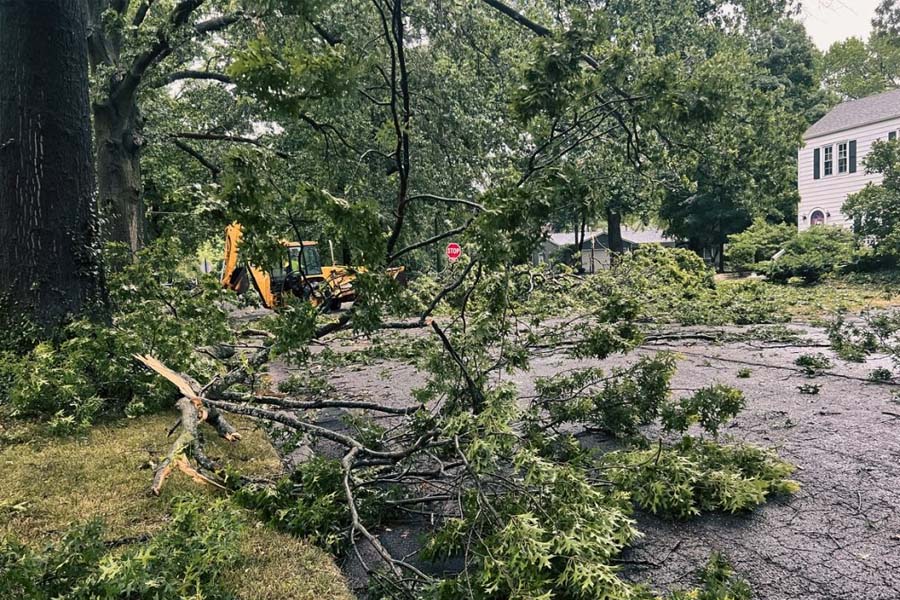
What to Do After a Storm
- Wait until the danger passes.Stay indoors during lightning and active high winds.
- Inspect from a distance.Look for fallen trunks, split limbs, hanging branches, and disturbed soil.
- Keep people and pets away.Damaged wood can shift or fall without warning.
- Document safely.Take photos from a secure location for insurance and planning purposes.
- Report electrical hazards.Contact the utility provider if a tree or limb is near a downed line.
- Arrange an assessment.Hidden cracks and root damage are not always obvious from ground level.
Tree and Power Line Safety Rules
Assume every downed or contacted electrical line is energized. Do not climb a tree, use a ladder nearby, pull a limb away, or attempt chainsaw work around overhead wires.
- Never walk or drive beneath a suspended limb.
- Do not stand beside a partially uprooted tree.
- Keep children away from storm debris.
- Call emergency services if a tree blocks a road or creates an immediate threat to people.
When to Call a Qualified Tree Professional
Professional help is appropriate when a tree is large, damaged, difficult to access, close to a structure, or near utilities. Ask whether the company is licensed and insured, whether an arborist will inspect the tree, what work is recommended, how the crew will protect the property, and whether cleanup is included. A clear explanation of why pruning, support systems, monitoring, or removal is recommended is a useful sign that the decision is based on risk rather than a one-size-fits-all approach.
Conclusion
Storm-ready trees begin with ordinary care. Notice changes, address deadwood and clearance issues early, and treat major cracks, decay, root movement, and power-line contact as reasons to get qualified help. The best outcome is not a treeless yard. It is a healthier, safer landscape that is better prepared when Chesapeake weather turns severe.