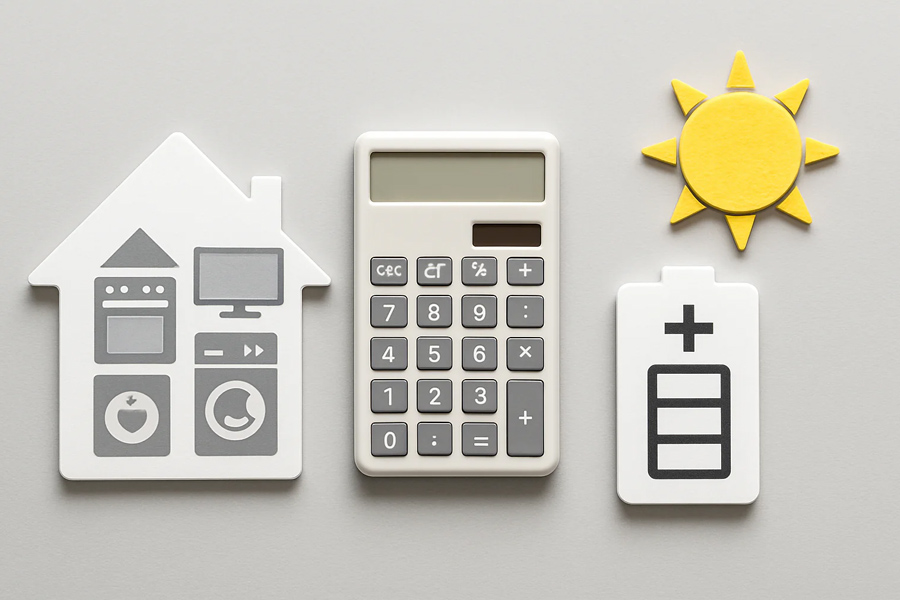
What dependable backup really looks like
A reliable house battery should be unnoticeable in normal life and crucial in storms. Lighting doesn’t flicker, the fridge runs, the router stays green, and well pumps and heat pumps start smoothly. Best systems go beyond blackouts. They absorb surplus solar, shift energy to cheaper hours, and grow with you as you add an EV or electrify heating. Imagine a quiet garage utility that’s always on and optimizing.
Modern platforms, including split-phase systems that deliver 120 and 240 volts, unlock full-house coverage. That means standard outlets and large appliances share the same lifeline. Solutions such as the Anker SOLIX E10 exemplify this whole-home approach with modular components, solar inputs, and fast recharge options that reduce downtime between outages.
A step-by-step sizing worksheet
Start with a snapshot of the power your life actually needs. Ten focused minutes here prevents costly misfires later.
- List essentials and nice-to-haves
- Essentials: refrigerator, lighting, Wi-Fi, phones, medical devices, security, sump pump, well pump, gas furnace blower or heat pump, garage door.
- Nice-to-haves: induction cooktop, oven, clothes dryer, pool pump, mini-split in extra rooms, home office gear beyond basics.
- Capture wattage and run-time
- Find the running watts on labels or manuals.
- Estimate hours per day during an outage.
- Note heavy startup loads for motors and compressors.
- Calculate daily energy use
- Energy per device = watts x hours.
- Sum your essentials for a 24-hour target.
- Multiply by expected outage length. A 2 to 3 day target is common in storm-prone regions.
- Translate to battery capacity and output
- Capacity: aim for usable kilowatt-hours to cover your target plus a buffer.
- Output: ensure continuous output covers the sum of simultaneous loads.
- Surge: pick an inverter that can start your biggest motor without tripping.
- Consider 120 vs 240 volts
- If you need a well pump, central AC, electric range, or dryer, you likely need 240V split-phase capability.
- If not, 120V-only can work but limits future growth.
- Add solar and recharge strategy
- Solar can stretch battery autonomy during long outages.
- If you lack solar, look for fast AC recharge and optional generator input to refuel quickly when the grid returns or a DC generator is available.
Power architecture choices
- Critical-loads subpanel: Routes only essential circuits to the battery. Lower cost and simpler, but you must decide what is essential.
- Whole-home with smart management: Powers the main panel while a smart controller sheds or throttles loads as needed. More flexible, closer to true normal living during an outage.
- Manual interlock vs automatic transfer: Manual saves cost and complexity. Automatic kicks in within seconds and feels seamless.
Split-phase inverters are the beating heart of a whole-home design. They feed standard circuits and 240V loads simultaneously. For large homes, stacking multiple inverters adds output and resilience, while smart load control avoids overloads when everything wants power at once.
Battery chemistry and longevity
- Lithium iron phosphate (LFP): Long cycle life, strong thermal stability, predictable performance. Slightly heavier for the same capacity, but a favorite for residential safety and lifetime value.
- Nickel manganese cobalt (NMC): Higher energy density per pound. Often used where space is tight. Typically fewer cycles than LFP at similar conditions.
Look for a generous cycle rating at a realistic depth of discharge. A warranty tied to both years and usable energy delivered paints a truer picture. Smart thermal management and weather-rated enclosures also extend lifespan.
Solar, generators, and EVs
Solar and storage transform a battery into a blackout marathoner and daily saver. Direct PV inputs for high-voltage strings eliminate components and improve charging. Isleling systems can securely isolate from the grid during outages and generate solar electricity.
Backup generators still have a niche. A quiet, efficient unit that can charge DC or AC into the battery shortens downtime when the sun is shy, fuel is available, and outages drag on. Coordination matters: your inverter and generator should handshake so the battery charges quickly without tripping protections.
EVs introduce a new wrinkle. Vehicle-to-home is emerging, but even without V2H, charging coordination can save money. A battery that throttles EV charging at peak times or during outages prevents overloads while keeping mobility intact.
Cost, incentives, and ROI
Costs have fallen, but smart planning maximizes payback.
- Value streams: time-of-use arbitrage, solar self-consumption, demand charge reduction, resilience.
- Incentives: federal credits, state programs, and utility rebates can cut the invoice significantly.
- Payback math: model your load profile, rate plan, and outage history. If your utility offers high peak rates or demand charges, payback accelerates. If outages are costly for work or medical needs, resilience value is non-negotiable.
Modular systems help you right-size today and expand later, reducing upfront spend without closing doors.
Installation and safety
A clean installation is part art, part code. A licensed residential electrician ensures proper placement near the main panel, ventilation clearance, and compliance with energy storage regulations.
- Placement: near the main panel, with clear working space and ventilation.
- Code and listings: UL 9540 systems with UL 1741 inverters, appropriate rapid shutdown where required, and adherence to the latest NEC articles for energy storage.
- Transfer equipment: a listed automatic transfer switch or smart inlet box for safe grid isolation.
- Fire safety: LFP chemistries, proper clearances, and compliant mounting reduce risk. Work with licensed electricians familiar with storage-specific rules.
Smart features and cybersecurity
Software makes or breaks daily experience.
- App visibility: real-time power flow, solar production, state of charge, and remote control of modes.
- Automation: rate-aware scheduling, storm watch precharge, seasonal profiles.
- Open integration: local APIs or integrations with home automation can unlock granular control.
- Security: encrypted communications, timely firmware updates, and the option to run essential functions offline maintain trust when the internet blinks.
Climate performance and placement
Batteries are like athletes. They excel within a temperature band.
- Cold climates: preheating and insulated enclosures protect charge acceptance and capacity.
- Hot climates: shaded, ventilated locations and thermal management preserve cycle life.
- Outdoor ratings: look for robust enclosures with high ingress protection to handle dust, rain, and snow.
If you cannot meet the environmental needs outdoors, select a garage or utility room with code-compliant clearances.
Upgrade paths and modularity
Homes evolve. Good batteries evolve with them.
- Stackable batteries: add kilowatt-hours without replacing the core system.
- Parallel inverters: scale output for big loads like central AC or shop equipment.
- Accessory ecosystem: smart inlet boxes, power docks, and optional generators extend capability.
- Example: an expandable split-phase platform like Anker SOLIX E10 can start small and grow into full-home coverage with solar and generator inputs as needs shift.
Example configurations
Small apartment or condo
- Portable power station for essentials, charged off a dedicated circuit or balcony solar where permitted.
- Focus on low-wattage LED lighting, internet, laptops, and a compact fridge.
- Manual switchover removes wiring complexity.
Typical suburban home on city water
- Split-phase fixed system feeding a critical-loads subpanel.
- 10 to 20 kWh initial capacity, scalable as usage grows.
- AC recharge plus PV input for daily savings and outage endurance.
Rural home with well pump
- Whole-home split-phase with stacked inverters for strong surge performance.
- 20 to 40 kWh of LFP storage, roof or ground-mount solar, and optional generator input.
- Smart load management to juggle HVAC, pump, and cooking without manual babysitting.
FAQ
How do I decide between partial-home and whole-home backup?
Partial-home backup feeds chosen circuits, reducing cost and installation. Whole-home backup powers the main panel and avoids overloads with smart management or enough inverter output. Whole-home is more smooth for 240V loads or near-normal life during outages.
What battery size covers a typical day for essentials?
For a fridge, lights, internet, phone charging, a gas furnace blower, and a few outlets, many homes land near 8 to 12 kWh per day. Add well pumps, mini-splits, or heavy cooking and the number climbs. Measure your own loads to avoid guesswork, then add a margin for weather or longer outages.
Do I need 240V split-phase capability?
If you have a well pump, central AC, electric dryer, or range that you want available during an outage, yes. Split-phase inverters deliver both 120 and 240 volts, enabling those large loads without separate hardware.
Which chemistry is better for home storage, LFP or NMC?
LFP is often preferred for residential storage due to long cycle life and strong thermal stability. It is a bit bulkier for the same capacity, but the safety and longevity benefits are compelling. NMC can make sense where space is tight and weight matters more.
Can I add solar later to a battery system?
Yes, if you select a system with dedicated PV inputs or compatible AC coupling. Choosing a platform that supports both direct solar charging and grid charging gives you flexibility to stage projects and incentives over time.
How does a generator work with a battery?
The generator supplies power to the inverter for fast battery charging and can feed loads simultaneously. A well-integrated system negotiates voltage and frequency smoothly, preventing nuisance trips and keeping charging efficient while fuel is available.
What happens in extreme cold or heat?
Cold reduces available capacity and charging speed. Heat can accelerate degradation. Systems with active thermal management and weather-rated enclosures maintain performance across seasons. Placement in a temperate, code-compliant location pays dividends.
Will a home battery lower my electric bill?
It can. Time-of-use shifting, solar self-consumption, and demand charge management reduce bills in many territories. Savings depend on your rate plan and load profile, so modeling your scenario is key.
Is modular expansion worth it?
Yes. It lets you buy what you need today and scale later as you add an EV, electrify heating, or experience more outages. A modular ecosystem also reduces replacement costs if a component needs service.
Where does a system like Anker SOLIX E10 fit?
It fits homeowners who want split-phase power, room to expand, solar integration, and fast recharge options. The modular layout supports growth from essential circuits to whole-home coverage while keeping the installation tidy and adaptable.